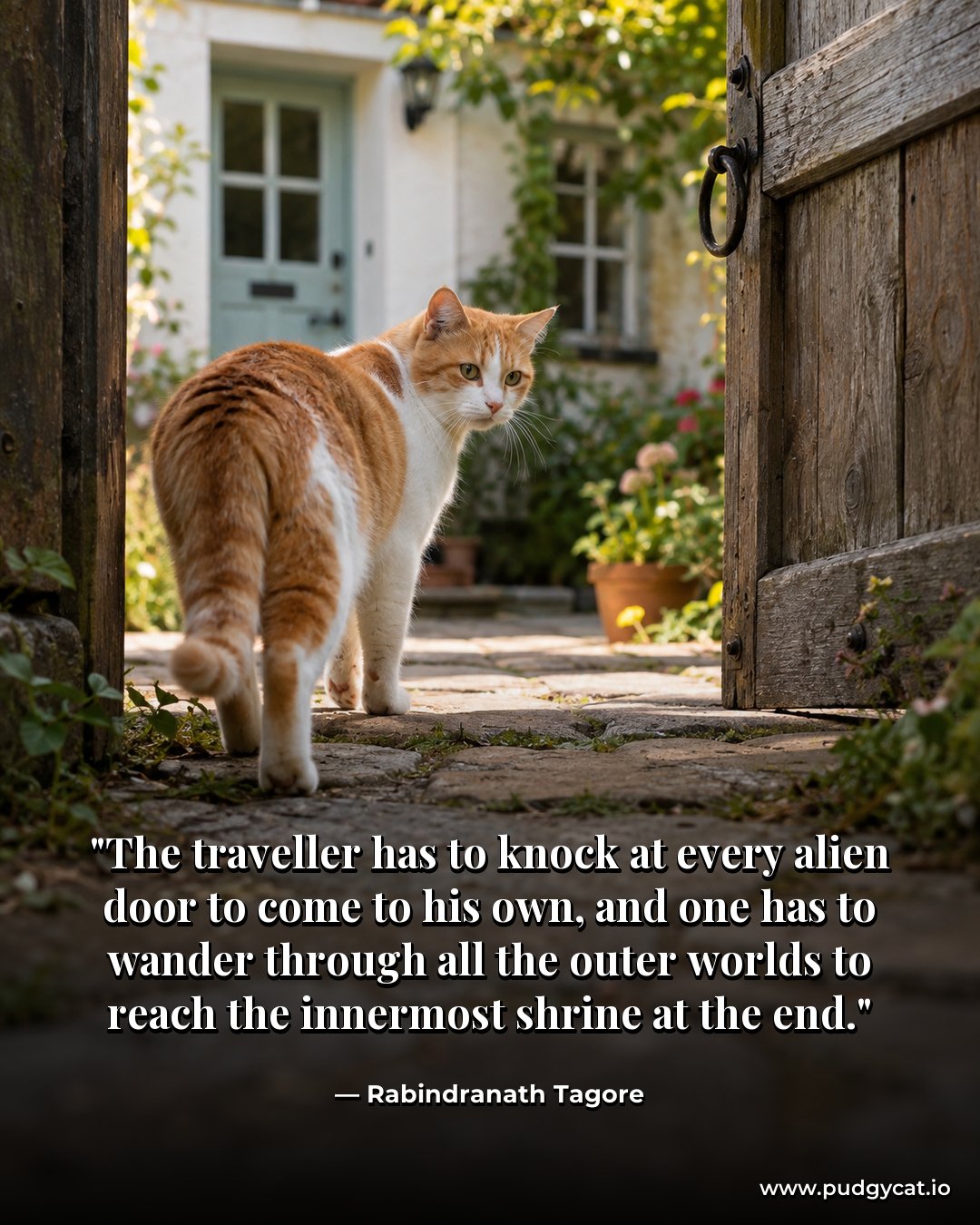
The traveller has to knock at every alien door to come to his own, and one has to wander through all the outer worlds to reach the innermost shrine at the end.
Rabindranath Tagore
Source, Gitanjali, 12; English prose version by Tagore
Why This Quote Matters
Poem 12 of Gitanjali turns a long outward journey toward an inward destination. Rabindranath Tagore's traveler must encounter unfamiliar doors before coming home to the innermost shrine. The surrounding lines move from searching far away to recognition close at hand. The passage gives wandering a place in discovery, rather than treating every detour as evidence that the traveler should have known better.
The metaphor is useful when experience seems indirect. A book, a conversation, or an unfamiliar place may reveal something about home that could not be noticed while it remained the only available comparison. That does not mean every search requires literal travel, or that an expensive journey guarantees insight. The important movement is through other ways of seeing. An encounter can bring someone back to a familiar question with a different capacity to understand why it mattered in the first place.
The ginger-and-white cat at an old wooden doorway has a fitting position between departure and return. Its backward glance connects the open passage with the home behind it. The picture keeps the journey small enough to be ordinary. Sometimes coming home is not the end of curiosity. It is the moment when curiosity makes something familiar visible again, with a little of the wider world still attached to the view.
🐾 Visit the Pudgy Cat Shop for prints and cat-approved goodies, or find our illustrated books on Amazon.
More Cat Wisdom