
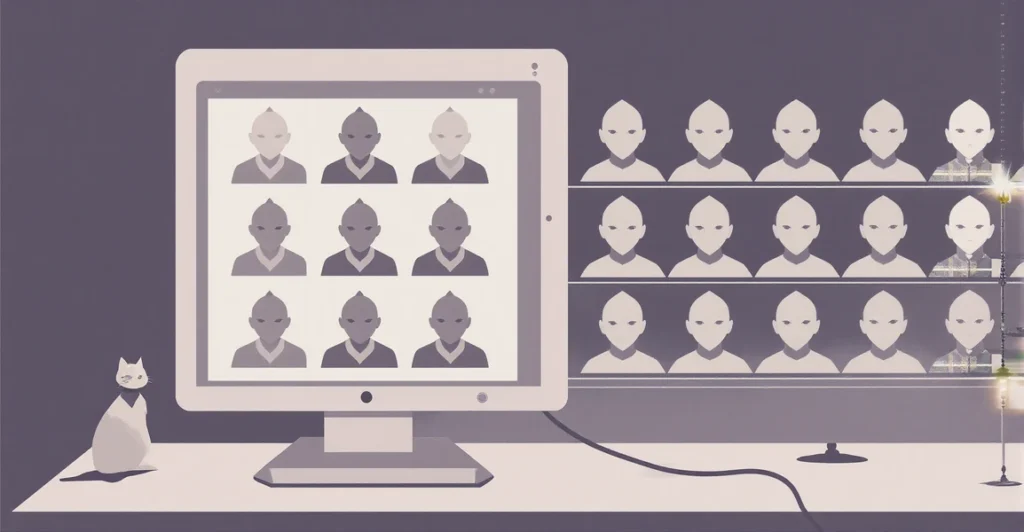
You open a feed and find the same joke three times, a suspiciously enthusiastic reply and a photograph of something that appears to have negotiated its anatomy with a committee. The Dead Internet Theory suddenly feels less like a conspiracy and more like a customer complaint.
But a feed that feels synthetic is not proof that the humans have left. This guide separates the theory, the evidence for widespread automation and the practical question underneath it all: how do you find something worth reading when so much content seems designed only to keep you scrolling?
In this guide:
- What the theory means
- Where it came from
- A concern versus a conspiracy
- What the evidence measures
- Why AI slop feels so pervasive
- Who might benefit
- Finding the human parts
- Common questions
What Is the Dead Internet Theory?
The Dead Internet Theory proposes that much of the apparent activity online is artificial: bots producing posts, manufactured engagement making them look popular, and automated systems deciding what everyone sees. Its conspiratorial versions go further, suggesting a coordinated replacement or manipulation of ordinary human participation.
In everyday conversation, people also use the phrase more loosely. They may simply mean that the web feels repetitive, impersonal or packed with material made for algorithms rather than readers. Those experiences deserve discussion without treating every reply containing “Great insights!” as evidence of a secret machine civilisation.
Three things are easily confused here: automated traffic, automated accounts and generated content. A search crawler makes automated requests without pretending to be your friend. A human can publish an AI-generated image. A bot can repost a photograph originally taken by a person. They overlap, but they are not interchangeable.
Where Did the Idea Come From?
Know Your Meme’s history traces related posts to anonymous forums before a widely circulated January 2021 Agora Road post by a user called IlluminatiPirate. It is safer to describe that post as helping popularise the theory than to give one person sole credit for inventing the entire suspicion.
The older discussions matter because this feeling predates today’s familiar image generators and chatbots. Repeated memes, suspicious engagement and nostalgia for a smaller web were already part of the complaint. Generative AI gave it new examples and a much more convincing visual department.
That history does not establish that the internet died in a particular year. There is no verified death certificate for the web, although someone would almost certainly try to sell a commemorative NFT of it.
A Reasonable Concern Is Not the Same as a Proven Conspiracy
A useful distinction is between a limited claim and a sweeping one. The limited claim is that automation and cheaply produced material can crowd particular online spaces, distort popularity and make trustworthy contributions harder to find.
The sweeping claim is that most apparent human activity has been replaced as part of a coordinated operation. Evidence of spam does not establish that much larger story. Finding weeds in the garden does not prove the gardener has been replaced by three raccoons in a coat.
It also helps to ask which part of the internet someone means. A public recommendation feed, a specialist forum and a private conversation are different environments. An observation about one should not automatically become a census of all three.
What Does the Evidence Actually Measure?
Bot traffic is not a head count
Imperva’s 2025 Bad Bot Report attributes 51% of web traffic in 2024 to automation: 37% classified as bad bots and 14% as good bots. Its analysis draws on traffic across Imperva’s global network.
That is an important security finding. It is not a measurement showing that 51% of social-media users are fake, or that 51% of articles were written by AI. A single automated system can make a large number of requests. Requests do not each come with one tiny person attached.
Generated images can attract real audiences
In a March 2024 study, Renee DiResta and Josh A. Goldstein documented Facebook pages using AI-generated images to build audiences, including spam and scam activity. They also observed recommendations of unlabelled synthetic images to people who did not follow the pages.
This is evidence of a concrete distribution problem. It does not require every viewer or commenter to be a bot. Indeed, a fabricated picture attracting real people is a different problem from machines talking exclusively to machines.
Even an “AI-only” network needs its numbers checked
Moltbook offered a striking example in early 2026: a social network presented as a space for AI agents. But Wiz’s February 2 investigation found roughly 17,000 human owners behind 1.5 million registered agents and no reliable mechanism to verify that a posting agent was actually AI rather than a human using a script.
The distinction matters. Registered accounts are not necessarily active participants, and an agent label is not proof of autonomy. Moltbook makes an interesting case study; it is not a miniature experiment proving that humanity has become unnecessary.
Why Does AI Slop Feel So Pervasive?
“AI slop” is a critical label for low-value synthetic material, especially when it is churned out in quantity with little concern for accuracy, originality or the audience’s time. It should not be treated as a precise category covering everything made with AI assistance.
The annoyance often comes from the packaging: an emotional image without a source, a confident answer that says very little, or an endless run of almost identical posts. Once you notice a template, every repetition becomes louder. Your feed starts to resemble a shop where all the shelves contain the same mug.
There is also a selection problem. What a recommendation system repeatedly shows you is not a random sample of everything people are creating. A terrible afternoon of scrolling can be a real experience without demonstrating that the entire web is equally terrible.
Our earlier look at the nihilist-penguin meme and its adoption by brands shows another route to sameness: recognisable material can be copied and repackaged by perfectly human organisations. Repetition alone cannot tell you who is behind the keyboard.
Who Benefits From All This Activity?
The possible incentives differ. A spammer may want clicks, a scammer may want trust, and an account operator may want a larger audience. The Facebook research offers examples of synthetic images serving audience-building rather than some grand ideological project.
It is tempting to flatten that into “everyone profits from bots.” But fake engagement is not equivalent to a useful customer, and automated abuse can impose costs on the services receiving it. A large counter is only impressive until someone asks what it counts.
The useful question is specific: who operates this account, what action are they encouraging, and where does that action lead? You do not need to solve the entire attention economy before deciding not to click a suspicious prize link.
How to Find the Human Parts of the Web
There is no four-step test that proves a stranger is a bot. Polished grammar, a generic avatar or repetitive wording can justify a closer look, but none settles the question. Nor does a paid badge automatically establish that every post is authentic.
- Follow the source. For a surprising factual claim, look for the original document, research or reporting rather than ten accounts repeating the same sentence.
- Read beyond one post. A consistent history, specific expertise and willingness to correct mistakes are more useful context than an impressive follower count alone.
- Check what a statistic counts. Traffic, accounts, posts and people have different denominators. Ask about the sample and date before accepting a platform-wide claim.
- Choose destinations deliberately. Bookmarks, direct visits and topic-focused communities let you spend less time depending on whatever a feed serves next.
- Keep small communities in perspective. Good moderation and relationships help; a low membership count is not an automatic shield against spam or deception.
The goal is not to interrogate everyone who makes a mediocre joke. It is to build a browsing habit around sources and people that reward your attention. Humans remain quite capable of producing mediocre jokes without any technical assistance.
Dead Internet Theory: Common Questions
Is the Dead Internet Theory true?
Widespread automation and synthetic spam are documented. The much broader claim that the human internet has largely been replaced by a coordinated artificial system is not established by those findings.
Does “more than half of traffic is bots” mean most users are bots?
No. Traffic measures activity, not unique people. A busy crawler can generate many requests, while one person may read a page without posting anything.
Can an AI detector prove who wrote a post?
Treat a detector’s output as a lead to investigate, not a substitute for provenance. It does not identify the account operator, and “AI-assisted text” and “fake person” are different claims.
Should I stop using the internet?
You can be more selective without abandoning it. Find a few useful places, visit them intentionally and leave when the feed turns into wallpaper. The cat recommends occasionally looking out of an actual window. Its recommendation algorithm is mostly birds.