Nyan Cat’s original animation appeared on April 2, 2011, and the famous YouTube video followed on April 5. Christopher Torres drew the rainbow-trailing pastry cat; YouTube user saraj00n paired it with the song. Those are two different creation dates for two parts of the same meme. The story below follows the drawing, the audio and the real cat behind them.
Start with the animation and Christopher Torres, the song and its cover, or the April 5 video. The credit matters: the artist, songwriter, cover performer and uploader did different jobs.
Table of Contents
- Nyan Cat History Begins With an Earthquake and a Livestream
- The Song Came From a Vocaloid Scene, Not From a Cat
- April 5, 2011: The Day Somebody Put the Two Together
- The Loop Was the Product
- What Nyan Cat History Says About Who Owns a Meme
- The 300 ETH NFT Sale
- Why It Still Works at Fifteen
- FAQ
Nyan Cat History Begins With an Earthquake and a Livestream
After the March 2011 earthquake and tsunami in Japan, Dallas illustrator Christopher Torres, known online as prguitarman, held a drawing livestream to raise donations for the American Red Cross. In his tenth-anniversary interview, he recalled the modest setting in which the idea emerged: viewers offering suggestions, an artist drawing, and no plan for an internet empire.
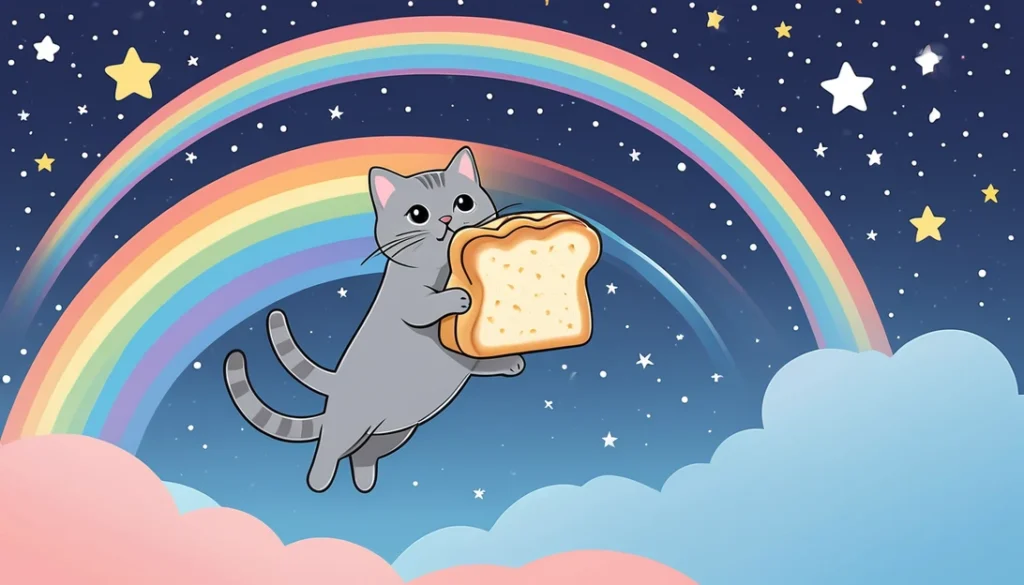
During one session, two different people in chat threw out two unrelated suggestions. One wanted a cat. One wanted a Pop-Tart. Torres did what any sensible person does with two prompts and no tiebreaker: he drew both at once. The result was a cat with a toaster pastry for a torso and rainbows coming out of it in several directions.
Torres turned the sketch into a pixel animation. He has described using Fireworks, and the small, readable design became one of its strengths. The outline remains legible when the image is shrunk, copied, embroidered, or squeezed onto a phone case. A pastry, a cat, and a rainbow are an unusually efficient set of ingredients.
He posted it on April 2, 2011, on LOL-Comics, his daily comics site. He called it Pop Tart Cat. It was not called Nyan Cat yet, because the part that gave it that name had not been attached.
Who Marty Was
The cat in the drawing was not generic. Its appearance drew on Marty, Torres’ Russian Blue. Marty died on November 1, 2012, after developing feline infectious peritonitis; Know Your Meme’s chronology records Torres’ account and the mourning animation that appeared on nyan.cat. The endlessly cheerful character has a quieter personal history behind it.
It is a detail many viewers never learn, and it changes the texture of the loop. A picture shared as a universal joke was also somebody’s portrait of a beloved pet.
The Song Came From a Vocaloid Scene, Not From a Cat
The audio has its own earlier history. On July 25, 2010, Japanese producer daniwell uploaded Nyanyanyanyanyanyanya! to Niconico using Hatsune Miku’s synthetic voice. The song’s documented history includes remixes before the flying pastry arrived. Miku was already part of a thriving music-making scene, not a voice invented for this particular cat.
A January 2011 cover used Momone Momo, a voicebank for the separate singing-synthesis program UTAU. It is that version, rather than the original Miku recording, that accompanies the famous video. The human artists composing, covering, animating, and combining the material deserve separate credit, even if the final result sounds like one very persistent cat.
So the song and the picture were made by different people, in different countries, in different years, for different reasons. Both had lives and audiences before the combination made them an international phenomenon. This is a normal pattern in internet meme history: the artifact that travels is usually a collision, not a creation.
April 5, 2011: The Day Somebody Put the Two Together
Three days after Torres posted the GIF, a YouTube user going by saraj00n, real name Sara June, set the animation to the Momone Momo version of the song and uploaded it under the title “Nyan Cat.” That upload is the version that broke. It passed a million views inside two weeks.
By May 31, 2011, YouTube’s own Trends blog was highlighting the video and its growing family of remixes. Its year-end list placed Nyan Cat fifth among globally most-viewed videos excluding major-label music videos. Rebecca Black’s Friday topped that list, which tells you a lot about what 2011 was like. On the first anniversary, YouTube reported 70 million views and a remarkably sustained following.
Torres did not upload the video that made him famous. Somebody else did, using his art, with a stranger’s song. He spent the next several years dealing with the consequences of that, which we will get to.
The Loop Was the Product
The joke also escaped the video player into dedicated looping sites such as nyan.cat, where a counter turned time spent watching into a score. No elaborate rules were necessary. You could leave the cat running, discover how long you had tolerated it, and wonder what precisely you had achieved.
YouTube itself joined in during 2011 with a custom progress bar: the flying cat left a rainbow along the timeline. Torres recalled that period in an interview about the meme’s first decade. A major video platform had made room in its interface for a cat constructed from breakfast.
Why an Infinite Loop Beat a Punchline
Most memes of that era were static images with captions. The image macro format ran on a joke you read once and then forwarded. Nyan Cat had no caption, no punchline, and nothing to read. It ran on duration instead. The content was the fact that it did not stop, which converted viewing into an endurance sport. People uploaded ten-hour versions. Then hundred-hour versions. The joke was your own tolerance.
The lack of text also made it stateless across languages. A caption meme needs translation, or at least literacy in the source language. The image can be understood without reading a caption, which is part of why the Japanese song, the American drawing, and the global audience never noticed the seams. The same borderless quality shows up in Longcat, which crossed over from Japanese imageboards to the English-speaking web without anyone bothering to translate anything.
What Nyan Cat History Says About Who Owns a Meme
Here is the part nostalgia can leave out. Torres has described struggling to prove ownership and challenge unauthorised commercial uses of his drawing. That is a practical enforcement problem, not a rule that the first person to file paperwork owns somebody else’s work. The U.S. Copyright Office explains that copyright generally arises automatically when an original work is fixed. Defending it can still take time, money, and considerably more patience than making a GIF.
In 2013, Torres and Keyboard Cat creator Charles Schmidt sued 5th Cell and Warner Bros. over the characters’ appearances in Scribblenauts. They alleged unlicensed use, and the dispute ended in a settlement that September. Reporting on the settlement described compensation and a licensing arrangement; the amount remained undisclosed. A settlement resolved this dispute, rather than producing a sweeping judgment about every use of every meme.
Another dispute followed Sum 41’s June 2016 video for Fake My Own Death, which included Nyan Cat among a montage of internet imagery. Speaking directly to Forbes in July 2016, Torres said the commercial use had not been cleared with him. The story illustrates the recurring licensing friction; his complaint should not be confused with a court’s finding against the band.
The Meme Manager Nobody Expected to Exist
Torres worked with Ben Lashes, a former musician who built an actual profession out of representing meme characters. Lashes also managed Keyboard Cat and later Grumpy Cat, another prominent example of a meme becoming a licensed character. The existence of a “meme manager” job title is itself a piece of internet history, and it reflects how much work can follow a joke once brands want to sell products with it.
The tension has not gone away. Our coverage of KC Green’s objection to an AI company’s use of his This Is Fine character follows another collision between internet familiarity and commercial permission. A creator’s public objection, negotiations, and a lawsuit are different stages, even when social media compresses them into one angry headline.
The 300 ETH NFT Sale
For the tenth anniversary in 2021, Torres offered a remastered animation through an NFT auction on Foundation. The sale completed on February 19 for 300 ETH. His April 2021 interview describes the result and his surprise. Contemporary dollar conversions put it above half a million dollars, with the exact figure depending on the exchange rate used.
The sale put a spectacular price beside an image people were accustomed to seeing for free. It did not remove the GIF from circulation or automatically hand the buyer its copyright. The 2024 joint report from the U.S. copyright and patent offices distinguishes ownership of a token from rights in the associated work. What changed for Torres was more immediate: the creator received a major payment while the rest of the internet could keep watching the rainbow.
Why It Still Works at Fifteen
Most 2011 memes are dead or embarrassing. Nyan Cat is neither, and the reason is structural. It has no reference to a news event, no celebrity, no slang, and no joke that ages. Strip away everything and you have a cat, a color spectrum, and repetition, three things that were working on human attention long before broadband.
It also feels like a bridge between familiar internet formats. Captioned stills on imageboards such as 4chan coexisted with animated GIFs, music videos, and looping jokes long before Nyan Cat. It did not invent the combination or single-handedly lead to TikTok, Reels, or Shorts. It simply demonstrated its appeal exceptionally well: recognisable motion, sticky audio, and very little explanation. Rickrolling offers another, quite different case of a song acquiring a second life through repetition.
And cats keep winning. Nyan Cat sits roughly in the middle of a line that runs from Victorian photographers staging kittens on cabinet cards to whatever the algorithm is pushing this week, a line we walked through in our complete history of cat memes. The technology changed six times. The subject did not change once.
FAQ
Who created Nyan Cat?
Illustrator Christopher Torres, known online as prguitarman, drew and animated the character and posted it on April 2, 2011, under the name Pop Tart Cat. The viral video version was assembled and uploaded three days later by a different person, YouTube user saraj00n, who added the song.
What is the Nyan Cat song?
It is a UTAU cover of “Nyanyanyanyanyanyanya!”, a track uploaded to Niconico on July 25, 2010 by the Japanese producer daniwell using Hatsune Miku. The version in the meme uses the Momone Momo voicebank, recorded from a woman named Momoko Fujimoto, and appeared in January 2011.
Was Nyan Cat based on a real cat?
Yes. Torres identifies his Russian Blue, Marty, as the inspiration for the cat’s appearance. Marty died in November 2012. The pastry body and rainbow, understandably, were artistic additions.
How much did the Nyan Cat NFT sell for?
300 ETH on Foundation in February 2021, worth more than half a million dollars at the time. It was an NFT associated with a remastered version, rather than exclusive possession of every copy of the GIF or an automatic transfer of its copyright.
Did anyone get sued over Nyan Cat?
Torres and Keyboard Cat creator Charles Schmidt brought a claim against 5th Cell and Warner Bros. in 2013 over uses in Scribblenauts. The dispute ended in a settlement and licensing arrangement that September; the payment amount was not disclosed.
The Rainbow Has a Paper Trail
Fifteen years on, the loop looks inevitable. It was not. It needed a charity drawing session, a song and its cover from another creative scene, somebody combining the pieces, and a gray cat named Marty. Its commercial afterlife then demanded an entirely different kind of work. The internet is very good at turning specific things into ambient ones. Occasionally it is worth reversing that, and remembering that somebody drew the cat.