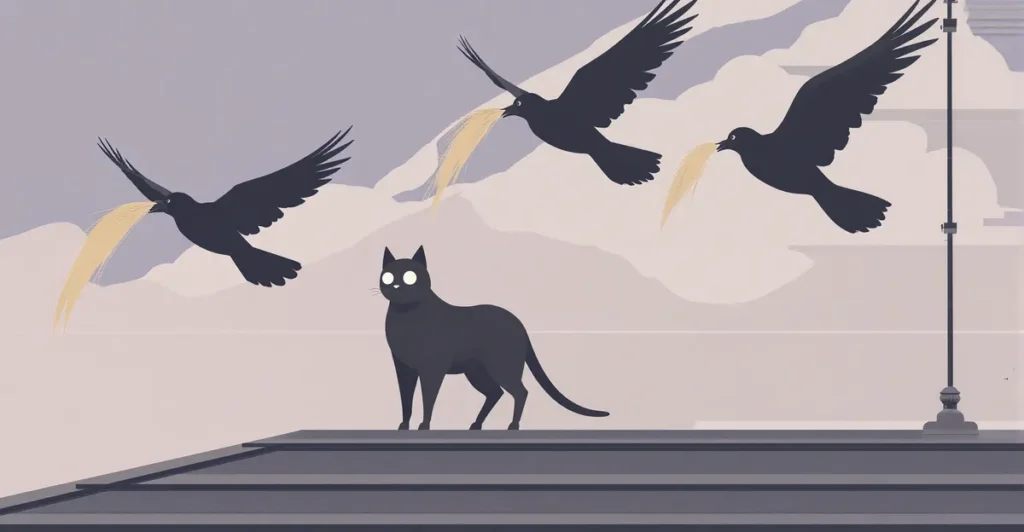
Tokyo DisneySea built a fairy-tale tower. The local crows appear to have seen a home-improvement shop.
Footage circulating in early April showed birds pulling at the hair of the Rapunzel figure at Rapunzel’s Lantern Festival. Later coverage showed them taking material from Maximus, the horse. Somewhere in this story is a princess, a carefully designed attraction, and a bird with absolutely no interest in respecting the brand.
A Very Expensive Setting, Not a Two-Billion-Dollar Wig
The ride belongs to Fantasy Springs, which opened on June 6, 2024. Operator Oriental Land Company’s presentation put the expansion’s investment at approximately ¥320 billion. That is the wider project, not the price of Rapunzel’s tower or the bill for replacing her hair.
The distinction does not spoil the joke. A huge amount of planning and investment still shares physical space with animals that never attended a project meeting. The attraction tells one story; the birds may be working on a much smaller domestic project of their own.
Rapunzel First, Then Maximus
WDW News Today’s April 13 report describes a pair of crows plucking at Maximus’s mane and tail after deterrent lines had been added around Rapunzel’s tower. The accompanying footage is the basis of the report, rather than a statement that the entire expansion is being dismantled.
It makes an excellent sequel. Rapunzel gets some protection; the horse discovers that working two floors down does not necessarily keep you out of an office crisis.
What the footage cannot establish is that the same birds evaluated the new perimeter and deliberately switched targets. That is an irresistible heist-movie interpretation, but identifying individuals and reconstructing their decisions would take more than watching a clip. We can enjoy the logistics-manager joke without promoting it to a behavioral study.
Why Hair Might Interest a Crow
Collecting material for nests is a plausible explanation for pulling and carrying off fibers. It fits the season and a known kind of behavior. It is not necessary to imagine that a crow mistook an animatronic princess for a living person, or that it has a particular grievance with Tangled.
Birds’ use of human-made material is documented beyond theme parks. A 2014 study of American crow nests found manufactured materials including string and cloth. It also documented entanglement risks, so useful-looking fibers are not automatically good nesting material.
That research concerns a different crow population, not these individual birds in Japan. It supports the general possibility of collecting artificial material; it does not prove where Rapunzel’s missing strands ended up.
For the birds, the important qualities are unlikely to include whether the object is an officially licensed character. Soft material within reach is a much more practical proposition. By human standards this is vandalism. In the imaginary crow procurement department, it is an unusually productive morning.
The Limits of a Viral Clip
A few dramatic images can make an incident look like an uninterrupted siege. They do not tell us the repair cost, how often it happened, or whether a solution worked after the camera stopped.
There is documented reporting about lines around the tower. There is not enough here to add a confirmed falcon program, audio-repeller campaign, or a running account of management panic. The park’s silence about a detail is not evidence of a secret disaster.
As a completely fictional next chapter, of course, the falcon gets a name, a character breakfast, and a plush toy before the crows finish their nest. Disney merchandising could probably write the treatment faster than we could. That remains a joke, not a booking announcement.
Why the Story Is So Satisfying
Theme parks offer an unusually carefully arranged environment. The buildings, music, scenery, and movement are intended to cooperate. Then a wild animal arrives and uses the setting for a purpose nobody put in the script.
The pleasure is the scale mismatch. We enjoy similar stories of persistence, from a three-wheeled car attempting a very long journey to Gertie, the remarkably long-lived chicken. A small creature or unlikely vehicle refuses to behave like background detail.
In this case, the birds do not need to win a war against a corporation. The moment is funny enough without a victory parade: Rapunzel has a scheduled performance, Maximus has a role to play, and the crows have spotted something they can carry away.
The fairy tale has supporting characters its designers did not hire. They are very committed to improvisation.