
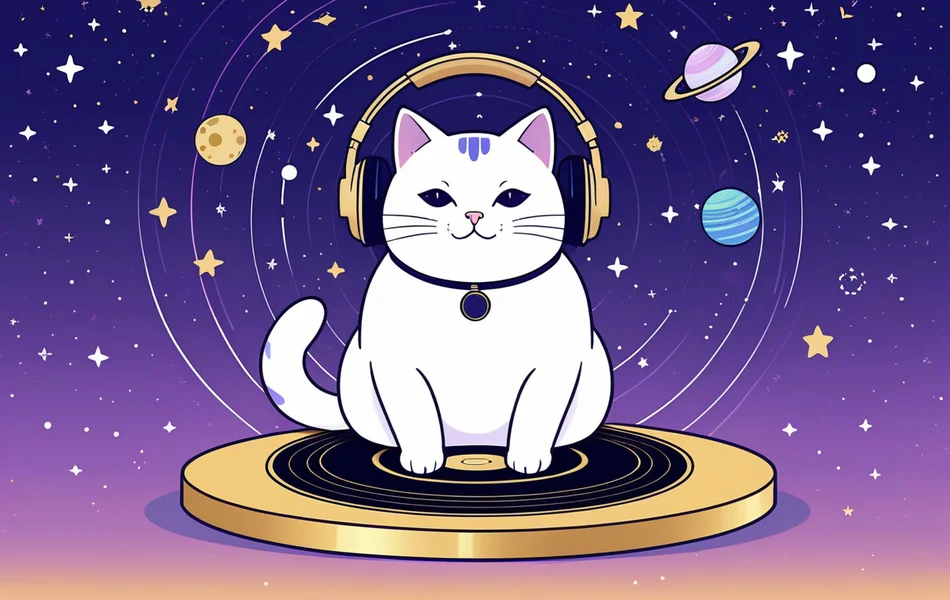
A Gold-Plated Mixtape Floating Past Pluto
In 1977, NASA launched two spacecraft into the void. Voyager 1 and Voyager 2 carried something besides sensors and cameras: a gold-plated copper record, 12 inches across, engraved with instructions for aliens on how to play it. Almost 50 years later, those records are still out there, drifting through interstellar space at roughly 17 kilometers per second, carrying a carefully curated portrait of who we were.
The Voyager Golden Record is the most ambitious mixtape ever made. 90 minutes of music, 115 photographs, greetings in 55 languages, the sounds of wind, rain, whales, and a human heartbeat. Carl Sagan led the committee that decided what to include. Their choices tell us more about humanity than most history books do.
What Made the Cut (and What Didn’t)
The music selection alone is wild. Chuck Berry’s “Johnny B. Goode” represents all of rock and roll. When committee member Alan Lomax protested that rock music was “adolescent,” Sagan replied: “There are a lot of adolescents on the planet.” Fair point. The record also includes Bach (three pieces, more than any other composer), Beethoven’s Fifth Symphony, Javanese gamelan, Peruvian panpipes, an Azerbaijani bagpipe piece, and a Navajo night chant. It is not the playlist you would build for a road trip, but it might be the most honest one ever assembled.
The Beatles almost made it. Sagan’s team wanted “Here Comes the Sun” on the record. EMI, the label holding the copyright, said no. Think about that for a second: somewhere in a boardroom, someone decided that licensing concerns outweighed sending the Beatles into eternity. The universe got Chuck Berry instead. The universe did fine.
The 115 images encoded on the record range from mathematical definitions to a woman in a supermarket, a page of sheet music, an X-ray of a hand, and Ansel Adams’ famous shot of the Tetons and the Snake River. There are diagrams of human anatomy, pictures of food, a photo of a violin alongside sheet music, and images of the solar system. It is less “greatest hits of Earth” and more “how to explain everything to someone who has never seen anything.”
The Love Story Hidden in the Grooves
Here is where it gets personal. Ann Druyan was the creative director of the Golden Record project. During the process of selecting content, she and Carl Sagan fell in love. Not gradually. In one phone call. She had left a message at his hotel about a piece of Chinese music for the record. When he called back, they talked, and by the end of that conversation they were engaged. Two days later, Voyager 1 launched.
Shortly after, Druyan had an idea. What if they recorded someone’s brainwaves and put them on the record? The theory was that an advanced civilization might, millions of years from now, decode the electrical impulses back into thoughts. She volunteered herself. At Bellevue Hospital in New York, technicians hooked her up to an EEG while she meditated for an hour. She later said she was thinking about the history of Earth, the state of the world, and, inevitably, about being newly and completely in love.
That hour of brainwaves was compressed into about a minute of audio and placed on the record. So somewhere beyond the edge of the solar system, there is a physical object carrying the electrical signature of a woman thinking about falling in love. That is arguably the most romantic gesture in the history of the species. No grand declaration, no diamond ring. Just neural activity, pressed into gold, encoded like a memory, and launched into forever.
55 Ways to Say Hello (and One From a Kid)
The greetings section includes spoken messages in 55 languages, from Akkadian (a dead language spoken in ancient Mesopotamia) to Wu Chinese. There is a greeting in Hittite, another dead language, and one in Latin. The committee wanted to represent not just who we are but who we were. The total number of native speakers covered by those 55 languages exceeds 4.7 billion people, more than 65% of the planet’s population at the time.
One greeting stands out. A six-year-old boy named Nick Sagan (Carl’s son) recorded: “Hello from the children of planet Earth.” He was nervous. He stumbled a little. They kept that take. It is the most human moment on the entire record.
Still Traveling, Still Playing
As of 2026, Voyager 1 is about 24.8 billion kilometers from Earth, the most distant human-made object in existence. Voyager 2 is not far behind. Both spacecraft are in interstellar space now, past the boundary where the sun’s influence ends. Their power sources are slowly dying. NASA expects to lose contact sometime in the 2030s.
But the records will keep going. Gold-plated copper does not decay in a vacuum. Scientists estimate the records could survive for at least a billion years, possibly much longer. In about 40,000 years, Voyager 1 will pass within 1.6 light-years of a star called Gliese 445 in the constellation Camelopardalis. Nobody lives there, as far as we know. But the record will be intact.
There is something both beautiful and absurd about it. We sent our best music, our best photos, and one woman’s lovesick brainwaves into a void so large that even light takes years to cross it. The chances of anyone finding it are statistically zero. The committee knew that. They did it anyway.
What the Golden Record Says About Us
The record is not really a message to aliens. It never was. The odds of an extraterrestrial civilization intercepting a small spacecraft in the infinite emptiness between stars are so absurdly low that even Sagan acknowledged it. The record is a message to ourselves. It is a snapshot of what we thought was worth preserving when someone finally asked the question: if you could only show a stranger 90 minutes of music and 115 photos, what would you pick?
The answer, apparently, is Bach and Chuck Berry and whale songs. A woman buying groceries and Ansel Adams and a child saying hello. The sound of rain and the electrical hum of a brain falling in love. No wars, no politics, no advertisements. Just the stuff that, when you strip everything else away, actually makes us who we are.
Almost 50 years later, it is still the best album cover ever designed: a gold disc with instructions etched by people who genuinely believed that curiosity was the most important thing about being human. They were right. And somewhere out past Neptune, their proof is still spinning through the dark, waiting for someone to drop the needle.
🐾 Visit the Pudgy Cat Shop for prints and cat-approved goodies, or find our illustrated books on Amazon.


Leave a Reply