
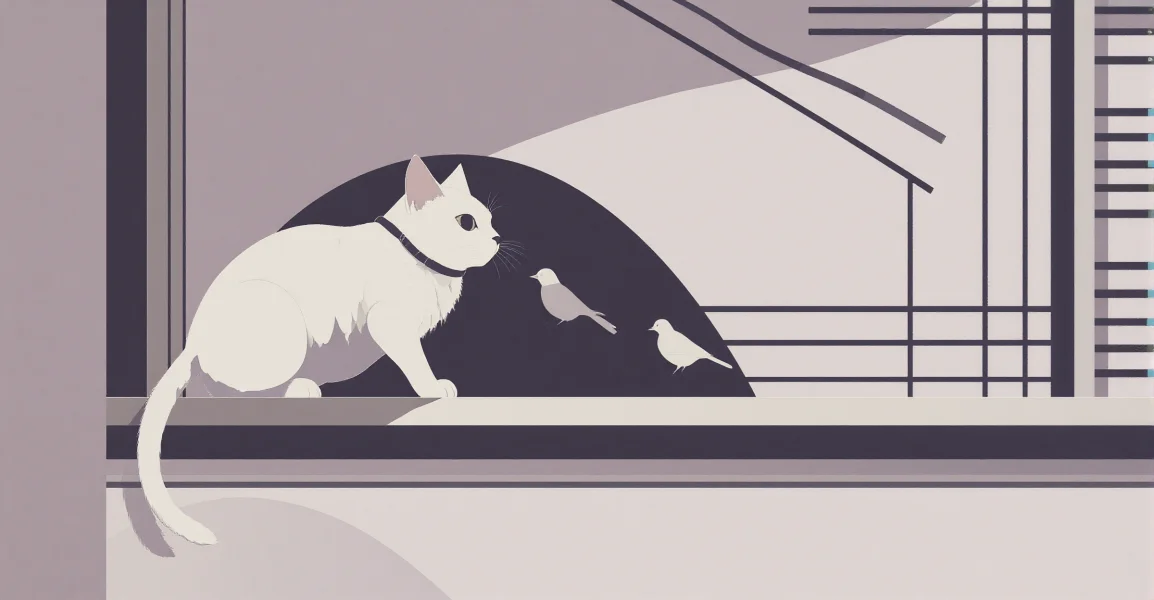
If you have ever watched a cat sit at a window, spot a sparrow on a branch, and erupt into a strange staccato of clicks and trills, you have met one of the most peculiar sounds in the feline repertoire. The question of why do cats chirp at birds has puzzled owners for decades, and the honest answer is that biologists still disagree. There are four serious theories, each with evidence behind it, and the behavior almost certainly involves more than one cause at once. This guide walks through what chirping actually is acoustically, what the competing scientific explanations propose, what recent research suggests, and what the chatter tells you about your own cat’s inner life. For more feline-science deep dives, browse our Science archive on Pudgy Cat.
Table of Contents
- 1. What Is Cat Chirping? The Sound Itself
- 2. Theory One: Hunting Arousal and Predatory Focus
- 3. Theory Two: Frustration at Unreachable Prey
- 4. Theory Three: Vocal Mimicry of Prey
- 5. Theory Four: A Neurological Reflex
- 6. Do Big Cats Chirp Too? Margays, Lions, and Field Evidence
- 7. What Your Cat’s Chirping Tells You
- 8. Frequently Asked Questions
1. What Is Cat Chirping? The Sound Itself
Before asking why cats chirp at birds, it helps to describe the noise precisely. Feline vocalizations fall into three broad families: purrs (continuous, low-frequency), meows and mews (tonal, voiced sounds in the 500 to 1500 Hz range), and a cluster of short, sharp, unvoiced sounds that includes chirps, chatters, trills, and chirrups. Chirping at birds sits in that third family.
Acoustic signature
A chirp is a short burst, usually 20 to 80 milliseconds long, with a rapid frequency sweep. Chattering, by contrast, is a rhythmic series of clicks produced by rapid jaw movement, often at 3 to 5 clicks per second. The teeth can be heard clacking together in some cats, while others produce an almost silent jaw tremor accompanied by a high-pitched trill. Both behaviors typically appear in the same window episode, blending into a single performance.
Body language that accompanies the sound
Chirping at prey is never just vocal. The cat is locked in a predator posture: dilated pupils, body pressed low, tail tip twitching, ears rotated forward, whiskers fanned wide. Muscles along the spine and shoulders often visibly shiver. Whatever is happening in the brain when a cat chirps, it is recruiting the full hunting motor program. Feline eyesight is built around motion detection, a topic we cover in more depth in our guide to how cats see the world.
2. Theory One: Hunting Arousal and Predatory Focus
The oldest and simplest explanation is that chirping is pure arousal. A cat sees prey, the sympathetic nervous system floods the body with adrenaline, the predatory sequence begins to fire, and the vocal tract leaks some of that excitement as sound. Under this view, chirping is less a deliberate signal and more a spillover, the way a runner at the starting line might exhale hard without meaning to.
Evidence for the arousal model
The strongest support comes from the context. Cats almost never chirp at empty windows, at other cats, or at their food bowl. The behavior is tightly coupled to visible prey, particularly small moving prey within visual range but outside physical reach. Heart rate monitors attached to domestic cats during simulated hunting tasks show sharp spikes that correlate with chirp bursts, consistent with a general arousal mechanism.
Problems with the arousal model
Pure arousal would predict that any intensely exciting stimulus could trigger chirping, but that is not what we see. A cat staring at an incoming predator, a running rival, or a sudden loud noise shows arousal through hissing, growling, or silence, not chirping. The sound is specific to prey, which suggests something more than generic excitement is at work.
3. Theory Two: Frustration at Unreachable Prey
A related but distinct theory holds that chirping is a frustration vocalization. The cat sees prey, the hunting program activates, but the final strike cannot happen because there is glass, distance, or a closed door in the way. The mismatch between motivation and opportunity produces the chattering noise.
Why frustration fits
Indoor cats chirp much more often than free-roaming cats. If chirping were a hunting tool, you would expect the reverse, since outdoor cats actually hunt. Instead, chirping peaks in precisely the situations where hunting is blocked: a house cat at a window, a caged big cat watching a keeper feed birds, a cat staring at a toy moved just out of paw range. That pattern makes the frustration reading attractive.
Critiques
The frustration model has trouble explaining why cats make the sound at all rather than, say, yowling or growling, which are the more typical frustration vocalizations in felids. It also struggles with cases where a cat chirps at prey it clearly could reach, such as a moth inside the same room. A complete theory probably needs another component. For readers interested in the full inventory of feline sounds, we keep a growing collection of cat curiosities on the blog.
4. Theory Three: Vocal Mimicry of Prey
The most striking hypothesis comes from a 2005 field observation by biologists working in the Amazon. Researchers with the Wildlife Conservation Society documented a margay, a small wild cat of Central and South America, producing calls that mimicked the vocalizations of a pied tamarin monkey. The apparent goal was to lure the monkeys close enough to attack. This was the first documented case of a wild cat using vocal mimicry to hunt.
How mimicry might apply to domestic cats
If a wild relative uses vocal mimicry as a hunting strategy, it is reasonable to ask whether house cats carry a shadow of the same impulse. Some feline researchers have proposed that the high-pitched portion of the chirp sweep resembles the alarm chirps of small birds, and that cats, consciously or not, produce sounds that echo their target.
Limits of the mimicry hypothesis
Most feline biologists treat the mimicry idea with caution. The acoustic match between cat chirps and bird calls is rough at best. Cats chirp at rodents and insects too, which do not vocalize in the same register. And the mimicry behavior in margays was rare and opportunistic, not a stable feature of the species. Mimicry cannot be the whole story, but it may contribute a small piece.
5. Theory Four: A Neurological Reflex Linked to the Killing Bite
The fourth and most mechanical theory argues that chattering is a partial rehearsal of the killing bite. Cats dispatch small prey with a rapid, precise bite to the back of the neck that severs the spinal cord. This bite requires very fast, very accurate jaw movement, and some researchers propose that the chattering jaw motion during chirping is the neural program for that bite firing without an actual target in the mouth.
The rehearsal reading
Under this view, chirping is a motor echo, the way a pianist’s fingers sometimes twitch when listening to a familiar piece. The cat is not trying to communicate anything. The sight of prey activates the killing-bite circuit, the circuit partially discharges through the jaw muscles, and the resulting dental chatter produces the sound we hear. The high-pitched trill component may simply be air moving through a slightly open, rapidly vibrating mouth.
What supports this reading
The visible jaw tremor is the best evidence. If you watch a chattering cat closely, the lower jaw moves in a tight, rapid oscillation that looks nothing like a deliberate call and everything like a motor tic. Anatomical studies of feline jaw reflexes have documented rhythmic patterns in the 3 to 5 Hz range, matching observed chatter rates. The sound, on this account, is a side effect of a movement that evolved for something else entirely.
6. Do Big Cats Chirp Too? Margays, Lions, and Field Evidence
Chirping is not unique to house cats. Cheetahs produce a well-documented chirp that researchers describe as similar to a bird call, used for communication between mother and cubs. Pumas chirp and whistle, sometimes loudly enough to carry for hundreds of meters. Margays, as mentioned earlier, produce the most startling prey-mimicry chirps in the family.
Why this matters for the domestic question
The fact that multiple felid species produce chirp-like sounds, in contexts ranging from social communication to hunting to apparent excitement, suggests the behavior is deep in the cat family’s vocal toolkit. Your house cat did not invent chirping at the window. The neural and anatomical hardware for the sound existed long before domestication, and the bird-window situation just activates a program that has been available for millions of years.
Lions and tigers
Interestingly, the biggest cats in the Panthera lineage, lions, tigers, jaguars, leopards, and snow leopards, rarely chirp. Their vocal anatomy is specialized for roaring, which requires different larynx and hyoid structures. Chirping appears to be a small-cat trait, preserved in cheetahs (which are technically outside Panthera) and in the cats that sit on our laps.
7. What Your Cat’s Chirping Tells You
Given that biologists cannot fully agree on the mechanism, what should a cat owner take away from all this? Three practical readings are worth keeping in mind.
Your cat is not broken
Chirping is completely normal behavior. It indicates a healthy, alert cat with a functioning predatory instinct. It is not a sign of stress, pain, or medical trouble on its own. Combined with other concerning signs (hiding, appetite loss, aggression), it may be worth a conversation with your vet, but chirping in isolation is a good sign.
Your cat wants enrichment
If your cat chirps often, it is broadcasting interest in hunting-like activity. Feather wands, laser pointers (used carefully and always ending on a physical target so the hunt resolves), puzzle feeders, and window perches with bird feeders outside all channel the drive productively. A bored indoor cat with nothing to hunt can drift into redirected aggression or overgrooming. Chirping is an invitation to play, and if you want to pair enrichment with a bit of decor, the Pudgy Cat Shop stocks prints and toys designed for exactly that kind of cat.
Your cat trusts the environment
Chirping requires a relaxed enough setting that the cat feels safe breaking predator silence. Stalking cats in the wild are quiet; chirping is a luxury of the indoor life, where no larger predator will hear the sound and interrupt. In that sense, every chirp is a small compliment to the home you have built.
8. Frequently Asked Questions
Do all cats chirp at birds?
No. Chirping is individual. Some cats chirp constantly, some only rarely, and some never produce the sound in their entire lives. Breed plays a small role (Bengals, Abyssinians, and Siamese are often described as more vocal), but personality and environment matter more. A silent cat is not defective, just differently wired.
Why does my cat chirp at me?
Cats sometimes produce a softer version of the chirp as a greeting or attention call aimed at humans. This is usually called a trill rather than a chirp, and it appears to derive from the mother-to-kitten vocalization used to gather the litter. If your cat trills when you enter the room, read it as the feline equivalent of saying hello.
Is chirping the same as chattering?
They often occur together but are technically distinct. Chattering is the rhythmic jaw-clacking sound, usually silent or percussive. Chirping is the higher-pitched vocal component, a trill-like burst from the larynx. Many cats produce both simultaneously when watching birds, which is why the terms are often used interchangeably.
Should I stop my cat from chirping?
No, and in most cases you cannot. Chirping is an involuntary response to a specific visual trigger. Removing the trigger (closing blinds) stops the behavior, but there is no reason to suppress it. If the chirping escalates into frustrated aggression (redirected swatting at people or other pets), consider giving the cat a more satisfying hunting outlet with interactive toys.
Do kittens chirp at birds?
Kittens can start chirping as early as eight weeks old, though it usually becomes more common as the predatory sequence matures around four to six months. Mother cats also chirp and trill to their kittens during feeding and grooming, which is partly how the sound enters the kitten’s vocal vocabulary in the first place. We track more unusual animal behavior stories under Curiosities and Science.
Conclusion
The question of why cats chirp at birds does not have one clean answer, and that is actually the interesting part. Chirping sits at the intersection of arousal, frustration, possible mimicry, and pure motor reflex, and any given episode probably involves several of these at once. What we can say with confidence is that the sound is ancient, shared across much of the cat family, and tightly bound to the feline hunter at the core of every domestic tabby. The next time your cat erupts into that strange staccato at the window, you are watching a million years of predatory evolution leak out through a house pet that will never actually catch the bird. Give them a feather wand. They have earned it.
🐾 Visit the Pudgy Cat Shop for prints and cat-approved goodies, or find our illustrated books on Amazon.



Leave a Reply