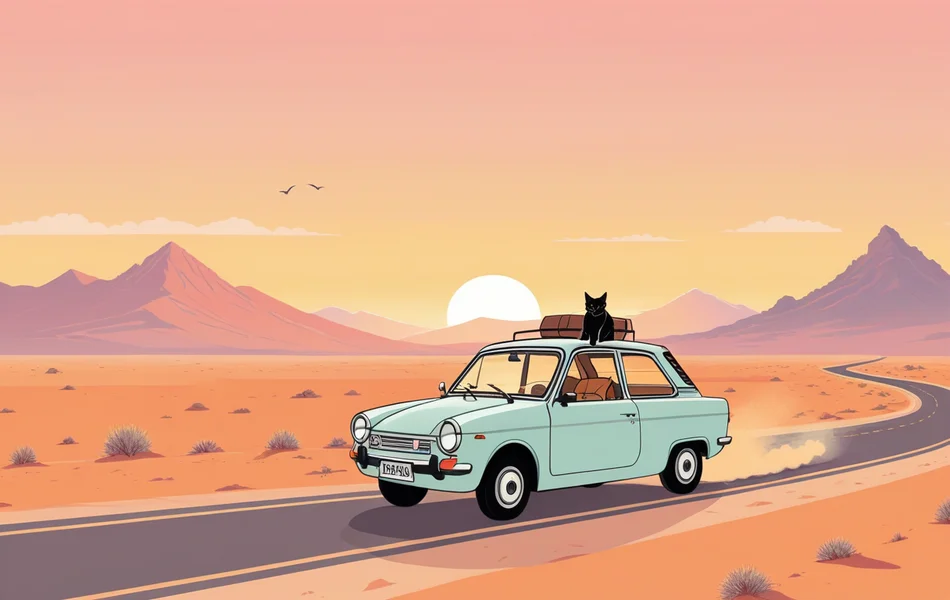
Ollie Jenks and Seth Scott drove a Reliant Robin called Sheila from London to Cape Town. The journey covered about 14,000 miles through 22 countries, according to the Associated Press’s April 22 report. Three wheels reached the destination. Common sense appears to have taken a separate flight.
It is an underdog story with a particularly literal vehicle: a small British three-wheeler attempting a journey that sounds ambitious even before you specify the car.
Sheila Was Chosen for the Adventure
AP describes Sheila as one of the later Robins built, not a 1970s example. The trip’s reported aim was a three-wheeled distance record. A reported record attempt and an independently verified Guinness title are different things; the account does not establish that certification had been awarded.
The journey itself is enough to appreciate. A certificate would add a line to the story. It would not make the car more improbable than it already looks.
There is something irresistible about a vehicle that seems to have misunderstood the assignment. You expect a small errand. The map keeps unfolding.
The Repair Bill Became Part of the Route
The pair’s account includes a failed gearbox in Ghana and an engine failure in Cameroon, with replacement parts obtained through help from other people. It also describes a roughly 300-mile military escort in Cameroon and a close encounter with an overtaking bus in Congo.
Those are reported experiences, not reasons to treat this as a travel recommendation. The charm of hearing that someone completed an awkward journey is different from deciding that the hazards are what made it worth attempting.
The mechanical element, though, is easy to grasp. A plan says where you intend to go. A broken car asks what you intend to do right here. Suddenly the important destination is a workshop rather than the distant endpoint on the map.
A Solo-Looking Stunt Needs Other People
Jenks told AP the trip cost around $40,000–$50,000 and received sponsorship and crowdfunding. Help from mechanics and enthusiasts was part of the story too. There is no need to choose between “supported expedition” and “human kindness” as if they cancel each other out.
The most satisfying adventure stories often make that visible. Two names fit neatly in a headline, but getting something repaired can involve people who did not feature in the original plan. The driver needs a part, someone knows where to look, and a stranger’s impractical idea becomes a problem worth helping with.
That does not tell us every mechanic worked for free, or that nobody involved benefited from the publicity. It tells us that the headline’s two-person cast is not the whole cast.
The Record Is Not the Entire Point
As a record category, distance in a three-wheeler may sound wonderfully specific. But it is possible to enjoy the specificity without pretending it is a measure of universal greatness. The achievement is the journey they chose to complete, in the vehicle they chose to take.
Nor does another person need to respond by finding something less suitable and a more dangerous route. An amusing story is allowed to end without launching an arms race of worse transport decisions.
There is a little of the same affectionate attention in the story of Gertie the elderly chicken: an unlikely protagonist becomes worth following on her own terms. Sheila has an engine instead of feathers, and rather different maintenance requirements.
Plans Are Still Plans
The reported next steps included servicing Sheila and eventually bringing her back to Britain, with a museum destination discussed. Those are future intentions, not confirmation that a museum has already accepted or displayed the car.
For now, the completed trip provides a better ending than any invented future exhibit label. Two friends aimed a tiny three-wheeler at a very distant city, dealt with a succession of obstacles, and arrived.
Sheila does not need to represent the death of polished influencer culture or the salvation of British motoring. Being an implausible little car at the end of a very long road is quite enough. Sometimes the punchline gets to drive itself home.