You died. The screen fades to gray, the bonfire is three rooms back, and the souls you spent the last twenty minutes farming are sitting on the floor next to a knight twice your size. You sigh, you stand up, you try again. If that loop sounds familiar (or terrifying), congratulations: you have just met a soulslike.
“Soulslike” gets thrown at anything hard, but the genre has a specific shape. This guide walks through what defines a soulslike, where it came from, and which games are worth your first death in 2026.
What Is a Soulslike Game in One Sentence
A Soulslike is an action game drawing on the design tradition associated with Demon’s Souls and Dark Souls: demanding encounters, deliberate actions, checkpoints, and learning through repeated attempts. Currency recovery and interlinked spaces are common features, but not compulsory in every example. The label describes a family resemblance, not a checklist that every game passes identically.
That definition is narrower than people think. A game can be hard and not be a soulslike. The label sticks when the loop is right: read, commit, manage stamina, die, recover your stuff, try again.
What Is a Soulslike Game: The Six Defining Features
These six features are useful ways to discuss the tradition. Their combination and importance vary; there is no official four-out-of-six qualification exam.
1. Stamina-Gated Combat
In many examples, stamina limits attacks, dodges, or defensive actions. Spending it carelessly can leave you vulnerable. Other games use different resources or priorities, so a green bar is not the only way to create the rhythm of reading an opponent, committing, and recovering.
2. Animation Commitment
An attack can leave you committed long enough for a mistake to matter. That encourages judging openings instead of pressing buttons continuously. Cancellation rules vary between games and actions; “you can never cancel anything” is not a reliable genre definition.
3. The Bonfire (or Lantern, or Stargazer)
Checkpoints organize repeated attempts, but their functions differ. Bloodborne’s lanterns connect you to the Hunter’s Dream, for example, rather than reproducing every Dark Souls bonfire function on the spot. Healing, leveling, travel, and enemy resets can be distributed differently.
4. The Currency Death Penalty
Many games put unspent progression currency at risk and offer a chance to recover it. That is not the same as dropping your entire inventory. There are exceptions even among games often grouped together: Sekiro’s manual describes losing half of current sen and progress toward the next skill point, with Unseen Aid sometimes preventing the loss. It is not a standard recover-your-souls bloodstain.
5. Environmental Storytelling
Item descriptions, architecture, enemy placement, and sparse conversations can carry much of the story. Cutscenes and direct narration can coexist with that approach. The appeal is often the invitation to piece things together, not a ban on the camera showing you a dramatic moment.
6. Interconnected World Design
The original Dark Souls withheld fast travel until later progression, and the world folded back on itself in ways that felt impossible. You climbed a tower, came out on top of a structure you had been looking up at for ten hours, and gasped. The map is a puzzle, not a checklist.
Where the Genre Came From
FromSoftware’s Demon’s Souls (2009) and Dark Souls (2011), directed by Hidetaka Miyazaki, became key reference points. Bloodborne (2015), Sekiro (2019), and Elden Ring (2022) explored related ideas in different forms. The differences are as revealing as the similarities: posture-focused combat, an open world, and different death rules do not make one uniform formula. For me, the appeal is the feeling of gradually understanding an initially intimidating game.
Soulslike vs Soulsborne vs Souls-Lite
- Soulsborne: the FromSoftware originals. Demon’s Souls, the Dark Souls trilogy, Bloodborne, Sekiro, Elden Ring.
- Soulslike: any game that copies the core loop in good faith. Lies of P, Nioh, Lords of the Fallen, The Surge, Mortal Shell, Code Vein.
- Souls-lite: games that borrow the death-and-recovery mechanic but live in another genre. Hollow Knight is a metroidvania with souls mechanics. Hades is a run-based action game; fast combat alone does not settle its relationship to Soulslikes.
- Soulslike-adjacent: a loose description for games borrowing some ideas without closely matching the overall structure. It is a discussion label, not evidence of misleading marketing.
Where to Start: The Best Soulslike Games in 2026
Elden Ring (2022, with Shadow of the Erdtree 2024)
Elden Ring is my suggestion if the freedom to explore elsewhere appeals to you. Many obstacles can be approached later, and summons or a different build can help. Mandatory encounters still exist, and it remains demanding. The appeal is having options, not a guarantee that every difficult fight can be bypassed indefinitely.
Lies of P (2023, with Overture DLC 2025)
The strongest non-FromSoftware soulslike of the past several years. Belle Époque puppet horror, aggressive combat built around perfect parries, and a story that takes Pinocchio seriously. If you do not own a PlayStation and want the Bloodborne feeling, this is the closest you will get.
Hollow Knight and Silksong
Technically metroidvanias, but with so much soulslike DNA that they count. Hollow Knight earns its place in any indie best-of list, and Silksong finally arrived in 2025 after a wait that became a meme of its own.
One Tip for Your First Soulslike
If repeated attempts have stopped teaching you anything, pause and reconsider. Where the game allows it, explore another route or adjust your equipment. In a more linear section, focus on learning a few attacks rather than winning immediately. Leaving is a useful option in some places, not unique freedom guaranteed by every Soulslike.
How Soulslikes Connect to Older Genres
Soulslikes belong to a wider history of action games and RPGs. Comparing encounter design, exploration, and progression is more useful than assigning every feature to a single ancestor. If precise repeated play interests you, our speedrunning guide explores another way players learn a game’s systems.
Frequently Asked Questions About Soulslike Games
Are soulslike games actually that hard?
They can be demanding, especially while you learn an unfamiliar combat rhythm. Difficulty varies between titles and players, and not every death feels fair or teaches an obvious lesson. The enjoyment comes when experimenting and improving are rewarding to you; there is no ten-hour deadline by which you should start liking it.
Which soulslike should I play first?
I would start with Elden Ring if you want exploration and multiple approaches, or consider Lies of P if a more directed adventure appeals. Check the available difficulty and accessibility options against what you enjoy. A recommendation is a starting point, not an endurance test.
Is there an easy mode in soulslike games?
Some games have explicit difficulty settings. Lies of P added difficulty options in June 2025. Others offer help through summons, character builds, or cooperative play. Those systems are not identical to an easy-mode switch, and their usefulness depends on the encounter and player.
What is the difference between a soulslike and a roguelike?
Run-based roguelikes and roguelites often reset substantial progress after defeat, while Soulslikes commonly keep a persistent world and character progression. Procedural generation and persistent upgrades vary across the run-based family. See our roguelike versus roguelite explanation for that distinction. Hybrids can borrow from both.
The Real Reason Soulslikes Caught On
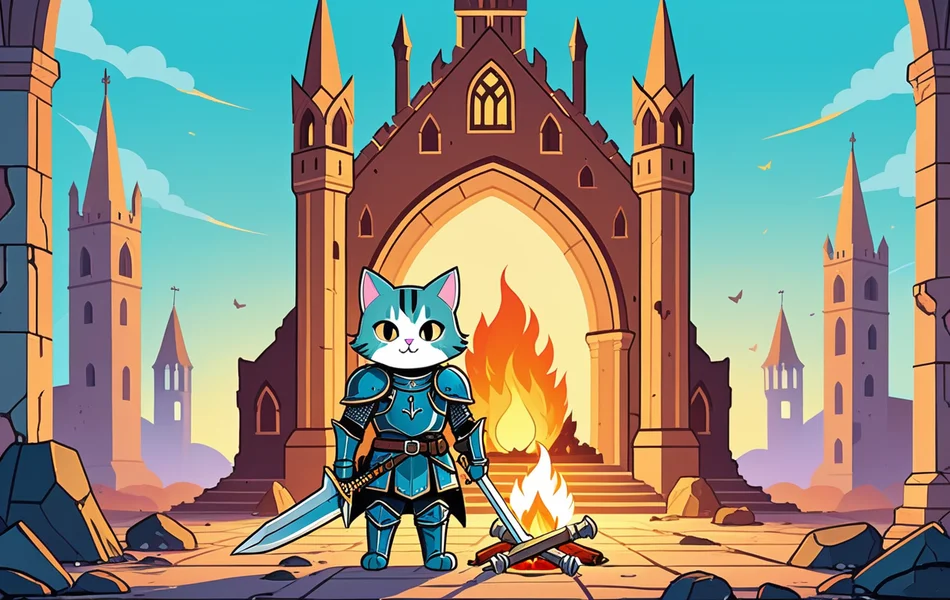
Strip away the dark fantasy and the difficulty memes, and what soulslikes actually offer is rare: a game that trusts you. Often, discovery and mastery matter more than constant guidance. It hands you a sword and a world and expects you to make sense of both. The cat, for what it is worth, has been killed by the same hollow knight on the Undead Burg stairs about a hundred and twelve times. The cat is still trying. That is the genre in one paragraph.