
What is hygge, really, beyond the candles and the chunky knit socks Instagram keeps trying to sell you? The short answer is that hygge is a Danish word for a feeling of warm, low-stakes contentment, usually shared with people you actually like, often involving soft light and something hot in a mug. The longer answer involves climate, history, a very successful publishing trend, and a cat sprawled across your lap at exactly the angle that makes getting up impossible. This guide walks through where hygge came from, what it actually means in Danish daily life, why it became a global obsession around 2016 and never quite left, and how to practice it without buying anything at all.
Table of Contents
- What Is Hygge? The Short Definition
- The Origins of Hygge: Norway, Denmark, and a Long Winter
- How Danes Actually Practice Hygge
- Hygge vs Cozy vs Comfort: They Are Not the Same Thing
- Why the Idea Appeals
- How to Build a Hyggelig Evening Without Buying Anything
- Cats Were Doing Hygge First
- FAQ
What Is Hygge? The Short Definition
Hygge is a Danish noun and verb describing the feeling of cozy contentment that comes from being warm, safe, present, and usually in good company. It is not an aesthetic. It is a state. You can have hygge alone with a book and a blanket, you can have hygge with five friends and a pot of stew, and you can have hygge with a cat on your chest while the rain does whatever rain does outside. “Cosiness” and “conviviality” capture parts of it, though the everyday cultural associations do not fit neatly into one English equivalent.
Denmark’s official introduction to hygge emphasizes taking time for simple pleasures and stepping away from the rush. That is a more useful starting point than a shopping list. A low-lit kitchen with friends eating cinnamon buns makes the idea easier to picture, but the buns do not issue certificates of authenticity.
The Origins of Hygge: Norway, Denmark, and a Long Winter
The word predates the lifestyle shelves. The historical Ordbog over det danske Sprog records the noun as adopted from Norwegian in the late eighteenth century. Its linguistic relatives reach further back. That is a history of the word, not a claim that Denmark invented feeling comfortable—or that everyone in the country gives the concept exactly the same meaning.
Long, dark winters make indoor comforts an understandable part of the picture. But climate alone does not explain a culture, and hygge is not restricted to hiding from December. Still, when the afternoon already looks like bedtime, a pleasant corner of the house starts making an excellent argument for itself.
How Hygge Went Global
The English-language publishing boom gathered pace in 2016. Meik Wiking’s The Little Book of Hygge appeared that September, among several books introducing the idea to a wider audience. Hygge also appeared in Collins’ 2016 word-of-the-year coverage, though Brexit took the top spot. Cosiness had a good year; political upheaval had a louder one.
Turning an everyday pleasure into a purchasable lifestyle has an obvious comic side. Hygge is not something you buy. It is something you do. The candle industry was, naturally, delighted.
How Danes Actually Practice Hygge
Soft lighting is one familiar way to create an inviting atmosphere, and candlelight appears often in descriptions of hygge. But you do not need a national candle-consumption league table to decide which light feels pleasant in your room. A lamp is perfectly capable of doing the job. Nobody needs to burn six kilograms of anything to qualify.
Beyond lighting, real hygge tends to involve a few quiet ingredients. There is warmth, usually in the form of layers, blankets, or hot drinks. There is presence, meaning phones are mostly put away and the conversation stays unhurried. There is a small treat, often baked, often involving cardamom or cinnamon. And there is a deliberate slowness. The invitation is to ease off performing or documenting the evening for an outside audience. The whole point is that the moment is for the people inside it.
Common Hygge Settings
- A Sunday breakfast that runs to lunch because nobody is in a hurry to leave the table
- A small group of friends drinking wine by candlelight while it rains outside
- Reading a paperback under a heavy blanket while a cat slowly takes over the armrest
- A solo walk through a familiar park in late afternoon light
- A pot of stew shared with one or two people who do not need to be entertained
- An evening where the most interesting thing that happens is the playlist changing
The thread running through these examples is feeling at ease. A quiet evening is one route there, rather than the only approved form. Hygge can be social and cheerful too; it is not a clinical category called “the opposite of a party.” Sometimes the best gathering is simply the one where nobody feels they need to impress anyone.
Hygge vs Cozy vs Comfort: They Are Not the Same Thing
English speakers tend to translate hygge as cozy, and that is close but not quite right. Cozy describes a quality of a space or an object. A blanket is cozy. A reading nook is cozy. Hygge is the feeling that arises when cozy conditions meet present-tense attention and, usually, gentle company. You can be inside a cozy room and not be having hygge, if you are scrolling your phone and worrying about work emails. For the kind of evening suggested here, giving the moment some attention is more useful than getting every decorative detail right.
It is also worth distinguishing hygge from comfort. Comfort can be passive, even numbing. A whole evening of doomscrolling on the sofa is comfortable in a thin, regrettable way, but it is not hygge. Related words such as Dutch gezelligheid and German Gemütlichkeit have their own associations. They are reminders that enjoyment of comfortable company is hardly exclusive to Denmark.
Why the Idea Appeals
It is easy to see the appeal of an evening with less pressure and more room for things you enjoy. It is much harder to turn hygge into a validated bundle of biological effects. A warm-looking bulb’s colour temperature alone does not tell us its effect on sleep, and a relaxed dinner is not a precise measurement of the parasympathetic nervous system. You can enjoy the ritual without dressing it in a laboratory coat.
Nor does Denmark’s position in a happiness ranking establish how much hygge contributes. A national comparison involves many social and economic circumstances; it cannot isolate the effect of candles and comfortable company. Treat the idea as a cultural invitation, rather than a treatment or a proven explanation of a country’s well-being.
The interesting thing is that hygge is essentially the inverse of optimization culture. There is no productivity gain. There is no metric. You cannot post a great hygge evening to LinkedIn. That is not a bug. That is the whole mechanism. The mind needs hours that are not being measured, and the body needs evenings that are not being marketed at. If you have been reading about why minimalism is really about attention rather than stuff, hygge fits into the same family of ideas. Both are pushback against the assumption that every hour of your life should be doing work.
How to Build a Hyggelig Evening Without Buying Anything
The publishing industry has done its best to convince everyone that hygge requires a wool throw from a specific Copenhagen design house and at least three taper candles in matte brass holders. It does not. Here is what a working hygge evening actually needs, with nothing in a shopping cart.
Step One: Turn Off the Big Lights
Try a lamp instead of the ceiling fixture if it makes the room feel more comfortable. Keep enough light for whatever you are doing, especially reading. A candle is optional; if you use one, keep it away from fabrics and curious paws, and do not leave it unattended. The cat may be a hygge instructor, but fire safety is not its department.
Step Two: Put the Phone Somewhere Else
If the phone keeps drawing you away, try leaving it out of reach for part of the evening. Keep it available if you need it for access, care, or an important call. This is an experiment in reducing interruptions, not a universal rule that a switched-off phone inevitably ruins conversation. For more on the everyday distraction problem, see our piece on notifications and attention.
Step Three: Make Something Warm
A pot of tea. A mug of cocoa. A bowl of soup, heated whichever way suits your evening. Preparing something can be part of the pleasure, but a shortcut does not disqualify you. Bonus points if it involves cardamom, butter, or yeast.
Step Four: Sit Down and Stay Sat
Pick a book, a long conversation, a quiet game, or a record played all the way through. The crucial thing is that the activity should not be optimizing toward an outcome. You are not catching up on industry podcasts. You are not getting through your to-watch list. The evening is the point. Restful leisure and sleep are different things; an enjoyable evening need not make a scientific claim about either.
Cats Were Doing Hygge First
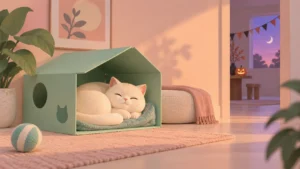
Here is the part the Danish lifestyle books understate. Cats invented hygge. They invented it sometime around 7500 BCE in the Fertile Crescent, the moment the first one decided that the warmest patch of a stranger’s hut was preferable to the open steppe, and they have been refining the practice since. A cat will, at any given moment, locate the single warmest, softest, lowest-stress position in a room and occupy it with the absolute certainty of a creature that does not believe in productivity guilt.
Watch a cat on a winter evening. The cat finds the patch of sun while the sun lasts. When the sun moves, the cat moves with it. When the sun is gone, the cat finds the radiator. When dinner is finished, the cat sits where the conversation is happening, not on the laps of people who are typing. This is functioning hygge instinct. The cat is not optimizing anything. The cat is, simply, where the warmth and the people are. If humans need a book to relearn this, the cat is willing to demonstrate, but only on its own schedule, and probably on top of the book.
This is one reason cats and hygge map onto each other so neatly in contemporary Danish iconography. The cat is not a decoration. The cat is a hygge instructor with fur. If you have ever wondered why a cat ignores the expensive bed and sleeps in the cardboard box, the answer is that the box is hyggelig and the bed is performative. The cat knows.
If you want to lean into the iconography, we have written about the related phenomenon of why cats knock things off tables, which is, in a way, the inverse of hygge: a cat asserting that the room should be slightly less ordered, slightly more present. Both behaviors come from the same source, which is a creature that lives entirely in the current moment and refuses to apologize for it. The wellness industry is currently trying to sell humans that exact orientation for ninety euros a month under names like rawdogging boredom and dopamine fasting. The cat does it for free.
FAQ
How do you pronounce hygge?
English approximations are imperfect. Cambridge provides English audio examples, while Den Danske Ordbog gives the Danish pronunciation. Listen rather than trying to imitate a throat-clearing sound: the Danish word does not contain the German ch sound in Bach.
Is hygge only for winter?
No, although winter is its peak season. Summer hygge in Denmark involves long, slow outdoor meals, unhurried picnics, and small gatherings on balconies or in gardens. The principle is the same: warmth, presence, low-stakes company, and no rush.
Can you have hygge alone?
Yes. Solo hygge is real and respected. A book, a hot drink, a candle, and a long unhurried evening counts. The cat, if present, counts as company. For a solo evening, choose something you enjoy rather than something you feel obliged to complete.
What is the opposite of hygge?
Danish has a word for it, uhyggelig, which means eerie, creepy, or unsettling. More casually, the opposite of hygge is any setting that is harsh, hurried, performative, or socially anxious. Fluorescent-lit waiting rooms, rushed airport meals, and dinners spent answering work emails are all the opposite of hygge.
Do you need to buy anything to have hygge?
No. You can start with what is already around you. Hygge is a practice, not a product category. The lamp you already own is fine. The mug you already have is fine. The cat, if you have one, was probably already doing the work.
An Evening Without a Shopping List
Hygge is not a brand, an aesthetic, or a thing you can checkout-cart your way into. It is a small cultural permission slip, written by a country that figured out how to enjoy long dark winters, to slow down without guilt and to spend an evening doing nothing measurable with people you care about. The cat understood this first. The Danes wrote it down. Everyone else is welcome to join, no purchase required, candle optional.