Why Are Almost All Calico Cats Female? The Genetics of Tortoiseshell Coats

On 30 April 1949, Murray Barr and his graduate student Ewart Bertram published a short paper in Nature about nerve cells taken from cats. They had noticed a small dark body pressed against the inside of the nuclear membrane, and it was there in females and missing in males. They called it a nucleolar satellite. Everyone else eventually called it the Barr body. Neither man was thinking about coat colour at the time, but calico cat genetics run straight through that dark speck, and the animals they were slicing up were the exact species that would later make the whole thing visible from across a room.

A calico coat is not decoration. It is a readout of a decision each cell made before the kitten had a face, and once you know what the patches mean, you can look at a tricolour cat and see genetics happening in public.

Table of Contents

Calico Cat Genetics Start With One Silenced X Chromosome

The switch that decides whether a cat’s pigment comes out orange or dark sits on the X chromosome. That single fact does all the work.

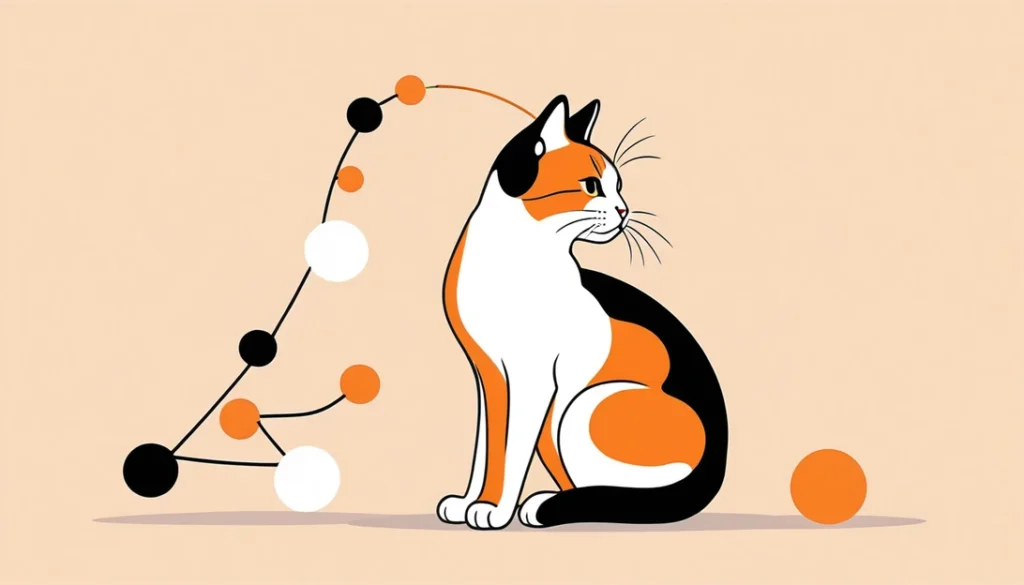
A cat with two X chromosomes can carry the orange version on one and the non-orange version on the other. Early in development, every cell shuts one of its two X chromosomes down, more or less at random, and then keeps that choice for life. Every cell it divides into inherits the same silenced copy. So one clump of skin ends up running the orange instruction, the clump next to it runs the black instruction, and the coat comes out in blocks.

A cat with one X chromosome has nothing to choose between. It gets one answer and applies it to the whole body: orange everywhere, or not orange anywhere. That is the entire reason almost every calico and tortoiseshell cat you have ever met is female. The pattern is not a colour, it is evidence of two X chromosomes disagreeing with each other.

It also means the tricolour coat is one of the few genetic mechanisms in mammals you can assess without a laboratory, which is why it turns up in every introductory biology course alongside the other things cats do that we have explained here, like the mechanics of purring and how feline vision actually works.

Mary Lyon and the 1961 Paper That Explained the Patches

Barr and Bertram found the dark body. Nobody knew what it was for. Twelve years later, the British geneticist Mary Lyon worked it out from mice.

Her 1961 paper in Nature, “Gene Action in the X-chromosome of the Mouse (Mus musculus L.)”, proposed that one X chromosome in each female cell is inactivated early in embryonic life, and that the choice is random. She was trying to explain why female mice carrying two different coat colour genes on their X chromosomes came out mottled instead of blended. The condensed Barr body was the switched-off chromosome, sitting there in every female nucleus like a folded-up instruction manual nobody reads.

For decades the process was called lyonization in her honour. The name has faded, the idea has not. X-inactivation turned out to matter for a long list of human genetic conditions, and it started with mottled mice and a dark blob in a cat neuron.

Why the patches have hard edges

Calico patches do not fade into each other. They have borders, because the decision is made once and then copied. When a cell inactivates one X and then divides a few million times, all of its descendants carry the same silenced chromosome, and they stay physically clustered as the embryo grows.

So patch size is a rough clock. Big, bold blocks of colour suggest the choice was made when there were very few cells to make it. Fine, speckled, brindled mixing suggests the decision came later, with more cells already in play. Two calico kittens from the same litter, with the same parents and the same genes, come out with different maps. Nobody can predict them, including the kitten.

CC, the cloned cat who looked nothing like her donor

The best demonstration of this came from Texas A&M University, which announced the birth of the world’s first cloned cat in December 2001. The kitten was named CC, variously reported as short for Copy Cat or Carbon Copy. Her genetic donor was a calico named Rainbow.

CC was a tabby with no orange on her at all.

Same DNA, different coat, because the clone ran its own X-inactivation lottery from scratch and the white spotting pattern is laid down developmentally too. Anyone hoping to buy back a dead pet got the bad news early and got it in colour. CC lived a normal life in College Station and died in March 2020 at the age of eighteen. Cloning copies the genome. It does not copy the animal, and the coat is the receipt. If you enjoy the parts of biology that refuse to behave, we also wrote about the pond organism that rewrote two of the three universal stop codons.

Calico, Tortoiseshell, Dilute: Three Words for Three Different Genes

People use these terms interchangeably and they are not interchangeable.

A tortoiseshell cat has orange and black mixed together with little or no white, often marbled or brindled. A calico is a tortoiseshell that also carries white spotting, which breaks the colour into distinct islands on a white ground. Calico is largely an American word. British registries usually write “tortoiseshell and white” and mean the same animal.

The white patches come from an ancient virus

White spotting in cats maps near the KIT gene on feline chromosome B1, and the cause is an insertion of a feline endogenous retrovirus into KIT. The same locus produces both dominant white and the piebald spotting that makes a calico look like a calico instead of a tortoiseshell.

The important part: KIT is autosomal. It has nothing to do with the sex chromosomes. So a calico coat is two independent genetic systems stacked on top of each other, one sex-linked and one not, and a viral sequence that moved into a cat genome a very long time ago is responsible for the white. Then there is dilution, caused by a single-base deletion in the MLPH gene, inherited as an autosomal recessive. Dilution turns black into grey and orange into cream, which is how you get the softer version sold as a dilute calico or, more precisely, blue-cream and white.

The Orange Gene Hid for a Century, Then Fell in 2025

Here is the embarrassing part of the story. Geneticists have known since the early twentieth century that orange in cats is sex-linked. They could predict inheritance patterns, breed to them, teach them. They just could not find the gene. It stayed missing for over a hundred years while genomics solved far harder problems.

It fell in May 2025, twice, in the same journal. Two teams published in Current Biology: one at Kyushu University in Japan led by Hiroyuki Sasaki, the other at Stanford University with Christopher Kaelin and Gregory Barsh. Both landed on the same answer.

The culprit is a deletion of roughly five kilobases in a non-coding stretch at the X-linked ARHGAP36 locus. The Kyushu group started with 18 cats, 10 orange and 8 not, found the deletion in every orange animal and in none of the others, then checked the result against 49 more cats and international genome data. Part of their work was paid for by a crowdfunding campaign, which is a strange sentence to write about a hundred-year-old genetics problem.

What the deletion actually does

ARHGAP36 is normally kept quiet in pigment cells. The deleted stretch is the thing doing the keeping. Remove it and ARHGAP36 stays switched on in melanocytes where it does not belong, which lowers the activity of the pigment production genes and swings the output from dark eumelanin toward the reddish pheomelanin. That is orange.

Now put that back into a calico. In an orange patch, the X chromosome that stayed active is the one carrying the deletion. In a black patch, the active X is the one without it. The coat is a chromosome-by-chromosome map of which copy won in each region, printed on the outside of the animal at full size. “Identifying the gene has been a longtime dream, so it’s a joy to have finally cracked it,” Sasaki said when the Kyushu work came out. Kaelin has noted that every orange cat alive appears to descend from a single original orange or tortoiseshell ancestor, which makes the entire ginger population one very large extended family.

What Calico Cat Genetics Cannot Do: Make a Reliable Male

Male calicos exist. They are not mythical, they are just chromosomally unusual, and a vet who finds one is looking at a diagnosis rather than a coat.

The main route is an extra X. In 1975, W. R. Centerwall and K. Benirschke published a karyotype study in the American Journal of Veterinary Research covering 25 male tortoiseshell or calico cats. Sixteen of the 25 carried an XXY complement. Almost all of them were sterile, with testicular changes comparable to human Klinefelter syndrome, which is why the paper was written as an animal model for the human condition in the first place. The extra X gives the cat two orange-locus copies to disagree about, plus the Y that makes it male.

The other route is chimerism. Two embryos fuse early, and the resulting animal carries cell lines with different chromosome sets, some XX and some XY, in one body. Rare male calicos that turn out to be fertile are generally chimeras or mosaics whose reproductive tissue happens to be genetically ordinary.

You will see “1 in 3,000” quoted everywhere for the frequency of male calicos. Treat it gently. It is an estimate derived from the known rate of chromosomal anomalies combined with the frequency of tricolour coats, not a count anybody actually performed, and rival sources will happily tell you 1 in 1,000 or 1 in 10,000 with the same confidence. The honest version is that they are rare enough that most people will never meet one.

From Edo Japan to the Maryland State House

Cultures that could not have known any of this still noticed that tricolour cats were uncommon, and did what humans do with uncommon things.

In Japan the pattern is called mi-ke, “three fur”, and it is the traditional colouring of the maneki-neko, the beckoning cat figurine that sits by cash registers worldwide. The classic form is a calico Japanese Bobtail with one paw raised. The figurines come out of the Edo period, with the marushime-neko in Imado ware as the earliest known version, an entry in the Bukō nenpyō chronicle in 1852, a Meiji-era newspaper mention in 1876, and an advertisement by 1902 showing they had gone mainstream. A rare coat became a luck object, and a luck object became a global export. If you like watching Japanese aesthetics turn scarcity into meaning, the same instinct sits underneath wabi-sabi and its taste for the imperfect.

The United States went a different direction and made it official. Effective 1 October 2001, the calico cat became the official state cat of Maryland, under Chapter 194 of the Acts of 2001. The reasoning was chromatic rather than genetic: orange, black and white are also the colours of the Baltimore oriole, the state bird, and the Baltimore checkerspot butterfly, the state insect. Maryland picked a cat because it matched the rest of the branding. Compare that with the darker treatment the plain black cat has received across European history, which we traced in the long story of black cat superstitions. Same species, opposite reputations, and the only real difference is which pigment switch happened to be on.

Frequently Asked Questions

Can a calico cat be male?

Yes, but it takes a chromosomal irregularity. Most male calicos carry an extra X chromosome (XXY), the feline parallel to Klinefelter syndrome, and are almost always sterile. A smaller number are chimeras built from two fused embryos. A male calico is a genuine clinical finding, not just an unusual coat.

What is the difference between a calico and a tortoiseshell?

White. A tortoiseshell has orange and dark pigment mixed with little or no white. A calico is the same orange and dark combination plus white spotting from the KIT locus, which separates the colours into defined patches. British usage often prefers “tortoiseshell and white” over calico.

Why do no two calico cats look the same?

Because X-inactivation is random and happens independently in each embryo. Even littermates with identical genotypes, and even clones, produce different maps. The first cloned cat, CC, came from a calico donor and had no orange on her at all.

Is calico a breed of cat?

No. Calico describes a colour pattern, not a breed, and it turns up across many breeds as well as in ordinary domestic shorthairs and longhairs. Registries list it as a coat description. A calico Persian and a calico Japanese Bobtail have nothing in common except the pattern.

The Short Version

The orange switch sits on the X chromosome, so it takes two X chromosomes to run both colours at once, and cats with two X chromosomes are usually female. Each cell silences one X early and its descendants keep that choice, which is why the patches have edges and why no two calicos match. The gene behind orange was only pinned down in 2025, more than a century after the inheritance pattern was described. Rare males exist through an extra X or through chimerism, and are nearly always sterile. Nice cats. Also a walking genetics lecture that kneads your leg.


🐾 Visit the Pudgy Cat Shop for prints and cat-approved goodies, or find our illustrated books on Amazon.

Stay Curious, Stay Engaged!
Get our best stories delivered weekly. No spam, no fluff.
Share this story

Leave a Reply

Your email address will not be published. Required fields are marked *