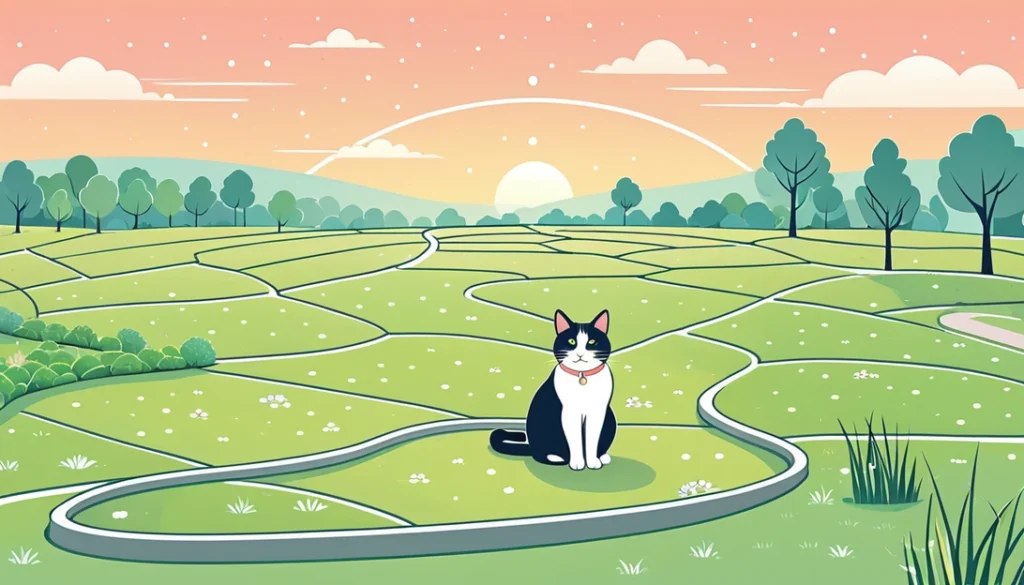
GPS cat trackers were sold on a promise that turned out to be mostly wrong. The marketing image is a cat crossing three postcodes at night, living a secret second life, with the collar finally exposing it. Then researchers strapped receivers to hundreds of pet cats across six countries and found the opposite. Most cats barely leave the block. The average home range in the largest study of its kind is 3.6 hectares, roughly five football pitches, and the ecological damage sits almost entirely within about 100 metres of the front door.
What Is in This Article
- How GPS Cat Trackers Actually Work
- Not All GPS Cat Trackers Use GPS
- 925 Cats, Six Countries, Very Small Worlds
- What Australia, New Zealand and Illinois Found
- The Ecological Bill Nobody Reads
- The Collar Problem: Weight, Breakaway, and 538 Cats
- How to Read Your Own Cat’s Map
- FAQ
How GPS Cat Trackers Actually Work
A GPS cat tracker is three separate machines pretending to be one lump of plastic: a satellite receiver that works out where the collar is, a radio transmitter that ships that position somewhere you can see it, and a battery keeping both alive for days rather than hours. Every design compromise in the category comes from those three parts fighting each other.
Trilateration, Not Triangulation
The receiver does not talk to satellites. It only listens. Each GPS satellite broadcasts a timestamped signal, and the receiver measures how long each signal took to arrive. Distance is time multiplied by the speed of light, so four measurements give four spheres, and the point where they intersect is the collar. Four satellites, not three, because the collar’s own clock is cheap and wrong, and the fourth measurement is spent solving for that clock error rather than for position.
Under open sky a consumer receiver lands within a few metres. Under a hedge, a car chassis, or a dense tree canopy, it degrades fast, and in the worst urban cases the signal bounces off a wall before it arrives and puts your cat inside a neighbour’s kitchen. This is why tracker maps show cats teleporting through fences. The cat did not teleport. The multipath did.
Time to First Fix and the Duty Cycle Problem
A receiver starting from nothing, with no idea of the time, its rough position, or where the satellites currently are, needs roughly two to four minutes to produce a first fix. That is a cold start. A warm start, where the device still remembers recent orbital data, drops to about 45 seconds. A hot start can be a handful of seconds. Assisted GNSS cuts the wait further by downloading the satellite almanac over the cellular network instead of waiting for it to trickle down from space at 50 bits per second.
That arithmetic dictates battery life. A collar that fixes every two minutes is awake most of the time and dead by dinner. So trackers sleep. They use an accelerometer to detect that the cat is stationary, stretch the interval out to hours, and switch to fast updates only when the cat moves or when you open the app. The gap between the advertised battery figure and yours is mostly a question of how often you panic and hit refresh. Our piece on how solid-state batteries work covers why small cells stay stubbornly small.
Not All GPS Cat Trackers Use GPS
That is an irritating sentence but a true one. Four other technologies compete for space in the same collar, and they fail in different directions.
Radio direction finding. The oldest approach, used by wildlife biologists for decades before satellites got cheap. A small tag transmits a beacon and you walk around with a handset that gets louder as you point at it. Range is a few hundred metres, there is no map and no subscription, and it works under a shed floor where GPS is blind. It finds a cat trapped in a garage. It is useless for finding a cat two streets away.
Bluetooth. A tag with no positioning hardware at all. It shouts an identifier, and any passing phone on the same crowd network reports the sighting. In a dense city it is uncannily good. On a farm it is a very small paperweight. It also relies entirely on other people’s handsets, which is a privacy trade in both directions, similar in shape to the questions we unpacked in how end-to-end encryption works.
Cellular and LTE-M. The mainstream choice. The collar has an embedded SIM and pushes each fix to a server, which is why almost every real-time tracker carries a monthly fee. LTE-M is a low power variant of LTE built for small battery devices. Where it is not deployed, the collar drops back to normal cellular and the battery figure on the box quietly stops applying.
LoRa and LoRaWAN. Long-range, very low power radio that carries tiny packets a long way. Line of sight it reaches six to fifteen kilometres, in a built-up area more like one to five. No SIM, no subscription, but it needs a gateway within range, which means a community network or a base station you own. For rural cats and hobbyists who like soldering, it is the most interesting option on the list.
925 Cats, Six Countries, Very Small Worlds
The definitive dataset came out of a citizen science project called Cat Tracker, run by Roland Kays at the Biodiversity Lab of the North Carolina Museum of Natural Sciences and North Carolina State University. Volunteers were sent a GPS unit in a 3D-printed case on a harness, a rig that cost about fifty dollars a set, and asked to log what their cat brought home. The results were published on 11 March 2020 in the journal Animal Conservation under the title “The small home ranges and large local ecological impacts of pet cats”.
The headline number: 925 pet cats tracked across six countries, mean home range 3.6 hectares with a standard deviation of 5.6. Only three cats in the entire dataset ranged over one square kilometre. Three, out of 925. Seventy-five percent of the cats spent at least 90 percent of their time in disturbed habitat, meaning gardens, verges, car parks and alleys rather than woodland. The author list pulls in the groups that had been doing this independently, including Rob Dunn, Jenni McDonald at Exeter, Heidy Kikillus in Wellington and Philip Roetman in South Australia.
One finding surprised the team more than the small ranges. There was no relationship between home range size and the presence of larger native predators. American cats living in coyote country did not shrink their territory to compensate. Whatever governs a pet cat’s map, it is not fear of being eaten. The raw movement data sits on Movebank, the free animal tracking archive run out of the Max Planck Institute of Animal Behavior in Germany, which is where most serious animal telemetry ends up.
What Australia, New Zealand and Illinois Found
The 2020 paper pulled together national projects that each stand on their own, and the national differences are the interesting part.
South Australia: A Median of One Hectare
Cat Tracker South Australia, run by Philip Roetman and the Discovery Circle team at the University of South Australia, tracked 428 pet cats between February 2015 and September 2016 and published its report on 3 February 2017. The median home range was 1.04 hectares. The project’s own comparison, which is the one that stuck in the Australian press, is that the typical tracked cat lived inside an area about the size of eight Olympic swimming pools.
New Zealand: Nobody Stayed Home
Cat Tracker New Zealand, led by Heidy Kikillus at Te Herenga Waka Victoria University of Wellington, surveyed 2,428 cats and GPS-tracked 209 of them, reporting in December 2017. Ranges spread from 0.1 hectares to over 200. The average cat covered about five kilometres in a week, one outlier managed more than 30, and males consistently travelled further than females while age and breed made no measurable difference. The line that landed hardest with owners: not one of the tracked cats stayed entirely on its owner’s property. New Zealand is also the sharpest test case, because it has no native land mammals apart from bats, so a house cat there is the apex predator by default.
Illinois: Owned Cats Versus Everyone Else
Before the citizen science wave, Jeff Horn and colleagues used radio telemetry and collar activity sensors on 42 adult cats around Champaign-Urbana, Illinois, publishing in the Journal of Wildlife Management in 2011. Owned cats averaged under two hectares. Unowned free-roaming cats ranged up to 157 hectares, and they were markedly more nocturnal. That comparison explains most of the confusion in this field. A fed cat with a warm radiator behaves nothing like an unfed one, and studies that mix the two produce averages describing neither.
The Ecological Bill Nobody Reads
Small home ranges sound reassuring. They are not. Owners in the 2020 study reported their cats killing an average of 3.5 prey items per month, which is a modest number until you divide it by the size of the territory. The paper’s estimate is an ecological impact of 14.2 to 38.9 prey per hectare per year, which is comparable to or higher than the per-animal impact of wild carnivores. Kays summarised the finding for NC State as house cats having between two and ten times the impact of wild predators on local wildlife.
The mechanism is concentration, not appetite. A wild predator spreads its kills across a large territory. A pet cat eats from a bowl, hunts recreationally, and does all of it inside a few hectares, in a neighbourhood that also contains twenty other cats doing the same thing. The 2020 paper puts the damage almost entirely within about 100 metres of the cat’s home. The birds paying the bill are the birds in your garden, and if you have ever watched the buildup to that, our piece on why cats chirp at birds covers the noise they make while doing it.
Some places skipped the debate. In Longyearbyen, on the Norwegian archipelago of Svalbard, cats are simply banned to protect the seabird population, which we wrote about in the town where it is illegal to die.
The Collar Problem: Weight, Breakaway, and 538 Cats
Before any of this data exists, something has to stay on the cat. The best GPS cat trackers on the market now sit between roughly 17 and 30 grams, and the rule of thumb carried over from wildlife telemetry is that a device should stay under about five percent of the animal’s body weight. For a four kilogram cat that is a 200 gram ceiling, so weight is rarely the binding constraint. Bulk and balance are. A 30 gram brick that swings under the chin gets attacked, groomed off, or wedged.
The retention question has a real number attached. Lord and colleagues published a study in the Journal of the American Veterinary Medical Association in 2010 covering 538 client-owned cats, randomly assigned one of three collar types: plastic buckle, breakaway plastic buckle safety, and elastic stretch safety. After six months, 391 of the 538 cats, or 72.7 percent, were still wearing the collar. The single strongest predictor of success was the owner’s initial expectation that the cat would tolerate it, which is a polite way of saying that owners who assume failure produce it.
The risk everyone worries about did show up, at 1.9 percent. Ten cats got a collar caught in the mouth or a forelimb. Small, but not zero, and it is why a breakaway or safety-release buckle is not optional. The same study found microchips, which cannot be lost and cannot strangle anything, working in all but one case at six months. A tracker is a convenience. A chip is the actual safety net.
How to Read Your Own Cat’s Map
If you clip a tracker on this week, three things will happen and all of them are normal. The map will show a cloud rather than a path, because fixes are sampled and the lines between them are drawn by software. You will get outlier points hundreds of metres away that your cat never visited. And the territory will be smaller than you expected, shaped by a fence line, a road, or one aggressive neighbouring cat.
The useful reading is not the maximum distance. It is the shape. Cats build routes and reuse them, and the interesting information is which corridor they favour at 3am and which garden they never enter. The rest of feline behaviour stays where it always was, in the domestic weirdness we cover in why cats purr and why cats knead.
FAQ
How far do pet cats really roam?
Much less than folklore suggests. The 2020 study of 925 cats across six countries found a mean home range of 3.6 hectares, and only three cats exceeded one square kilometre. South Australian data put the median at 1.04 hectares. Unowned free-roaming cats are the exception and can range far wider, up to 157 hectares in the Illinois study.
Are GPS cat trackers accurate enough to be useful?
Outdoors with a clear sky, yes, within a few metres. Under tree cover, inside a shed, or between tall buildings, accuracy degrades and the collar may fail to fix at all. For the final few metres of a search, a short-range radio finder is more reliable than any satellite receiver.
Do I need a subscription?
For real-time cellular trackers, almost always, because someone pays for the SIM and the servers. Bluetooth tags, radio finders and LoRa devices avoid the fee, and each gives up something in exchange: range, mapping, or nearby infrastructure.
Is a collar safe for a cat?
With a breakaway or safety-release buckle, mostly. In the 538-cat JAVMA study, 72.7 percent of cats wore a collar successfully for six months and 1.9 percent had an entrapment incident. Fit it snugly enough that a paw cannot slip under it, check it weekly, and treat a microchip as the primary identification rather than the collar.
Does tracking my cat help wildlife?
Indirectly. Tracking shows where the pressure lands, which the research says is within roughly 100 metres of the house. The interventions that reduce predation are the boring ones: keeping the cat in at dawn and dusk, or restricting outdoor access entirely.
The Short Version
The tracker industry sold a mystery and the science delivered an anticlimax that is far more useful. Cats are not secret adventurers. They are intensely local animals with tiny, heavily reused territories, and that smallness is exactly why their effect on local birds and mammals is so concentrated. Understand the hardware before you buy any of it, because a satellite receiver, a radio beacon and a Bluetooth tag solve three different problems and only one of them is yours. Clip the thing on, watch for a fortnight, and expect to learn more about your fence line than about your cat.
🐾 Visit the Pudgy Cat Shop for prints and cat-approved goodies, or find our illustrated books on Amazon.


Leave a Reply