
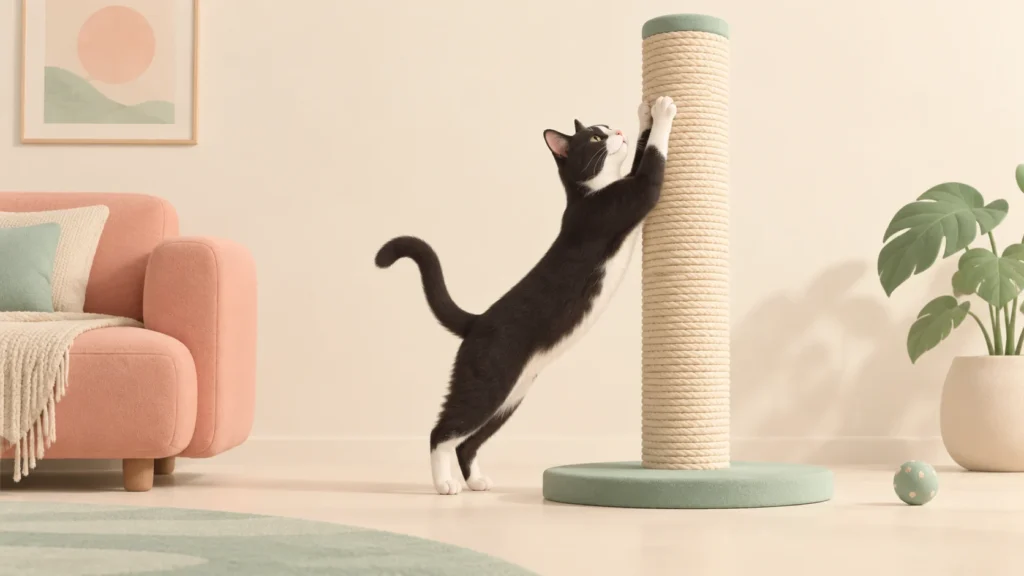
The scratching post is new. The sofa is not. Your cat considers both and returns to the sofa, leaving you to wonder whether the expensive purchase has been mistaken for a decorative column.
Before buying another one, look at the choice from the cat’s position. The sofa may offer a firm surface, a satisfying texture and a convenient location. A post hidden behind a door has quite a bit of competition.
Scratching has a job to do
Cats Protection explains that scratching helps maintain claws and leaves both visible marks and scent from glands around the paws. Stretching is part of the activity too. Expecting a cat to give it up altogether would remove an ordinary part of its behaviour.
Watch the position your cat chooses. Scratching the upright arm of a chair gives you different information from working at a rug. One suggests a vertical surface to reach up against; the other makes a horizontal scratching pad worth considering. The object sold as a scratching post is only one possible design.
A useful upright post should remain steady when the cat pulls against it and allow a comfortable full stretch. Test the base before judging the cat’s willingness to use it. Something that wobbles under pressure may lose the comparison with a heavy piece of furniture immediately.
Start where the scratching happens
The AAHA and AAFP life-stage guidance recommends offering scratching surfaces early and considering locations near resting places and frequently used routes. It also notes that individual cats have preferences for materials and designs.
Put an appropriate scratcher close to the place your cat already uses. If scratching follows a nap, a post beside the sleeping area has an obvious advantage over one at the other end of the house. You are making the wanted option easy to choose at the moment the behaviour happens.
Try changing one feature at a time. Moving a stable scratcher closer to the sofa tells you something about location. Replacing its surface while leaving the position unchanged tells you something about texture. Changing everything together makes it harder to learn which part helped.
Give the cat a reason to choose it
Reward voluntary use with something the cat enjoys. Our introduction to clicker training explains how timing helps connect a reward with an action. Keep the interaction brief and let the cat move away.
Cats Protection’s behavioural advice specifically warns against taking a cat’s paws and dragging them over the post. That does little to make the object attractive. Punishment can add fear while leaving the original need to scratch unresolved.
In a home with several cats, access deserves attention too. The feline environmental-needs guidelines recommend multiple, separated resources. One excellent post may still be a poor option for a cat that has to pass an intimidating housemate to reach it.
A sudden increase in scratching, or a change accompanied by signs of distress or discomfort, is a reason to ask your vet about possible causes. The furniture is the visible part of the problem; changes elsewhere in the household may matter.
When you check a scratcher, begin with the evidence your cat has already left. Height, direction, texture and location are more useful clues than how well the colour matches the curtains.