
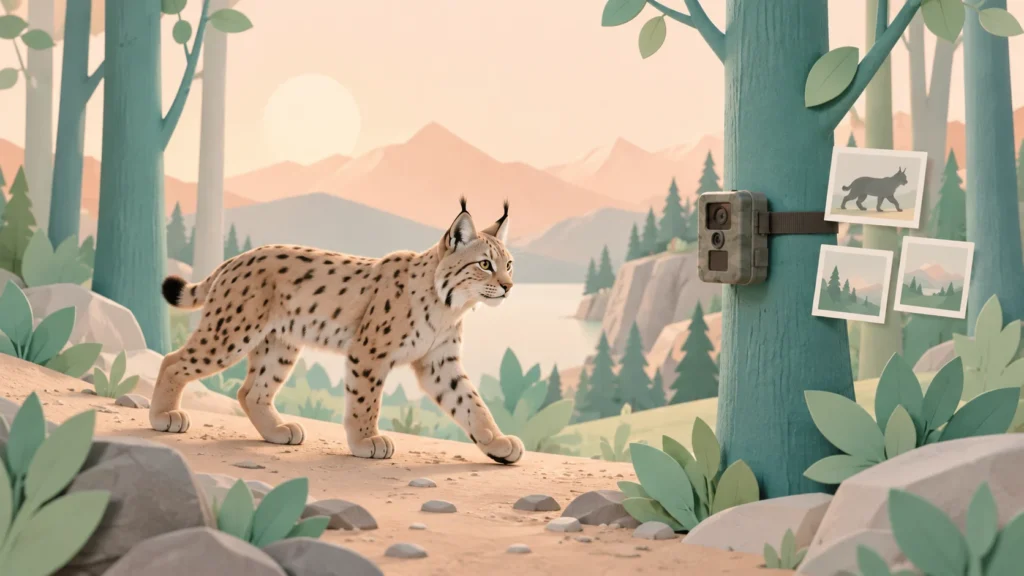
A camera strapped to a tree can spend days photographing moving leaves before a wild cat crosses its view. When several cameras work for months, the interesting pictures arrive inside a much larger collection of empty frames, familiar animals and difficult fragments.
Someone still has to sort them. Artificial intelligence can help with that first pass, giving researchers a way to spend more time on the images that need attention.
Finding an animal before naming it
Wildlife Insights uses machine learning to help identify wildlife in camera-trap photographs. The practical task begins with distinguishing images that contain animals from those that do not, then suggesting what appears in them.
Those are separate questions. A system might correctly notice an animal but give it the wrong species label. It might also miss an animal whose tail is the only part visible at the edge of the frame. A useful review process has to allow for both kinds of error.
Imagine a folder with thousands of pictures and a small number of possible wild-cat sightings. A suggested label can bring the relevant candidates together. It has not yet established that each one belongs in a scientific record of that species.
Why a confident label can still be wrong
The platform’s explanation of its AI describes how performance depends on the training material available for different species. Images that are distant, blurred, partly obscured or poorly lit make identification harder. Similar-looking species create additional difficulties.
A confidence score expresses the model’s assessment within its system. It is not a guarantee that the image is correctly labelled. Treating a high score as unquestionable would be especially risky when a result falls outside the expected range of a species.
Consider a hypothetical rare-cat label on a small, grainy shape. A reviewer might inspect the original image, the photographs immediately before and after it, and the location. A clearer frame in the same sequence could settle the question. If it cannot be settled, retaining uncertainty is more useful than forcing an exciting answer.
Our article on cats in AI training data explores the importance of the examples a system learns from. Camera traps add a demanding setting: the animals do not face the lens on request, and darkness rarely improves the portrait.
From sorted pictures to conservation evidence
Wildlife Insights’ tools bring uploading, identification, visualisation and data export into the same workflow. Human review remains part of making the resulting records useful. Corrected identifications can also contribute to improving the system as it is developed.
Even a correctly identified photograph has a limited meaning. It documents an animal in view of that camera at that time. Ten images could show one animal lingering or several animals passing separately. Counting photographs therefore requires different reasoning from counting individual cats.
Placement matters as well. A camera overlooking a path samples that path, not every part of the surrounding habitat equally. These are questions about how observations were collected, and no automatic label removes them.
For readers, a useful habit is to look for the step between an impressive image and a population claim. Who checked the identification? How were repeated visits handled? What area did the cameras actually cover?
The most valuable result may be unglamorous: fewer hours spent sorting blank frames, more time available to examine uncertain records, and a clearer route from a photograph in the woods to evidence that conservation teams can use.