
 English
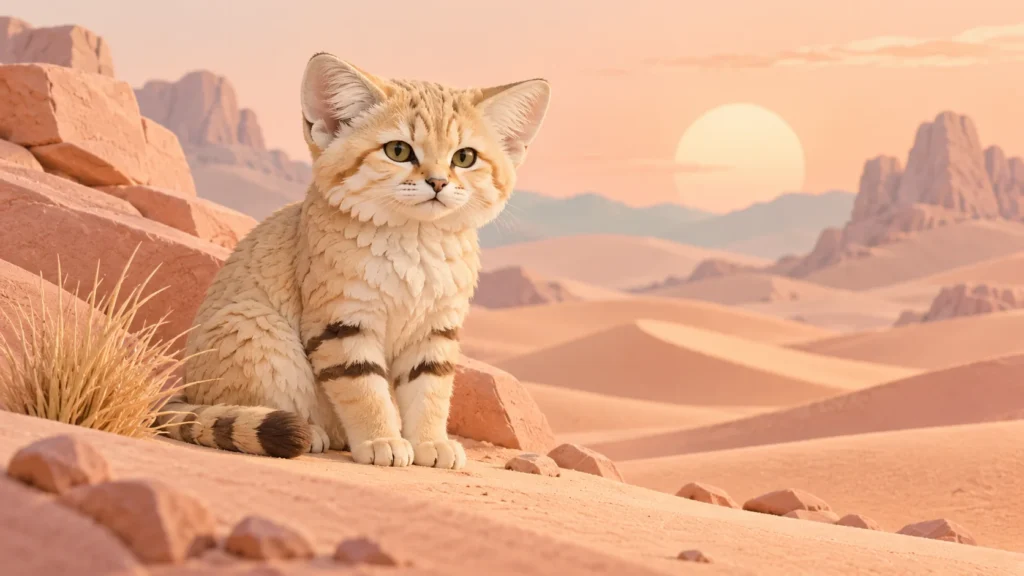
A sand cat can look like a domestic kitten assembled with unusually generous ears. The resemblance lasts until you consider where it lives.
Felis margarita occupies desert regions of Africa and Asia, where shelter, prey and usable water can be widely separated. Its size is familiar. The demands placed on that small body are much less like those of a cat waiting beside a kitchen cupboard.
Look at the ears before the expression
The Smithsonian's species account describes a broad head, low-set ears and short limbs. Its pale coat fits dry ground, while darker markings break up the face, legs and tail. Those features are more useful for identification than an impression of permanent cuteness.
The ears are particularly important to its hunting. The Smithsonian describes sand cats listening for prey moving underground and digging to reach it. A patch of ground that looks empty to a human observer may contain information an attentive predator can use.
That changes the meaning of a photograph. The animal looking still may be doing something much more specific than posing. Even in an illustrated portrait, giving those ears their proper shape matters more than enlarging the eyes.
A desert includes somewhere to hide
The same account describes burrows as shelter from extreme temperatures and places most activity around dusk and night. Desert survival includes avoiding exposure, not simply tolerating whatever the midday sun delivers.
It is easy to imagine a desert as uninterrupted dunes, but habitat includes different ground conditions and places that can be excavated. A small predator needs somewhere to spend the hours when hunting would be costly or dangerous.
This is also a useful corrective to the idea of a wild cat as a tireless machine. Resting out of the weather is part of its life. The shelter is as relevant to the story as the hunt.
Photographs can flatten the scale of a landscape. When looking at an image of a sand cat, include the burrow entrance, ground surface and available shade in your attention. Those details help turn an isolated portrait into a picture of an animal living somewhere.
For children, comparing that scene with a domestic cat's resting spot can start a conversation about shelter without pretending the two animals need the same home.
Water still enters the picture
Sand cats can obtain moisture from prey and go substantial periods without drinking. That should not be shortened to the claim that they need no water. Water contained in food still counts, and an adaptation to a particular environment is not a general care instruction.
Their diet and habitat belong together. A desert animal's physiology does not turn it into an easy pet for somebody who happens to live somewhere hot.
Our profile of the Pallas's cat, or manul, describes another wild feline whose familiar outline can conceal a highly specialised life. The two animals invite the same first reaction from viewers, but their environments ask different things of them.
A useful way to enjoy a sand-cat photograph is to stay with the details after the initial delight: ears held low and wide, a compact body close to the ground, and surroundings that contain far more than their apparent emptiness suggests.