 English
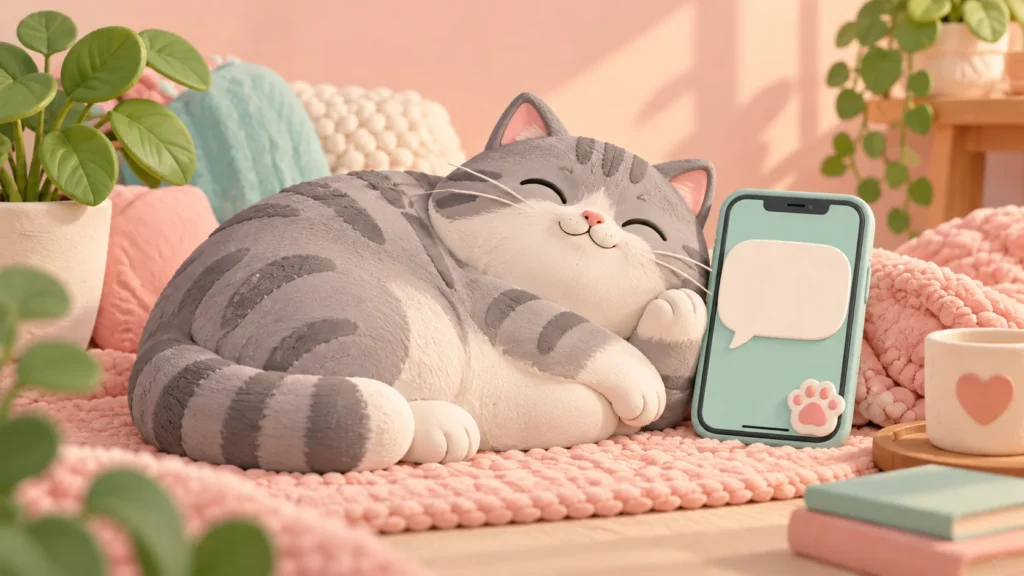
Someone asks how your day is going. You could explain. Or you could send a small grey cat lying down.
Pusheen works particularly well in that gap between having something to express and wanting to compose a sentence. The character arrives with a recognisable mood, while leaving the sender room to decide how seriously it should be taken.
From comic to conversation
According to the official history, Claire Belton created Pusheen in a short online comic series written with Andrew Duff in 2010. The project developed into a Tumblr blog sharing comics and animated GIFs.
In 2013, the book I Am Pusheen the Cat appeared, and Pusheen joined Facebook's newly launched chat stickers. That change of setting matters as much as the move from one website to another.
A comic is something you read. A sticker is something you use while talking to somebody else. It can answer a message, soften an awkward pause or acknowledge that you have run out of words.
A small drawing has to work quickly
Pusheen's rounded shape and limited details make the character easy to recognise at chat-window size. The expressive work falls on pose, movement and whatever the cat is doing.
That leaves very little time for exposition. A sticker has to communicate before the reader scrolls past it. Eating, resting or looking pleased are legible activities even when the viewer knows nothing about a character's wider cast or history.
The simplification also makes room for projection. The sender is not necessarily declaring that they are a cartoon cat. They are borrowing one small action to describe their own state.
Repetition becomes familiarity
Using the same character across many conversations builds a kind of shared vocabulary. A friend may recognise your usual exhausted-cat reply before thinking about its original creator.
This is a different route through internet cat culture from the photograph that becomes a meme after strangers add captions. Pusheen begins as an authored character, then enters everyday exchanges through a collection of repeatable expressions.
The commercial world around the character is now extensive, but the smallest use remains easy to understand. A sticker has to earn its place in a particular conversation.
A sticker also leaves space for the recipient to answer in the same visual language. One image can invite another without requiring either person to produce a carefully worded message. That suits quick, affectionate exchanges between people who already understand the relationship.
The limitation is just as interesting. A sticker that feels warm between friends may feel unclear in a serious conversation. Pusheen can suggest a mood, but the surrounding exchange determines how that mood will be read. The character's flexibility depends partly on what the humans have already said to each other.
The message is also in the choice
Try reading a chat exchange with the sticker removed. Does the remaining text become colder, more abrupt or strangely unfinished?
That missing effect is part of Pusheen's usefulness. The image can carry affection, silliness or fatigue without spelling it out. A grey cat taking a break becomes a way for one person to tell another that they could use one too.