 English
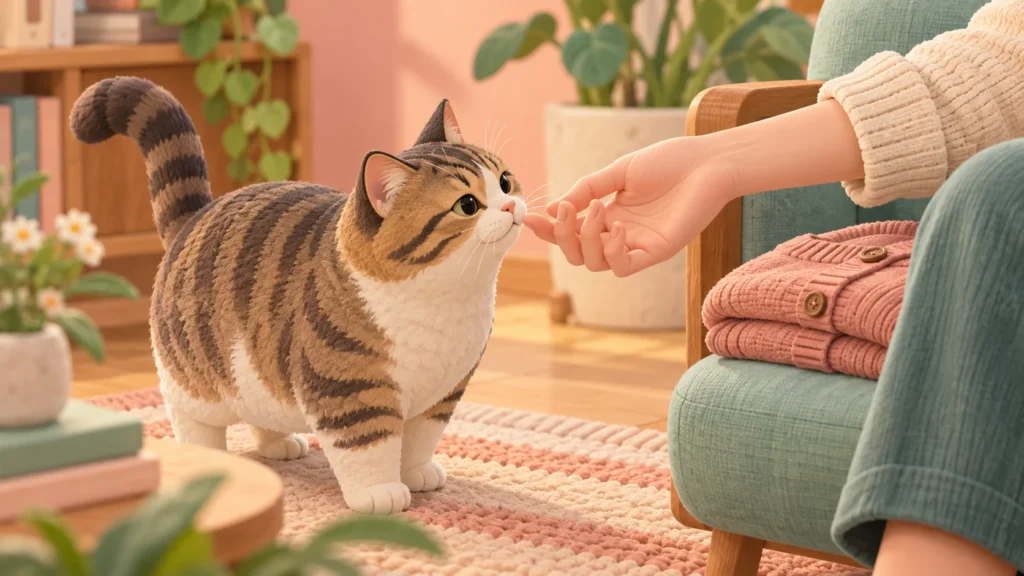
You hold out a hand and your cat pauses to investigate. To you, the greeting may feel visual: you are standing right there. The cat has another source of information close to its nose.
A 2025 study by Yutaro Miyairi and colleagues asked whether domestic cats respond differently to the scent of a familiar person and an unfamiliar one.
Three samples, one small choice
Thirty cats were presented with samples carrying their owner's odour, an unfamiliar person's odour and a blank control. The researchers recorded how the animals investigated them.
The cats spent longer sniffing unfamiliar human odour than their owners' odour. That difference supports the idea that scent helps them distinguish familiar from unfamiliar people.
The researchers also observed differences in nostril use during investigation. Those observations are interesting, but they do not turn an ordinary sniff into a simple code an owner can read at home.
Familiarity is a specific result
Recognising that something is familiar and identifying exactly who it belongs to are related questions, but they require different evidence.
Imagine being shown a handwriting sample. You might know that it looks familiar before you could confidently name the writer. The analogy is imperfect, yet it helps show why researchers separate levels of recognition.
The study's authors say that identifying a specific person from scent needs further investigation. A headline suggesting cats can name any human by smell would go beyond the result.
A longer sniff is not a popularity vote
The unfamiliar sample received more investigation. That does not mean the cats preferred strangers or cared less about their owners.
Novel information often needs examining. A shorter response to something already familiar can be compatible with recognition. The duration of one behaviour is a poor substitute for a complete account of a relationship.
For the same reason, do not use a cat's sniffing time as a test of affection. At home, the animal is responding to a changing mixture of smells and circumstances rather than a controlled set of samples.
Consider what a person brings home after a journey: a coat that has been elsewhere, shoes from outside and perhaps contact with another animal. The person is familiar, but the exact scent mixture need not be identical from one encounter to the next.
That makes an ordinary greeting a poor controlled test. A cat spending longer over a sleeve on Tuesday than on Monday has not provided a clean measure of recognition. The difference may be interesting to observe, but explaining it requires more than the stopwatch and a hopeful interpretation of the result.
Smell changes how we read a greeting
Our article on the flehmen response looks at another conspicuous part of feline scent investigation. The owner-odour study asks a different question: what information might a human smell provide?
The useful everyday lesson is modest. Give the cat time to investigate instead of immediately moving your hand towards its head. A familiar person can still arrive carrying unfamiliar scents from work, another animal or the journey home.
The research does not translate the greeting into words. It makes the pause before contact look a little less empty.