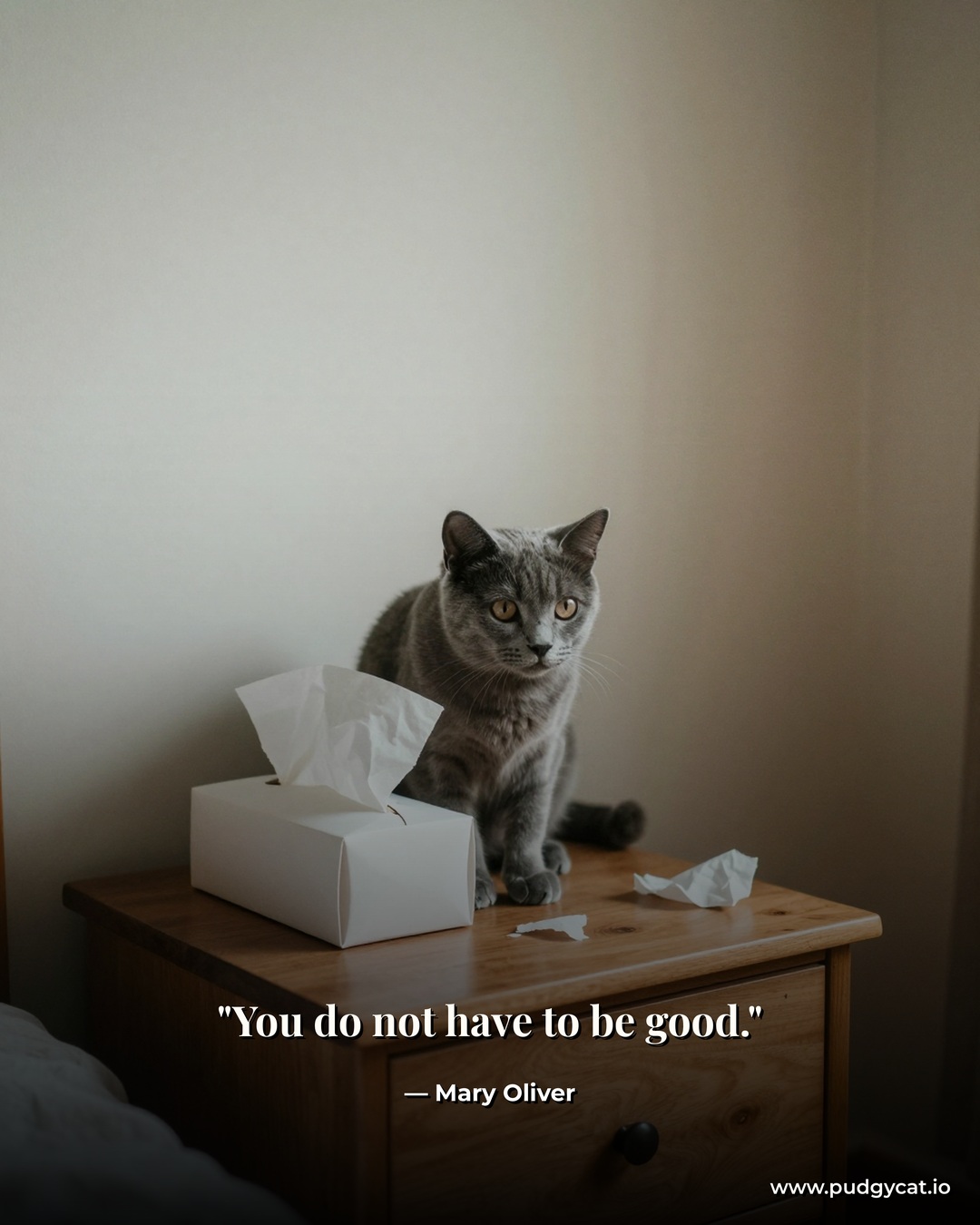
You do not have to be good.
Mary Oliver
Source, Wild Geese, 1986
Why This Quote Matters
Mary Oliver opened Wild Geese in 1986 with this sentence, and then published it in Dream Work that year. She had grown up in a difficult house in Ohio and spent most of her adult life in Provincetown, walking in the woods, paying attention. The poem became so widely read that the first line is often cited by people who have never finished the rest of it. That is unfortunate, because the rest of it is the load-bearing part.
Oliver is not giving permission to behave badly. She is dismantling the specific exhaustion of people who have been told, implicitly and explicitly, that they must earn their right to exist through virtue. You do not have to be good, she writes, meaning: your existence is not a performance review. The pressure to be worthy has already cost you more than it could ever return. The world, she adds later in the poem, offers itself to your imagination regardless.
A small grey kitten that has just folded itself into an empty tissue box with no achievement, no purpose, and no audience is enacting this. The kitten has not earned the box. The box does not require a credential. The fit is the whole moral. Most of us have been told, at some point, to earn the right to rest. Oliver and the kitten agree. The rest is not a reward. It was always already yours.
🐾 Visit the Pudgy Cat Shop for prints and cat-approved goodies, or find our illustrated books on Amazon.
More Cat Wisdom