The Dutch angle in film is the moment a camera tilts sideways and the entire world inside the frame starts to feel wrong. Walls lean, characters slide toward the edge of the screen, and your stomach quietly informs you that something bad is about to happen. No dialogue needed. Just a few degrees of rotation can make an ordinary room feel suspicious.
This guide unpacks the Dutch angle in film from every direction. Where it came from, how it changes a composition, where it appears, what it can communicate, and how to use it without looking like you just discovered the rotate tool in DaVinci Resolve. The cat is supervising.
Table of Contents
- What Is a Dutch Angle in Film
- Where the Name Comes From
- What the Tilt Does to a Scene
- A Short History of the Tilted Frame
- Famous Dutch Angles in Cinema
- How to Use the Dutch Angle Without Embarrassing Yourself
- Common Mistakes Filmmakers Make With Dutch Angles
- The Dutch Angle in TV and Streaming
- FAQ
What Is a Dutch Angle in Film
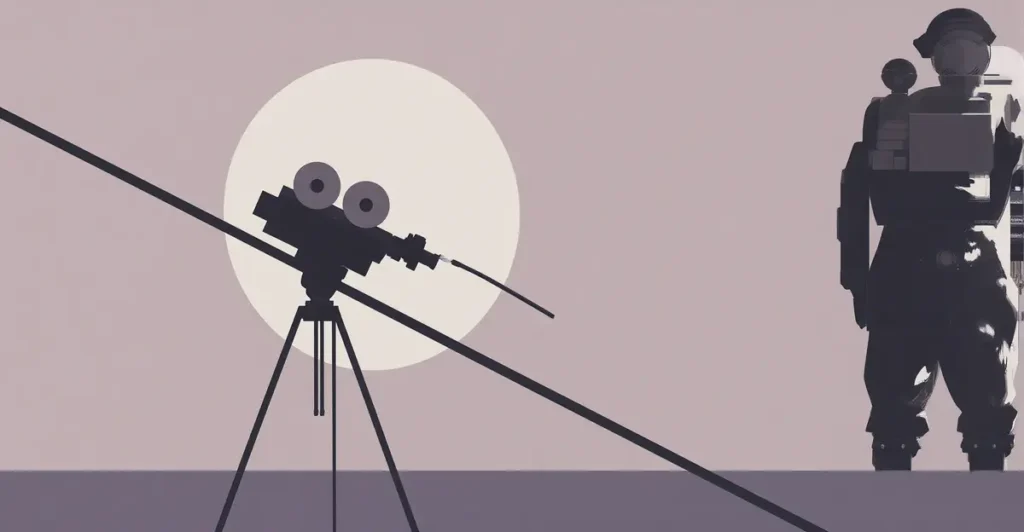
A Dutch angle in film is a shot where the camera is tilted on its roll axis, so the horizon line in the frame is not parallel to the bottom of the screen. Sometimes you also see it called a Dutch tilt, a canted angle, or an oblique angle. The horizon goes diagonal. Vertical lines lean. The whole composition feels like it slipped off a shelf.
The tilt can be subtle, three or four degrees, just enough that the viewer feels uneasy without knowing exactly why. It can also be aggressive, twenty or thirty degrees, where the effect becomes openly stylized. Both are valid choices. The effect can be uneasy, energetic, comic, or simply conspicuously stylized, depending on the scene.
Cinematographers reach for it when a character is losing their grip, when a space is supernatural, when a power dynamic is broken, or when a stable wide shot would simply be too calm. It is one of the cheapest, most readable visual tools in the language of film, which is precisely why so many directors overuse it.
Where the Name Comes From
A common explanation connects “Dutch” with Deutsch, the German word for “German,” and with the influence of German Expressionist cinema. Nashville Film Institute’s overview presents this as a suggested origin. It is best treated as the familiar explanation rather than a documented moment when one translator changed the name. “Canted angle” describes the technique without the nationality puzzle.
It is also worth separating a Dutch tilt from an ordinary camera tilt. Pitching the camera up or down changes where it looks vertically. Rolling it turns the frame sideways around the viewing axis. You can combine those movements, or hold a canted composition perfectly still. A Dutch angle does not require the camera to roll during the shot.
What the Tilt Does to a Scene
A level frame supplies familiar horizontal and vertical references. Canting it puts those lines into tension with the edges of the screen. That change can make a space seem unstable, especially when it interrupts otherwise level coverage. Columbia’s Film Language Glossary describes imbalance, transition, and instability among its usual suggestions. Those are expressive possibilities, not an automatic bodily reaction shared by every viewer.
The effect works with performance, sound, movement, lighting, and the surrounding shots. A slanted hallway in a thriller may feel threatening; a similarly tilted frame in a playful sequence may feel exuberant. A diagonal can lead the eye, interrupt a pattern, or make a character seem at odds with the space around them. Watch the whole sequence to see how those choices build the mood.
Context Gives the Angle Meaning
A villain framed at a heavy angle can seem threatening, but the same angle can make someone look ridiculous or overwhelmed. A conversation at fifteen degrees might suggest a sinking ship, or a comedy delighted with its own exaggeration. The angle contributes to the meaning; it does not stamp “danger” on the image regardless of everything else.
A Short History of the Tilted Frame
German Expressionist films are an important visual reference for distorted cinematic worlds. The Cabinet of Dr. Caligari (1920) is famous for its crooked, stylized scenery. But a sloping wall within a set is not by itself evidence that the camera has rolled. Set design and canted framing can support similar moods through different means. Keeping that distinction clear helps when studying the technique rather than just collecting pictures with diagonals.
Film noir made especially memorable use of unsettled compositions. In The Third Man (1949), director Carol Reed and cinematographer Robert Krasker make postwar Vienna feel precarious through framing, lighting, and location together. The BFI’s account of the film’s visual world places its Dutch angles alongside shadows, wet streets, and damaged buildings. The city is doing part of the acting before anyone speaks.
Later films used canted framing for suspense, psychological disturbance, comic-book energy, and outright comedy. It does not belong exclusively to horror, and it did not wait for streaming television to reach the small screen. Its history is less a march toward one correct meaning than a growing collection of ways to make a rectangle misbehave.
Famous Dutch Angles in Cinema
These examples offer different reasons to study a tilted frame:
- The Third Man (1949). Notice how the canted compositions work with Vienna’s architecture and the film’s shadows, rather than supplying the atmosphere alone.
- The Conformist (1970). Columbia’s glossary uses a clip from Bernardo Bertolucci’s film to illustrate the canted angle. It is a useful example to compare with the surrounding framing.
- Mission: Impossible (1996). Nashville Film Institute examines the restaurant conversation between Hunt and Kittridge, where the framing helps turn an exchange of information into a loss of trust.
- Batman, the 1960s television series. Its conspicuously tilted villain scenes show that the technique can be playful and theatrical as well as unsettling.
For another visual choice that changes how a story feels, see our discussion of Spider-Noir’s black-and-white and color versions. Framing and color are different tools, but both work best as part of a coherent approach to the scene.
How to Use the Dutch Angle Without Embarrassing Yourself
A useful starting exercise is to treat the Dutch angle as punctuation: establish a level composition, then introduce the cant when the scene changes. That makes the contrast easy to evaluate. It is an exercise, not a law. A film can also choose sustained angularity as part of its style, provided the compositions remain purposeful and readable.
Pair It With Story Logic
Ask what the slant adds. A revelation may justify a sudden change of balance; a haunted room may feel wrong before a character notices why. Even a sip of coffee could become funny if the scene is deliberately overdramatic. But if you cannot explain what the angle contributes, shoot a level version too. The cat would like both options before approving the edit.
Choose Your Degree Carefully
There is no standard number of degrees for unease, comedy, or chaos. A small roll can be conspicuous beside a clear horizon and almost disappear in a frame without strong reference lines. Compare several versions of the actual composition. Check the actor’s position, the lines behind them, and the shot before and after it. A protractor can measure the choice; it cannot tell you whether the scene works.
Common Mistakes Filmmakers Make With Dutch Angles
The Dutch angle is one of the most abused tools in indie filmmaking, music videos, and superhero franchises from the early 2000s. The same mistakes show up again and again.
- Using it as a default look. If every shot is canted, the angle becomes part of the baseline style. Repeated canting can reduce the contrast with other shots; there is no fixed thirty-second expiration timer.
- Mixing tilt directions randomly. Cutting from a left tilt to a right tilt without intention feels chaotic in a bad way.
- Forgetting about head room. Tilted frames cut off heads and feet in ways flat frames do not. Re-block your shot.
- Tilting in dialogue scenes that do not need it. An angle alone does not make an ordinary grocery-list conversation profound; it needs a purpose within the scene.
- Mistaking style for substance. The tilt does not fix bad writing. It just makes bad writing look slanted.
You do not need a list of directors who supposedly never tilt to appreciate restraint. Try comparing a level frame with a canted one while leaving the lens, action, and lighting unchanged. Then examine the cut between them. The question is whether the choice helps this sequence, not whether the director has earned membership in the Society of Perfectly Horizontal Pictures.
The Dutch Angle in TV and Streaming
Television was using Dutch angles long before prestige cable. The 1960s Batman series is a conspicuous counterexample: its tilted villain scenes became a recognizable part of the show’s playful visual language. The device can appear in a comedy, soap, thriller, or music program; the delivery platform does not determine what the camera is allowed to do.
When discussing a modern series, distinguish canted framing from other ways of making a shot feel unusual. Extreme headroom, placing a character near the bottom edge, or leaving space on the “wrong” side of a face can all feel disorienting while the frame remains level. Naming the exact choice makes it easier to understand the scene, rather than calling every unsettling composition a Dutch angle.
Keeping a Visual Language Coherent
A series with multiple directors and cinematographers may establish shared visual conventions, but it need not use one unchanging rule for every episode. Consistency can include planned exceptions: a dream, a shift in viewpoint, or a moment of rupture. The useful question is whether the departure makes sense in the show’s language. A tilt is a sentence in that language, not the whole dictionary.
FAQ
What is the Dutch angle in film, in one sentence?
It is a shot where the camera is tilted on its roll axis so the horizon is diagonal, used to signal unease, instability, or distorted reality.
Why is it called Dutch if it came from Germany?
A common account links “Dutch” to a confusion with the German word Deutsch and the technique’s association with German Expressionism. The exact naming story is less firmly documented than the familiar explanation suggests.
What degree of tilt counts as a Dutch angle?
There is no universal minimum angle. A Dutch angle is deliberately canted framing, and how noticeable it looks depends on the lines and action within the image. Degree ranges are possible choices, not a definition.
Is the Dutch angle overused in modern cinema?
It can be, but repetition alone does not settle the question. A sustained stylized look may be intentional; an isolated tilt may still be unmotivated. Judge how the framing supports the scene rather than counting the angles.
Can the Dutch angle be used in comedy?
Yes. Exaggerated imbalance can be playful, absurd, or part of a comic-book style. The scene’s performance, timing, and visual context help determine whether the tilt feels funny rather than threatening.
Conclusion
A Dutch angle changes the balance of a frame with a simple roll. That can suggest unease, add energy, or invite a joke, but it does not bypass the rest of filmmaking and directly press an anxiety button. Study the composition, test the cut, and let the scene justify the choice. The cat suggests saving the most dramatic lean for something more consequential than an empty food bowl. The cat is, of course, lying.