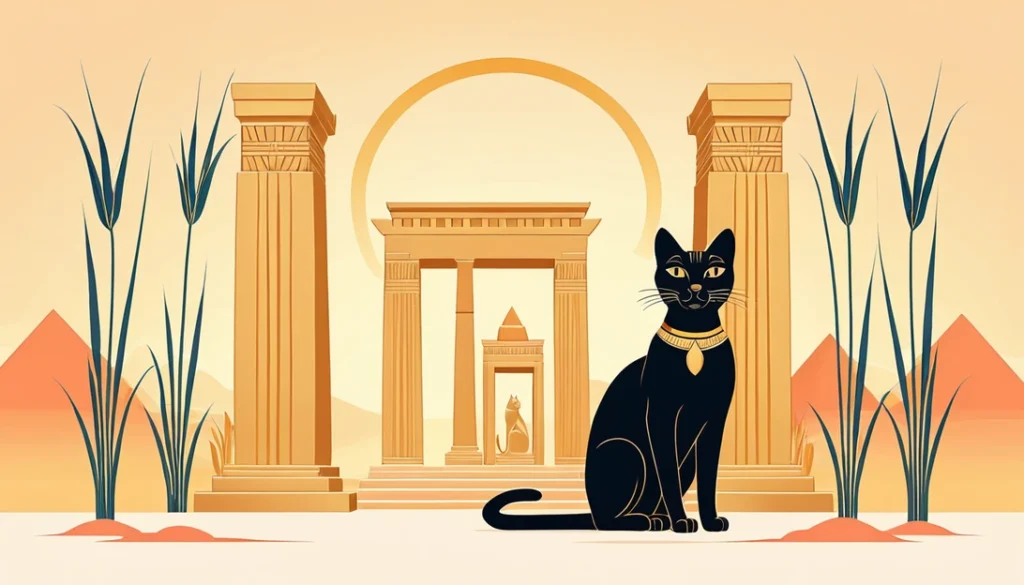
Around 60 BC, a member of a Roman delegation in Egypt killed a cat. Probably by accident. A crowd found his house, and neither the officials the king sent to beg for his life nor the general terror of Rome saved him. The Greek historian Diodorus Siculus wrote the scene down and added that he had watched it happen. It is one of the most memorable stories about cats in ancient Egypt, and it is easy to turn it into a much tidier rule than the evidence allows.
The real history is stranger than the meme version. A close relationship between people and cats long predates the best-known Egyptian cat cults, but the origins of domestication remain a research question. The famous death penalty comes through Greek accounts, rather than a surviving Egyptian statute. And many mummified cats were religious offerings, not pets whose owners had commissioned one final portrait.
Table of Contents
- Cats and People Before the Famous Egyptian Cults
- Bastet Was a Lioness Before She Was a Cat
- Greek Accounts of Fatal Punishment
- The Cat Mummy Industry Was About Offerings
- 180,000 Cat Mummies Went to Liverpool as Fertilizer
- How Cats in Ancient Egypt Ended Up Everywhere Else
- What Egypt Actually Gave the Cat
- Frequently Asked Questions
Cats and People Before the Famous Egyptian Cults
In 2004, a French team led by Jean-Denis Vigne published a find from Shillourokambos, a Neolithic site in southern Cyprus, in the journal Science. In a grave roughly 9,500 years old, an eight-month-old cat lay about 40 centimetres from a human burial, at the same depth, in the same sediment, skeleton still articulated. Somebody put it there on purpose.
The detail that matters: cats were introduced to Cyprus by people. Bringing a cat across the water and deliberately burying it near a human shows an early relationship, but it does not establish the animal as a member of the fully domesticated population we know today. Taming an individual and domesticating a species are different things. Egypt’s later religious imagery is one chapter in a much longer story, not a timestamp for the first friendly encounter.
Bastet Was a Lioness Before She Was a Cat
The goddess now sold on a million fridge magnets as a slim bronze housecat did not start out that way. Bastet had earlier leonine forms, while the familiar domestic-cat image became prominent in the first millennium BC. UCL’s account of Bubastis places that imagery in its historical setting. The change is a history of religious representation; it is not a diagram of cats becoming tame. Even the goddess on the souvenir shelf has a complicated back catalogue.
Per-Bast, the City Built for a Cat Goddess
Her cult city was Per-Bast, “House of Bastet,” known to the Greeks as Bubastis and now as Tell Basta near Zagazig. The Egyptian antiquities ministry’s site history records Naville’s excavations in 1887–89. The sanctuary had a long building history, with important additions under the 22nd Dynasty. Osorkon II was a major contributor, not the beginning and end of the temple. The cat goddess received the architectural attention that comes with royal favour.
What Herodotus Saw at the Festival
Herodotus visited in the fifth century BC and left a description in Book II of the Histories that reads like a travel writer who cannot quite believe his own notes. The temple, he says, is “very well worthy of mention, for though there are other temples which are larger and built with more cost, none more than this is a pleasure to the eyes.” Two channels ran in from the Nile, each about a hundred feet wide and shaded with trees, wrapping the building so completely that only the entrance stayed dry. The city around it had been banked up over centuries, so worshippers looked down into the sanctuary from every side.
The annual festival was not a quiet affair. Pilgrims arrived by boat, women shaking rattles, men playing flutes, everyone singing and clapping, stopping at each riverside town so the women could shout mockery at the local women and lift their skirts at them. At Bubastis, Herodotus writes, “more wine of grapes is consumed upon that festival than during the whole of the rest of the year.” Attendance ran to “seventy myriads of men and women, besides children”, which is 700,000, reported by a Greek tourist quoting locals, so treat it as a mood rather than a census. For a sense of how strange ancient ritual could get, the Roman well in Frankfurt with a skeleton and a bronze goddess at the bottom is a useful companion piece.
Greek Accounts of Fatal Punishment
Here is the careful version, because this is where the internet goes feral. No Egyptian legal text survives that says “kill a cat, die”. What survives is Greek testimony about Egyptian practice, from two writers separated by four centuries.
In Book II, chapter 65, Herodotus reports death for deliberately killing a sacred animal and a priestly penalty for accidental killing. He singles out the ibis and hawk as exceptions for which intention makes no difference. Cats are not named in that exceptional category in his account.
Diodorus Siculus gives a different account in Book I, chapter 83. He includes cats and ibises among animals whose killers face death even after an accident, and describes crowds sometimes acting before a trial. The difference between the writers is worth noticing. It does not, by itself, document the date of a change in Egyptian law.
A crowd’s violence and a legal procedure are not the same thing. Diodorus discusses both punishment and the public reaction; his anecdote is not a recovered statute. He also describes people loudly insisting that an animal was already dead when they found it. In his telling, merely being nearby could require an immediate explanation.
The Roman Who Died for a Cat
The famous incident sits in the same chapter. Diodorus places it in the years before Ptolemy XII was granted the title of “friend” by Rome, which puts it shortly before 59 BC. Egypt was courting an Italian embassy and desperate to avoid giving Rome any pretext for war. One of the Romans killed a cat. The crowd went to his house. The king sent officials to plead for the man and it made no difference, the fear of Rome made no difference, and the fact that his act had been an accident changed nothing.
Diodorus explicitly presents the incident as something he witnessed, rather than heard about. That makes it a striking ancient testimony, though eyewitness status does not turn an account into a transcript or a law code. The story is strong enough without pretending it settles every question about Egyptian justice. For another example of the work involved in interpreting traces from the past, see the Roman shipwreck’s reconstructed service history.
The Cat Mummy Industry Was About Offerings
Herodotus gives the version everyone likes. When a cat died naturally in a house, the household shaved their eyebrows in mourning, and only their eyebrows. For a dog they shaved the entire body including the head. The dead cats went to sacred buildings at Bubastis to be embalmed and buried. He also claims that during a fire, Egyptians stood in a cordon watching the cats instead of fighting the flames, and the cats leapt over the line and threw themselves in. File that under things Herodotus was told.
Votive animal mummification was a large religious enterprise, especially from the Late Period through the Ptolemaic and Roman periods. It did not begin neatly in 332 BC or stop in 30 BC. Pilgrims could obtain mummified animals as offerings associated with a deity; the comparison with buying a candle at a shrine is useful, if rather alarming from the cat’s perspective. Other animal burials had different purposes, including pets and sacred animals cared for in life.
What the Scans Show
In a 2020 study, researchers at Swansea University used 3D micro-CT to digitally unwrap animal mummies without opening them, including a kitten under five months old. The neck vertebrae were separated, consistent with the animal being strangled or having its neck snapped, though the team noted the separation could also have come from embalmers forcing the head upright during wrapping.
Young animals occur frequently among studied votive cats, and evidence of deliberate killing is part of the story. But the samples do not justify calling every cat mummy a two-to-four-month-old kitten or explaining the ages simply by how neatly they fitted a package. The outward shape can conceal a complete animal, partial remains, or other materials. That variation needs interpretation: the absence of a whole skeleton does not, on its own, prove a fraudulent transaction at a temple gate.
Discoveries also show the variety of the material. In November 2019, the antiquities ministry announced a Saqqara cache including 25 chests containing cat mummies and 75 wooden and bronze cat statues. Several large feline mummies were examined; the announcement described possible lion cubs and said further studies were needed to confirm the identifications. The distinction matters: a group of large wrapped cats is not automatically five confirmed lions.
180,000 Cat Mummies Went to Liverpool as Fertilizer
The cemetery at Beni Hasan became a particularly grim example of the trade in ancient remains. Large quantities of mummified animals were removed in the late nineteenth century. Whatever their original religious role, the overseas market could treat them as bulk material. A label that once meant an offering could become a line on a cargo invoice.
In 1890, about 19.5 tons of cat mummies were shipped to Liverpool for fertiliser, as Liverpool’s museum and university account records. A contemporary report reproduced by the Museum of Freemasonry gave the memorable estimate of 180,000 cats. That number belongs to the historical reporting, rather than a modern count of intact specimens. Some examples escaped destruction and survive in museum collections.
It is the bleakest joke in the subject. One civilisation executed people for killing a single cat. Another bought a hundred and eighty thousand of them by the ton. Archaeology has since gotten better at recognising what it is holding, as with the hundred game boards Polish archaeologists identified in a fallen Greek city in Libya, but that came far too late for Beni Hasan.
How Cats in Ancient Egypt Ended Up Everywhere Else
In 2017, Claudio Ottoni and colleagues published a study of ancient cat DNA proposing contributions from Near Eastern and Egyptian populations at different times. It was an important attempt to reconstruct dispersal from genetic traces, but it should not be read as the last word on every route or the birthplace of domestication.
A 2025 genomic study described by LMU revised the European part of that picture. It placed the arrival of domestic cats on the European mainland from North Africa around 2,000 years ago, rather than with Neolithic farmers thousands of years earlier. The researchers still identified uncertainties about the early history within North Africa. Egypt is central to the cultural evidence; assigning every ancestor an Egyptian address is another matter.
Trade and rodent control offer a plausible part of the mechanism. Ships and ports provided food opportunities, while people had reasons to tolerate an animal that hunted mice and rats. Not every ancient cat left a genetic itinerary, but maritime connections help explain how populations could spread. Cargo insurance with whiskers is still a useful image, provided we remember it is an image.
What Egypt Actually Gave the Cat
Egypt’s contribution remains enormous without granting it ownership of every stage of the story. Cats acquired powerful religious associations, appeared in household and sacred imagery, and became part of a visual tradition that is still immediately recognisable. A bronze cat made as an offering can look startlingly familiar to someone whose own cat has just taken over the desk.
The contrasts with later European ideas are fascinating, too, but they do not form a simple chain in which one Egyptian belief flips into its opposite. Cats have carried different meanings in different settings. Our history of black-cat superstitions follows some of those later associations.
The cat was not consulted at any stage. It moved into grain stores, killed rodents, accepted worship, endured mass mummification, boarded ships, and ended up asleep on a keyboard four thousand years later. Same animal, same indifference. The most successful negotiating strategy in the history of domestication, and it was to do essentially nothing.
Frequently Asked Questions
Was killing a cat really punishable by death in ancient Egypt?
Greek writers report severe penalties, and Diodorus describes a Roman attacked by a crowd after accidentally killing a cat. These accounts are evidence for beliefs and reported practices, but they are not a surviving Egyptian statute that can simply be applied to every period.
Did the Egyptians domesticate the cat?
The full origin of domestication remains under investigation. The roughly 9,500-year-old Cyprus burial shows a very early human–cat relationship, not conclusive proof that the animal was fully domesticated. More recent genomic work points to North Africa as important in the ancestry and European spread of domestic cats.
Why are so many Egyptian cat mummies kittens?
Many votive cats were young animals, and studies have found evidence consistent with deliberate killing. They were religious offerings rather than simply deceased household pets. Ages and contents vary, so a universal explanation based on convenient package size goes beyond the evidence.
What happened to the cat mummies found at Beni Hasan?
Large quantities were exported from Beni Hasan. About 19.5 tons reached Liverpool in 1890 for use as fertiliser; contemporary reporting estimated 180,000 cats. Some surviving specimens are now in museum collections, but much material was lost.
Where was Bastet worshipped?
Her principal cult centre was Bubastis, the Egyptian Per-Bast, now Tell Basta near Zagazig in the eastern Nile Delta. Its temple developed over many periods, with important 22nd-Dynasty additions. Cat votive deposits are also known elsewhere, including Saqqara.
The Short Version
Cats reached Cyprus with people long before Egypt’s most familiar cat imagery. Bastet’s forms changed, Greek writers described startling punishments, and votive offerings created a vast religious economy around animals. Centuries later, the fertiliser trade destroyed enormous quantities of those remains. The surviving evidence is stranger than a tidy story of a nation worshipping its pets, and much less comfortable. For another encounter with an ancient habit reconstructed from objects, see the 12,000-year-old dice and the history of gambling.