
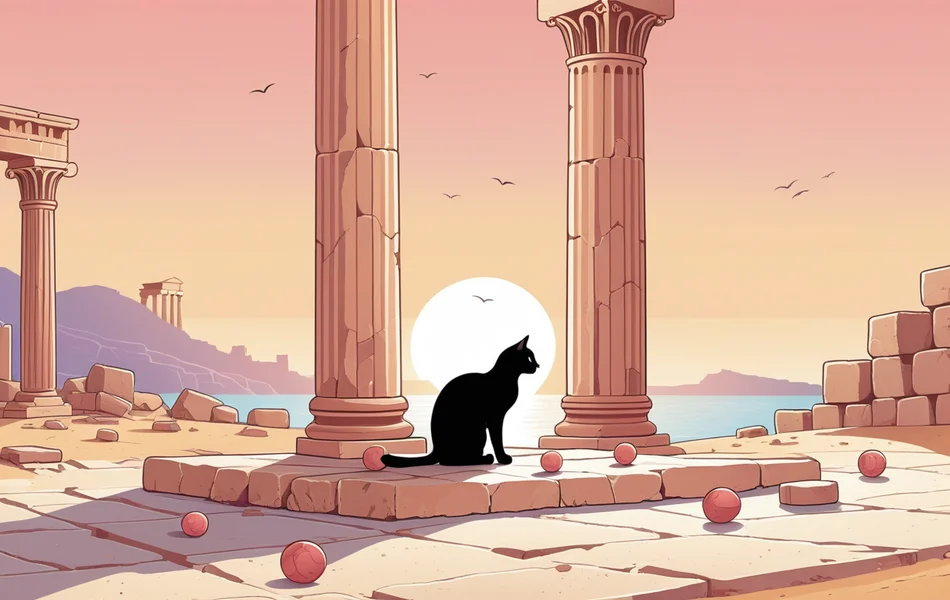
In the ruins of Ptolemais on the Libyan coast, archaeologist Zofia Kowarska has documented more than 100 game boards carved into stone. A former city became a place to sit, keep an eye on animals, and try to beat somebody at a game. The empire falls; someone still has to watch the goats.
The discovery offers a wonderfully ordinary angle on a monumental site. It also comes with a distinction worth keeping: the ancient buildings and the games cut into their ruins do not automatically share a birthday.
A City Becomes a Gaming Surface
Ptolemais lies in Cyrenaica, in northeastern Libya, near modern Tolmeita. The Polish archaeological mission has been investigating much more than games, including the city’s acropolis and underwater remains. An update from Poland’s embassy also describes Kowarska’s archaeological and ethnographic work on the carved boards and their connection with shepherds.
That combination matters. A monument can lose its original purpose without becoming useless to everyone nearby. A block that once belonged to an impressive building can become a seat. Add a playing surface and it becomes somewhere to spend an afternoon. The city stopped being a city and started being furniture.
It is easy to picture two people arguing over a move while occasionally looking up at the herd. That imagined scene is the appeal of the story, not a transcript archaeologists found under a goat.
Small Hollows, Many Possible Moves
In her interview with Science in Poland, Kowarska describes square and rectangular arrangements of small depressions. They include three-by-three layouts and larger grids. Some places contain numerous boards together.
She also reports learning about two surviving games from a local resident: an alignment game resembling tic-tac-toe and a capturing game comparable to checkers. Those comparisons help a reader picture the activity. They do not establish that every carved grid had the same rules, or that a familiar-looking board is simply the modern game transported into the past.
This is where the little hollows become more interesting than they first appear. A board can preserve the places where pieces went while losing the instructions that made those places meaningful. You can see the playing field without knowing every legal move. Anyone who has opened a secondhand board game with half the rulebook missing knows the problem.
The Date Belongs to the Carving, Too
Kowarska says the boards are difficult to date precisely, but their placement on ruined structures indicates a later use of the site. Elevated positions with views over grazing ground help support the shepherd interpretation.
That is a more useful story than assigning the games the full age of the city. An old stone does not make every mark on it equally old. Nor can we arrange the different grid sizes into a neat sequence in which one frustrated player invented a bigger board and launched version 2.0.
“Game design peer-reviewed by goats” remains an excellent description for the imaginary scene. It is less suitable as the label on an archaeological findings table.
Entertainment Does Not Need a Storefront
There is an inviting parallel with small games today: a bounded space, a few agreed rules, and somebody to play against. Calling the shepherds indie developers would stretch a modern label too far, but the comparison catches something recognizable. The pleasure need not depend on spectacular equipment.
There is another version of that appeal in Alfred Butts’s work on the game that became Scrabble: familiar materials can become a whole afternoon once someone gives them rules. The Ptolemais boards do not need to be the oldest anything to invite that recognition.
Archaeology can tell stories about rulers and trade routes, but it can also ask what happened between the grand events. Where did people sit? What did they reuse? How did they pass time together? A game scratched into a convenient surface belongs in that history without having to win a competition for the oldest anything.
The Goats Were Not the Audience
The most appealing part is the shift in attention. We arrive looking for the remains of a great city and notice evidence of a smaller encounter: a place prepared for play.
Imagine the last move, the glance toward the hillside, the disagreement about whose turn came next. Keep the imagined details separate from the carved evidence, and the scene loses none of its warmth. A ruin can be monumental from a distance and wonderfully human when you sit down.