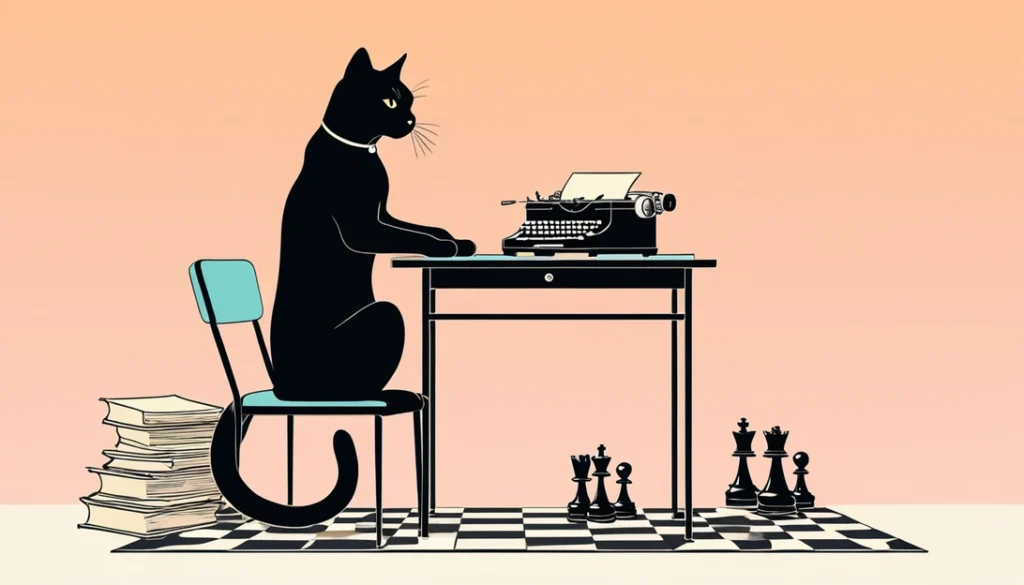
Bulgakov’s Behemoth is a black cat the size of a pig who walks on two legs, attempts to ride a Moscow tram, cheats at chess, drinks neat alcohol, and fires a Browning at people trying to arrest him. He is also a magnificent way to make respectable institutions look ridiculous. A talking cat can turn an ordinary bureaucratic encounter into a scene nobody knows how to report. That is part of the pleasure of Mikhail Bulgakov’s novel about a city full of vanished neighbours, frightened officials, and very inconvenient supernatural visitors.
The book is The Master and Margarita. Bulgakov worked on it from 1928 until his death in 1940. It reached print in no form until 1966, and complete in the Soviet Union only in 1973. The cat outlived the censors and the country that employed them.
What You Will Find Here
- Who Bulgakov’s Behemoth Actually Is
- The Novel Was Written Under Surveillance, Then Burned
- How Satire Worked Under Censorship
- The 1966 Serialisation and the Missing 12 Percent
- Bulgakov’s Behemoth and the Russian Talking Cat Tradition
- The Translations Do Not Agree on What the Book Says
- Where the Cat Ended Up
- Frequently Asked Questions
Who Bulgakov’s Behemoth Actually Is
Behemoth arrives in Moscow with the retinue of Woland, a foreign professor of black magic who is, transparently, the Devil. The novel describes him as a tomcat huge as a hog, black as soot, with the whiskers of a desperate cavalryman. He is the least dignified member of the group and by far the loudest: a scene at the Performance Committee, arson at the Griboedov writers’ house and the Torgsin hard currency store, an assault on Varenukha in a public toilet. He even offers to pay his tram fare like a citizen, which the conductor does not appreciate.
Margarita slaps him at one point with no consequence at all, which tells you where he sits in the hierarchy of hell: near the bottom, as the jester. In chapter 32, when Woland’s crew leaves Moscow and drops the disguises, Behemoth turns out to be a slim youth, a demon page, described as the best jester the world has ever seen. The cat was a costume.
The Name Is a Joke About a Hippopotamus
In Russian, begemot is the ordinary word for hippopotamus, so a Russian reader meets an enormous black cat named, in effect, Hippo. Underneath the joke sits the biblical Behemoth of Job chapter 40, a monster whose identity translators have argued over for centuries, elephant or hippopotamus depending on who you ask. There is a third layer. Behemoth turns up in demonological literature, including Mikhail Orlov’s 1904 History of the Relations Between Man and the Devil, a book Bulgakov used, where the demon is one of those said to have possessed Jeanne des Anges during the Loudun witchcraft trial of 1634 and is drawn with an elephant’s head, trunk and fangs.
Bulgakov took a demon that tradition had painted as a bloated grey monster and made him a cat. That is the whole method of the novel in one gag: take the enormous and the theological, shrink it into something domestic and rude, then watch what people do when they cannot admit what they are looking at.
A Real Grey Cat Called Flyushka
According to the recollection attributed to Lyubov Belozerskaya, Bulgakov’s second wife, the model for Behemoth was the couple’s own pet, a large grey cat named Flyushka. The most quoted demonic cat in Russian letters started as somebody’s overweight housecat who presumably sat on the manuscript.
The Novel Was Written Under Surveillance, Then Burned
Bulgakov began the book in the late 1920s and burned an early draft in 1930, amid devastating restrictions on his work. His plays had been removed from the stage and his livelihood was collapsing. The act belongs to that crisis; it is more complicated than a novelist simply deciding he dislikes a chapter. A story containing Jesus, Pontius Pilate, and Satan was hardly the obvious route back into official favour.
He returned to the novel in the early 1930s and kept revising it for the rest of his life. In his final months he dictated corrections to his third wife, Elena Bulgakova, who then spent decades working to bring it to readers. Woland’s famous declaration that manuscripts do not burn has an especially sharp edge here. Bulgakov had tested the literal claim personally and found it false, which is presumably why he needed the Devil to say it.
The Letter and the Phone Call
On 28 March 1930, Bulgakov wrote to the Soviet government asking for permission to leave or for work in the theatre. The Bulgakov Museum’s account of the letter describes the extraordinary response: Stalin telephoned him on 18 April. The conversation survives through recollections, rather than a recording. Bulgakov expressed doubt that a Russian writer could live away from his homeland, and Stalin promised help with employment. A position at the Moscow Art Theatre followed.
The job did not make the novel publishable. Bulgakov continued working inside Soviet theatrical institutions while developing this book away from a public readership. Patronage and restriction could occupy the same telephone call.
How Satire Worked Under Censorship
Soviet censorship was more than an official crossing out sentences. The Library of Congress exhibition on Soviet archives describes control over publishing decisions, writers’ organisations, and even paper supplies, as well as Glavlit’s censorship work. A fantastic story was not automatically exempt from that machinery. Behemoth did not secure a feline loophole in the regulations.
What fantasy does brilliantly is give readers several things to recognise at once. When Behemoth and Korovyev set Moscow institutions on fire and official explanations collapse, the scene can be both demonic slapstick and a joke about bureaucracy. That is a reading of the satire, rather than proof that officials failed to understand it. The eventual cuts show that this novel was hardly waved through untouched.
It is the trick behind the roman a clef with a different engine: instead of hiding real people behind fake names, Bulgakov hid a real system behind an impossible one. Readers who like the manoeuvre usually also like magical realism versus surrealism, which turns on the same question of what the impossible is asked to carry.
The 1966 Serialisation and the Missing 12 Percent
The book finally appeared in Moskva, in the issues dated November 1966 and January 1967, after the Khrushchev Thaw had ended. About twelve percent was removed. The publication history and account of the cuts records 21 excisions in Book One and 138 in Book Two. Political references, sexual material, and coarse language were among the targets. The cat survived, but the text around him had been through the scissors.
A 12 percent excision does not give you a shorter book, it gives you a different one, and readers noticed the prose lurching.
Samizdat Fixed It With Carbon Paper
Then comes a wonderfully practical response. The Bulgakov Museum’s account of Elena’s typescript describes her typing the deleted fragments, inserting them into the published version, and giving restored copies to friends and acquaintances. The missing passages also circulated in samizdat. Readers could recover what the legal edition had withheld without waiting for an official change of heart.
It was, in modern terms, a literary patch file: the published novel supplied the base text and the missing passages repaired it. Publication abroad was not a single clean leap to a definitive edition, either. The first Paris book edition of 1967 reproduced the censored text; the 1969 Frankfurt edition incorporated the excisions. A Soviet book edition followed in 1973. Later editors still had to work through Bulgakov’s revisions and surviving manuscripts. Getting past censorship and establishing a final text were two different jobs.
The machinery for removing books from circulation has not retired, it has changed venue. The numbers on who is actually filing book challenges today are less romantic than the samizdat era and more organised.
Bulgakov’s Behemoth and the Russian Talking Cat Tradition
A giant articulate cat did not land in Russian literature from nowhere. Folklore already had Kot Bayun, a sorcerer cat whose voice carries across huge distances and induces a sleep indistinguishable from death, after which he kills the sleeper with iron claws. Bayun is a hazard with a nice singing voice. His power cuts both ways: capture him and his stories heal illness.
Pushkin gives us a gentler literary companion: a learned cat walking around an oak on a golden chain, singing in one direction and telling tales in the other. The Pushkin Museum dates that famous prologue to the 1828 edition of Ruslan and Lyudmila, rather than its first publication in 1820. It belongs beside Bayun in this family of storytelling cats, without requiring the two to be exactly the same character.
So when Bulgakov’s Behemoth walks in on two legs and starts talking, the cultural circuit is already wired. The talking cat means storytelling itself, the voice that hypnotises and the voice that heals, dangerous precisely because it is charming. Bulgakov added vodka, a Primus stove and a firearm. The cat is how the reader gets let into a story the official world insists is not happening, a wonderfully disreputable addition to that storytelling family.
The Translations Do Not Agree on What the Book Says
Here is the wrinkle that catches out English speaking readers. Two English translations appeared in 1967, and they are not translations of the same text. Mirra Ginsburg, at Grove Press, worked from the censored Soviet version, so her edition reproduces the holes, including material on the secret police and most of Nikanor Ivanovich’s dream. Michael Glenny, at Harper and Row, had a fuller text and restored those passages.
Later translators worked from fuller texts, with their own editorial choices. A study of the English retranslations includes Diana Burgin and Katherine Tiernan O’Connor in 1995, Richard Pevear and Larissa Volokhonsky with Penguin in 1997, Hugh Aplin in 2008. So a reader picking up a battered second hand paperback may be holding a censored novel with nothing on the cover to say so. It is the rare case where edition history changes the plot.
The narrator of The Master and Margarita is already slippery by design, and the book then arrived in English in versions that disagree about what happened. Our guide to the unreliable narrator and how to spot one covers the deliberate kind.
Where the Cat Ended Up
Glenny’s 1967 translation reached London fast. Marianne Faithfull read it, handed it to Mick Jagger, and talked him through it. In a 2005 interview with Mojo she said plainly that she got Jagger to read the book and that the song came out of their discussions. The song is Sympathy for the Devil, released in 1968, its narrator a courteous Satan present at the century’s atrocities. That is Woland arriving at Patriarch’s Ponds, rerouted through a rock record, and a novel that could not be printed intact in Moscow was on Western radio within two years.
The addresses became shrines. In 1921 Bulgakov lived in a room of a large communal apartment at 10 Bolshaya Sadovaya in Moscow, flat 50, and turned it into the novel’s cursed flat. It is now a museum, established by the Moscow city government on 26 March 2007, and it is not the only Bulgakov museum in that building, which has produced a long running rivalry between two institutions a staircase apart. In Kyiv, where he was born, the family home at 13 Andriyivskyy Descent opened as a museum on 15 May 1991 for his centenary, holding roughly 2,500 objects.
Behemoth is the character who escaped the book entirely: murals, tote bags, tattoos, Russian internet shorthand for unrepentant misbehaviour. Not the Master, not Pilate, not Woland. The cat. One of the best-known novels to emerge from Soviet censorship is now recognisable to millions by a black cat holding a Primus stove, which is what tends to happen to fiction that refuses to behave: the strangest image survives the argument.
The same decades produced the Kuleshov effect, another Soviet discovery that meaning gets assembled in the audience’s head. Censors can cut a shot. They cannot cut the join.
Frequently Asked Questions
Is Behemoth a real cat or a demon?
A demon in cat form. He walks on two legs and talks, and in chapter 32 he sheds the shape and turns out to be a slim demon page, called the best jester in the world. The real world model was Bulgakov’s grey cat Flyushka, according to his second wife Lyubov Belozerskaya.
Why is a cat named after a hippopotamus?
Begemot is the standard Russian word for hippopotamus, so the name is a joke to any Russian speaker. It also points at the biblical Behemoth in Job 40 and at the demon in Mikhail Orlov’s 1904 study, linked there to the 1634 Loudun possession case and drawn with an elephant’s head and trunk.
How much of the novel was censored in 1966?
About twelve percent was removed from the 1966–67 magazine publication. The recorded cuts include political references, sexual material, and coarse language. Deleted passages circulated separately, allowing readers to restore a fuller text.
Which English translation should I read?
Not blind. Mirra Ginsburg’s 1967 version came from the censored Soviet text and reproduces its gaps. Michael Glenny’s, also 1967, restored much of that material. Burgin and O’Connor (1995), Pevear and Volokhonsky (1997) and Hugh Aplin (2008) worked from fuller Russian texts. Check the translator before buying used.
Did Bulgakov really burn the manuscript?
He burned an early draft in 1930 during a crisis in his writing career, then returned to the novel in the early 1930s. He kept revising it until shortly before his death in 1940. Woland’s remark about manuscripts not burning gains much of its bite from that history.
The Cat Won
Bulgakov never saw this novel in print. He burned an early version, rebuilt it, and left Elena the formidable task of bringing it to readers. What survived includes a fat black cat with a pistol and bad manners, still making official dignity look absurd. Publication came with cuts; readers and editors helped recover what had been removed. Political systems are good at deleting arguments. They are worse at deleting a joke people have already memorised. Behemoth is still walking.