Forest bathing sounds like it should involve a tub, a forest, and some questionable life choices. It involves none of those things. It is the practice of spending slow, unhurried time among trees with your senses switched on and your phone switched off, and it has a small but serious pile of research behind it. The Japanese call it shinrin-yoku, which translates to “taking in the forest atmosphere,” and it has been a recognized part of public health policy in Japan since the 1980s. This is not a TikTok invention. It is older than most of the people currently filming themselves doing it.
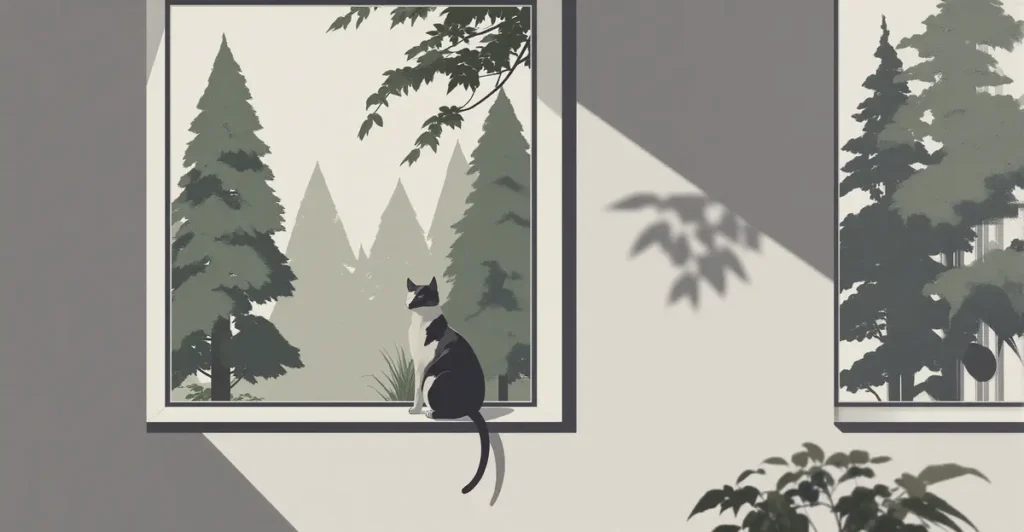
The cat, for the record, has been forest bathing through a window for its entire life and considers the whole thing painfully obvious.
What This Guide Covers
- What Forest Bathing Actually Is
- Where Shinrin-Yoku Came From
- The Science of Forest Bathing
- How to Forest Bathe Properly
- What to Do If You Have No Forest
- Common Mistakes People Make
- What the Cat Knows About All This
- Frequently Asked Questions
What Forest Bathing Actually Is
Forest bathing is the deliberate practice of being present in a natural, tree-heavy environment using all five senses. There is no swimming, no soap, and no required distance. You do not need to hike. In fact, hiking is almost the opposite of the point. A proper forest bathing session can cover a few hundred meters over two hours. The goal is not to get anywhere. The goal is to notice.
You walk slowly. You stop often. You look at how light moves through leaves, you listen to whatever the wind and the birds are doing, you touch bark and moss, you smell the wet-earth-and-pine cocktail that forests produce for free. That is the entire activity. It is so simple that people frequently assume there must be more to it, and there is not. The simplicity is the medicine, which is also why it pairs naturally with the broader case for owning less and protecting your attention.
What separates forest bathing from a normal walk in the woods is intent. A normal walk has a destination, a pace, and usually a podcast. Forest bathing strips all of that out. You are not exercising and you are not commuting through nature on your way to a view. You are simply there, paying attention, the way a cat pays attention to a sunbeam crossing the floor.
Where Shinrin-Yoku Came From
The term shinrin-yoku was coined in 1982 by the Japanese Ministry of Agriculture, Forestry and Fisheries. The timing was not accidental. Japan in the early 1980s was deep into a period of intense urban work culture, long hours, and rising stress, and the government wanted both a public health intervention and a reason for people to value the country’s forests. Forest bathing was the answer to both at once.
What started as a slogan turned into a research program. Over the following decades, Japanese institutions ran controlled studies on what actually happens to the human body in a forest. By the 2000s, the country had designated dozens of official “forest therapy” trails, each one studied to confirm it produced measurable physiological effects. Forest bathing went from marketing phrase to something a doctor might genuinely suggest.
The practice spread west slowly, then quickly. The same hunger for analog, low-stimulation rest that drives interest in the Dutch art of doing nothing and the broader pushback against constant notification overload created a ready audience. Forest bathing arrived with the rare advantage of having actual data behind it.
The Science of Forest Bathing
Here is where forest bathing earns its place above the average wellness fad. The effects are not just “you feel nice because trees are pretty.” Several measurable things appear to happen, and the leading theory points at chemistry, not vibes.
Phytoncides and Your Immune System
Trees release airborne compounds called phytoncides, essentially the chemicals plants use to defend themselves against insects and rot. When humans breathe them in, studies led by researchers like Dr. Qing Li at Nippon Medical School have recorded an increase in natural killer (NK) cell activity, a type of white blood cell involved in fighting infection. In some studies the boost lingered for days after a single forest trip. The sample sizes are modest and the field is young, so treat it as promising rather than proven, but the signal is consistent.
Cortisol, Heart Rate, and Blood Pressure
Multiple studies comparing time in forests versus time in cities have found lower cortisol levels, lower heart rate, and lower blood pressure in the forest group. Cortisol is the body’s main stress hormone, so a measurable drop is meaningful. The nervous system appears to shift toward its “rest and digest” mode when surrounded by greenery, and it does so faster than most people expect, often within fifteen to thirty minutes.
Attention and Mood
There is a separate strand of psychology research, Attention Restoration Theory, that helps explain the mental side. Natural environments hold attention gently, without the demanding, draining pull of screens and traffic. This lets the brain’s directed-attention systems recover. People consistently report better focus and lower rumination after time in nature, which lines up neatly with why a forest feels different from a busy street even when both are technically just “outside.”
How to Forest Bathe Properly
Forest bathing has almost no rules, which paradoxically makes people anxious about doing it wrong. You cannot really do it wrong, but you can do it more effectively. Here is a practical approach.
- Leave the phone behind, or at least silence and pocket it. No photos, no tracking your steps, no “documenting.” The instinct to capture the moment is the exact instinct forest bathing is trying to quiet.
- Walk slowly with no destination. Wander. Stop whenever something catches your attention and stay there as long as you like.
- Engage one sense at a time. Spend a few minutes on just sound. Then just smell. Then just touch. Isolating the senses sharpens them.
- Give it time. Research suggests around two hours produces the strongest effect, but even twenty minutes does measurable good. Do not skip the practice because you cannot commit to a long session.
- Sit at some point. Find a spot, sit down, and simply remain for ten minutes. This is where most of the nervous-system shift happens.
That is it. No app, no certification, no special clothing. The barrier to entry is roughly zero, which is part of why it has aged so well as a practice.
What to Do If You Have No Forest
Most people do not live next to a forest. The good news is that the research keeps suggesting the benefits scale down to smaller doses of nature. A city park, a tree-lined street, a botanical garden, even a well-planted backyard can produce a version of the effect. The key ingredients appear to be greenery, some quiet, and your attention. A dense urban park beats no park.
If you are truly stuck indoors, the effect weakens but does not vanish. Studies on house plants, nature sounds, and even nature videos have found smaller stress reductions. Open a window. Sit by it. Watch the world the way your cat does, with total commitment and zero agenda. Cats understand that a single window can be an entire nature documentary, which is a lesson worth borrowing. If you want to lean into the cozy, low-effort end of slowing down indoors, the cat is already an expert, the same way it is an expert at rearranging your possessions by gravity.
Common Mistakes People Make
The most common mistake is treating forest bathing like a workout. People march in, do a fast loop, check their watch, and leave feeling like they completed a task. That misses the entire mechanism. Speed and goal-setting keep the stress response switched on, which is the thing you came to switch off.
The second mistake is photographing everything. The moment you frame a shot, you stop experiencing the forest and start producing content about the forest. Those are different activities, and only one of them lowers cortisol.
The third mistake is expecting fireworks. Forest bathing is quiet. It does not produce a dramatic high. The benefits are subtle and cumulative, the kind of thing you notice in your sleep quality and your patience a week later rather than in the moment. People chasing a big feeling often quit early because nothing spectacular happened. Nothing spectacular is supposed to happen. That is the point. The same gentle, unglamorous payoff shows up in research on how rest actually repairs the body, where the boring, consistent version always beats the dramatic shortcut.
What the Cat Knows About All This
Cats have been practicing a feline version of forest bathing for roughly ten thousand years. Watch a cat near a window with a breeze coming through. It does not scroll. It does not multitask. It locks onto the rustle of a leaf or the smell of cut grass with the kind of total sensory focus that wellness retreats charge hundreds for. The cat is not trying to relax. The cat simply has no competing tabs open.
This is the part humans find hardest. We arrive at the forest carrying our entire mental browser, and forest bathing only works once we close most of those tabs. The cat, having never opened them, gets there instantly. There is something a little humbling about paying real money to learn a skill your pet was born with and uses daily on a patch of sunlight. If you have ever envied that effortless presence, you are not alone, and the cat is not going to teach you, because the cat does not do free workshops.
Frequently Asked Questions
How long should a forest bathing session last?
Research points to around two hours for the strongest measurable effect, but you get real benefits from much shorter sessions. Twenty to forty minutes is enough to lower stress markers for most people. Consistency matters more than duration, so a short weekly visit beats one heroic annual hike.
Is forest bathing the same as hiking?
No. Hiking is exercise with a destination and a pace. Forest bathing is the opposite. It is slow, aimless, and sensory. You can do both on the same trail, but they are not the same activity and the relaxation benefits come specifically from the slow, attentive version.
Does it actually boost your immune system?
Some studies have recorded increased natural killer cell activity after forest exposure, likely linked to phytoncides released by trees. The research is early and the sample sizes are small, so it is fair to call it promising rather than settled science. The stress-reduction effects are better established than the immune ones.
Can I forest bathe in a city park?
Yes. The benefits appear to scale with the amount of greenery and quiet, so a dense urban park, a botanical garden, or even a tree-lined street can produce a smaller version of the effect. You do not need wilderness, you need nature and attention.
Do I need any special equipment?
None at all. The only thing you genuinely need to leave behind is your phone, or at least your urge to use it. Comfortable shoes help, but the practice itself requires no apps, gear, or training.
The Quiet Takeaway
Forest bathing is one of the rare wellness ideas that survives scrutiny. It costs nothing, requires no equipment, has decades of research behind it, and asks only that you slow down and pay attention to trees. The science around phytoncides, cortisol, and attention restoration keeps pointing in the same direction, even if it is still filling in the details. Strip away the spa-sounding name and you are left with something almost embarrassingly simple. Go outside, go slowly, and notice. The cat figured this out millennia ago and has been quietly judging us for forgetting it ever since.
🐾 Visit the Pudgy Cat Shop for prints and cat-approved goodies, or find our illustrated books on Amazon.


Leave a Reply