
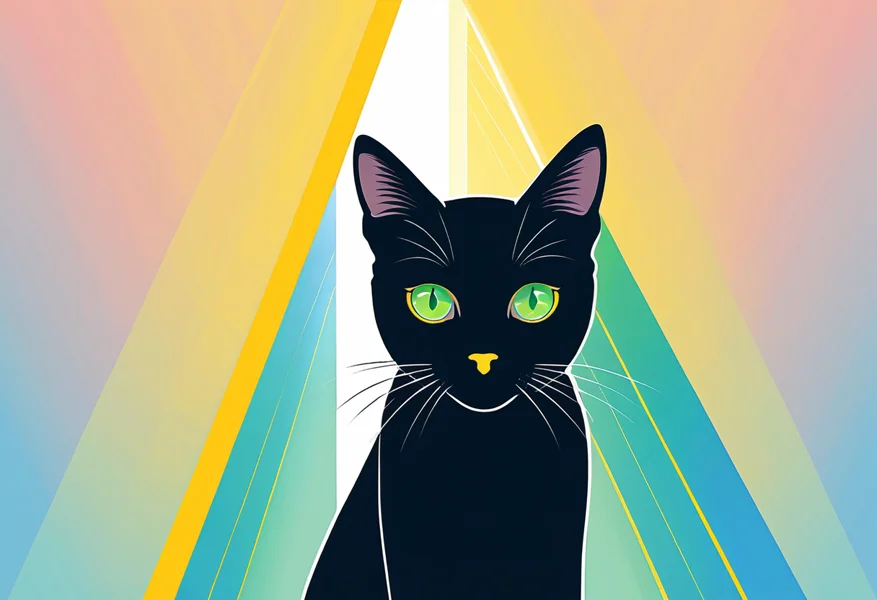
How Cats See the World: The Science of Feline Vision
How cats see the world is one of those questions that sounds simple until you dig into the science. Cats do not see the way we do. Their eyes evolved for a completely different set of priorities: hunting in dim light, tracking fast-moving prey, and scanning wide areas for threats. The result is a visual system that trades sharpness and color for speed and sensitivity. Here is everything research tells us about cat vision, from color blindness to ultraviolet light.
Table of Contents
- How Cats See the World in Color
- How Cats See the World at Night
- Cat Vision vs. Human Vision: Sharpness and Detail
- Field of Vision and Depth Perception
- Why Cats Are Wired to Detect Motion
- The Ultraviolet Secret: What Cats See That We Cannot
- How Age and Health Affect Cat Vision
- FAQ
How Cats See the World in Color (Hint: Not Like Us)
The old myth that cats see in black and white is wrong. Cats do see color, but their palette is much narrower than ours. Humans have three types of cone cells in the retina (red, green, and blue), giving us trichromatic vision. Cats only have two types of cones, making them dichromatic. Their world leans toward blues and yellows, while reds and greens blur into a muddy brownish-gray.
Dichromatic vs. Trichromatic Vision
Think of it this way: if you took a photograph and removed most of the red and green channels, you would get something close to what a cat perceives. A bright red laser dot, the classic cat toy, does not actually look red to your cat. It probably appears as a dull yellow or gray spot. What makes it irresistible is the movement, not the color.
Why This Matters for Cat Owners
If you are choosing toys, go for blue or yellow. Those are the colors your cat can distinguish most clearly. A bright blue feather wand will stand out far more than a red one. This is also why cats sometimes ignore a treat placed on a red mat. They can smell it, but visually it blends into the background.
How Cats See the World at Night: The Low-Light Advantage
This is where cat vision gets impressive. Cats can see in light levels about six to eight times lower than what humans need. They are not truly nocturnal (they are crepuscular, meaning most active at dawn and dusk), but their eyes are built for low-light conditions. Several biological adaptations make this possible.
The Tapetum Lucidum
Behind the retina, cats have a reflective layer called the tapetum lucidum. When light enters the eye and misses the photoreceptor cells on the first pass, the tapetum bounces it back for a second chance at detection. This is the reason cats’ eyes glow green or gold in photographs or headlights. It is not just a cool visual trick. It is a functional advantage that effectively doubles the available light for the retina to work with.
Rod Cell Density
Cat retinas contain roughly six to eight times more rod cells than human retinas. Rod cells are the photoreceptors responsible for detecting light and movement in dim conditions. More rods means more sensitivity to even the faintest ambient light. The trade-off is fewer cone cells, which is why color vision suffers.
Larger Pupils
Cat pupils can dilate to nearly 90% of the eye’s surface area, letting in far more light than human pupils. In bright light, they contract to thin vertical slits. This slit shape allows extremely precise control over light intake, protecting those sensitive rods from being overwhelmed during the day. The transition from fully dilated to a narrow slit is one of the fastest pupil adjustments in the animal kingdom.
Cat Vision vs. Human Vision: Sharpness and Detail
When it comes to visual acuity (the ability to see fine detail), humans win by a wide margin. The average human has 20/20 vision, meaning we can clearly see at 20 feet what a standard eye chart expects at 20 feet. Cats have been measured at around 20/100 to 20/200. In practical terms, what you can see sharply from 100 feet away, your cat would need to be 20 feet from to see with the same clarity.
Why Cats See a Softer World
The lower density of cone cells in the fovea (the part of the retina responsible for sharp central vision) is the main reason. Humans have a concentrated cluster of cones in the fovea, giving us the ability to read small text, recognize faces at a distance, and appreciate fine art. Cats have a less defined foveal area, which means their central vision is inherently less sharp. Imagine looking at the world through a very slight soft-focus filter. That is roughly the cat experience during daylight.
Near Vision
Cats also struggle with objects closer than about 30 centimeters (roughly 12 inches). Their lenses are less flexible than ours, making close-up focus difficult. This is why a cat might bat at a treat right in front of its nose: it can smell the treat, but the visual detail at that distance is blurry. Whiskers compensate for this blind spot by acting as close-range sensors.
Field of Vision and Depth Perception
Cats have a wider field of vision than humans. We see roughly 180 degrees, while cats see about 200 degrees. That extra 20 degrees of peripheral vision comes from the position of their eyes, which are set slightly more to the sides of the head compared to ours. This wider view helps them detect approaching predators or prey from the edges of their visual field.
Binocular Overlap and Depth Perception
Where the visual fields of both eyes overlap, cats get binocular vision, which is critical for judging distance. Cats have roughly 140 degrees of binocular overlap (humans have about 120 degrees). This overlap is essential for hunting. When a cat calculates the exact distance for a pounce, it relies on this stereoscopic depth perception. That is why cats are so accurate when leaping onto narrow surfaces, even from several feet away.
The Head Bobbing Behavior
You may have noticed cats bobbing their heads side to side before a big jump. This is not a quirky personality trait. It is a depth perception technique called motion parallax. By moving their head, they create slightly different viewing angles, which the brain uses to calculate distance more precisely. Birds do something similar, which is why pigeons bob their heads when walking.
Why Cats Are Wired to Detect Motion
If there is one thing cat eyes are optimized for above everything else, it is motion detection. Those extra rod cells do not just help with low light. They are also extremely sensitive to movement. A cat can detect motion at the edges of its visual field that a human would completely miss. This is why your cat suddenly stares at a blank wall. It probably noticed a tiny insect or a shadow shifting that your eyes cannot resolve.
Flicker Fusion Rate
Cats process visual information faster than humans. Their flicker fusion rate (the speed at which a flickering light appears to be a steady beam) is higher than ours. Research suggests cats can detect flickering at around 70-80 Hz, compared to roughly 60 Hz for most humans. This means a standard 60 Hz monitor or TV might look slightly flickery to a cat. It also means fast-moving objects are easier for cats to track, since their visual system refreshes more frequently.
Hunting Implications
This motion sensitivity explains most cat behavior that owners find entertaining. The sudden sprint after a dust particle floating in a sunbeam, the intense focus on a feather toy, the frozen “stalking pose” when something moves in the garden. All of these are the hunting instinct working together with a visual system that was built specifically to notice things that move.
The Ultraviolet Secret: What Cats See That We Cannot
A 2014 study published in the Proceedings of the Royal Society B revealed something surprising: cats (along with many other mammals) can see ultraviolet light. The human lens blocks UV wavelengths from reaching the retina, but the cat lens allows some UV light through. This means cats perceive a layer of visual information that is completely invisible to us.
What UV Vision Reveals
Under UV light, certain things look dramatically different. Urine trails glow brightly (useful for territorial marking), some flowers and insects display patterns invisible to the human eye, and even laundry detergent residue on clothing can appear luminous. When your cat stares at your freshly washed shirt with unusual intensity, it might genuinely look different to them than it does to you.
The Evolutionary Advantage
UV sensitivity likely helps cats detect urine markings from other animals, track prey that reflects UV light differently, and navigate environments where UV patterns provide additional information about textures and surfaces. It is a subtle advantage, but in survival terms, every extra bit of visual data matters. This discovery reshaped how scientists think about mammalian vision, since it was previously assumed that most mammals had no UV perception at all.
How Age and Health Affect Cat Vision
Like humans, cats experience vision changes as they age. Understanding these changes helps owners spot problems early and keep their cats comfortable.
Common Age-Related Changes
Nuclear sclerosis is the most common age-related eye change in cats. The lens gradually becomes denser and slightly cloudy, giving older cats’ eyes a bluish-gray haze. It usually does not severely impair vision, but it does reduce low-light performance. Cataracts, while less common in cats than in dogs, can also develop and cause more significant vision loss. Just as sleep affects human health in surprising ways, nutrition and overall health play a direct role in maintaining feline eye function over time.
Warning Signs to Watch For
If your cat starts bumping into furniture, misjudging jumps, or showing reluctance to move in dim light, a vet visit is in order. Sudden changes in pupil size (one pupil larger than the other) can indicate serious conditions including high blood pressure, glaucoma, or retinal detachment. Early detection makes a significant difference in treatment outcomes.
Frequently Asked Questions
Can cats see in complete darkness?
No. Cats need some ambient light to see. Their eyes are extremely efficient at gathering available light (they need about one-sixth the amount humans do), but in total darkness they rely on whiskers, hearing, and scent to navigate. The idea that cats have true night vision is a myth, though their low-light performance is remarkable compared to most mammals.
Do cats see TV screens the same way we do?
Not quite. Because cats have a higher flicker fusion rate, older CRT and lower-refresh-rate screens may appear to flicker. Modern 120 Hz displays look smoother to cats. They can perceive the images, but colors appear muted (mostly blues, yellows, and grays). Cats that “watch” TV or gaming screens are typically tracking movement rather than following a story.
Why do cats’ eyes glow in the dark?
The glow comes from the tapetum lucidum, a reflective layer behind the retina. When light enters the eye (from a camera flash or headlights, for example), it bounces off this layer and exits through the pupil, creating that eerie green, gold, or blue glow. The color of the glow depends on the cat’s eye color and the angle of the light.
Is cat vision better than human vision?
It depends on the context. Cats see better in low light, detect motion more effectively, have a wider field of view, and can perceive UV light. Humans see better in daylight, have sharper detail vision, perceive a fuller range of colors, and focus on close objects more easily. Neither system is universally “better.” Each evolved for different survival needs. Modern science keeps revealing that animal perception is far more complex than we once assumed.
Can cats see phone and tablet screens?
Yes, but with limited color. Phones and tablets emit light in the RGB spectrum, but since cats lack red cones, they see a simplified version. The brightness and movement on the screen are what attract their attention. Apps and tools designed for visual engagement work on the same principle: motion grabs focus, regardless of how the viewer perceives color.
The Bottom Line
Cats sacrificed color richness and fine detail for a visual system built around low-light sensitivity, motion detection, and wide-angle awareness. Their eyes are not worse than ours. They are simply optimized for a different job. Understanding how cats see the world changes the way you interact with them: choosing the right toy colors, understanding why they stare at “nothing,” and recognizing early signs of vision problems. The next time your cat locks eyes with a shadow you cannot see, remember that it is processing a version of reality that your eyes were never designed to access.
🐾 Visit the Pudgy Cat Shop for prints and cat-approved goodies, or find our illustrated books on Amazon.


Leave a Reply