
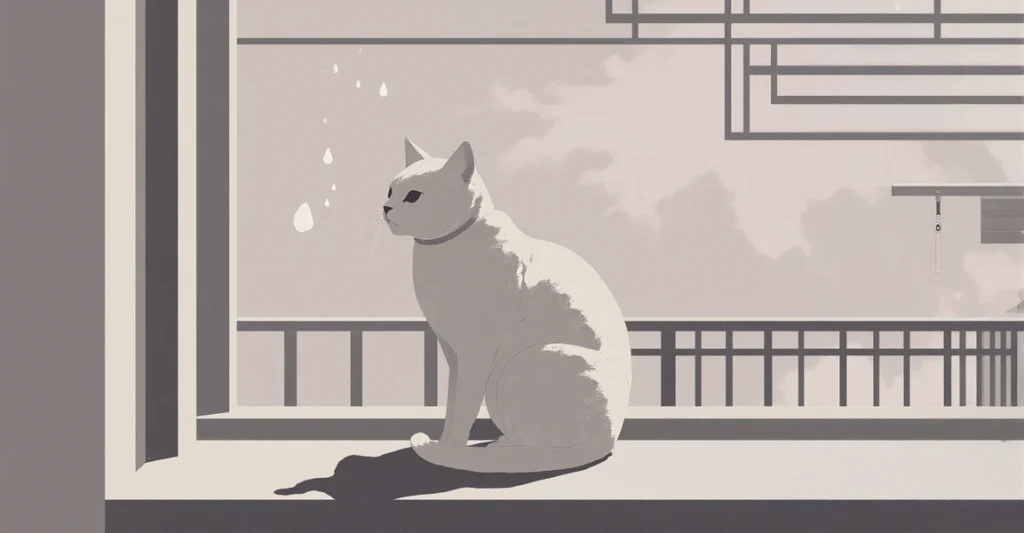
That earthy, almost sweet smell after the first rain in weeks has a name: petrichor. It is a scent, not a single chemical with one formula. Its story brings together soil chemistry, microbial activity, and the surprising physics of droplets. The rain has arrived, the pavement has acquired a perfume, and the cat would like the window opened immediately.
Table of Contents
- What Is Petrichor? The Short Answer
- The 1964 Paper That Gave the Smell Its Name
- Geosmin, the Molecule Doing Most of the Work
- Actinomycetes and Streptomyces: The Bacteria Making the Smell
- Plant Oils and Ozone: The Supporting Cast
- The MIT High-Speed Camera Study of Raindrop Aerosols
- Why Tiny Amounts of Geosmin Are Noticeable
- Petrichor in Perfume, Literature, and Pop Culture
- FAQ
What Is Petrichor? The Short Answer
Petrichor is the earthy scent associated with rain on dry ground. Compounds already present in soil and on surfaces contribute to what reaches your nose. Geosmin, made by microorganisms, is one familiar earthy-smelling molecule; plant-derived material is also part of the story. There is no universal three-ingredient recipe for every rainy street or garden.
Think of the smell as a meeting between chemistry and conditions. What is on the ground, how wet it already is, and how material enters the air can all matter. The water is doing more than making puddles. Whether your cat appreciates that distinction or merely resents the wet windowsill is harder to establish.
The 1964 Paper That Gave the Smell Its Name
Isabel Joy Bear and Richard G. Thomas introduced the term in their 1964 Nature paper “Nature of Argillaceous Odour”. Their work at CSIRO helped give a memorable name to an already familiar experience. Naming a smell does not mean nobody had investigated or enjoyed it before.
From “Argillaceous Odour” to a New Word
“Argillaceous” refers to clay: technically useful, but unlikely to become anyone’s favorite word. Petrichor combines Greek roots associated with stone and ichor, the fluid of the gods. Chemistry occasionally gets to borrow a little mythology, and this was an excellent opportunity.
What Bear and Thomas Actually Discovered
The early work associated the odor with material extracted from rocks and soil, rather than with rainwater alone. Their follow-up, “Petrichor and Plant Growth”, appeared in 1965. These papers are part of the history of the scent, not a complete modern formula for everything people smell during a storm.
Geosmin, the Molecule Doing Most of the Work
In a separate 1965 study, N. N. Gerber and H. A. Lechevalier isolated geosmin from actinomycete cultures. It has a strongly earthy odor. Keeping the terms separate helps: geosmin is a compound, while petrichor describes a broader sensory experience.
Where Geosmin Is Hiding
Geosmin also matters outside a rainy garden. Earthy or musty notes in water can be noticeable at very low concentrations. That makes odor measurement a practical concern for water researchers, not just an unusually niche hobby for people who enjoy sniffing flowerpots.
Why Bacteria Bother to Make It
A 2020 study involving the John Innes Centre found that geosmin and another compound attracted springtails to Streptomyces. These tiny arthropods feed on the bacteria and can disperse viable spores on their bodies and in their droppings. Geosmin, in this relationship, is a marketing campaign aimed at six-legged delivery vehicles. It is one demonstrated ecological role, not the final explanation for every organism that makes the compound.
Actinomycetes and Streptomyces: The Bacteria Making the Smell
Streptomyces are bacteria with branching growth that can look superficially fungus-like. Their chemistry is unusually productive: the genus is important both in soil ecology and in antibiotic discovery. “Bacteria” is a rather broader job description than “things you should wipe off the kitchen counter.”
Spores That Wait for Water
The springtail research linked the production of scent compounds with the regulation of spore formation. That is more precise than imagining every dry spell fills spores with perfume that they all release on getting wet. The familiar strong smell after rain involves environmental conditions as well as the microbes living there.
Streptomyces and Antibiotics
Streptomyces have been an important source of antibiotics, including streptomycin. That is a striking extra role for organisms already contributing to the smell of soil. It does not mean every antibiotic comes from this genus, or that all the bacteria under a flowerpot are manufacturing the same compounds. Not bad for a side hustle, though.
Plant Oils and Ozone: The Supporting Cast
The historical plant-oil account and the microbial account concern different contributions to earthy odors. Their relative importance can vary. A rain-soaked garden, a hot road, and a patch of clay need not produce identical scents just because we reach for the same lovely word.
Why Some Storms Smell Sharper
Ozone is a different molecule from geosmin, and a sharp smell around a thunderstorm should not automatically be folded into the definition of petrichor. Nor does a falling raindrop need to manufacture ozone by friction to explain an earthy scent. It is useful to separate the smell of wet ground from everything else we associate with stormy weather.
The MIT High-Speed Camera Study of Raindrop Aerosols
In 2015, Youngsoo Joung and Cullen Buie investigated a way raindrops can release aerosols from porous surfaces. Their high-speed imaging offered a possible mechanism for carrying aromatic material into the air, rather than a complete chemical analysis of petrichor.
Champagne Bubbles in Reverse
A drop can trap tiny bubbles where it meets a surface. Those bubbles rise and burst, ejecting small droplets: a miniature fizz reminiscent of champagne. The result depends on both the impact and the surface. The soil has not opened a bar, but it has discovered presentation.
Why Light Rain Smells Stronger Than a Downpour
In the experiments, conditions representing light or moderate rain produced more aerosols than heavier impacts. That does not establish that every drizzle smells stronger than every downpour. Surface properties and the available material matter too. Treat it as a useful mechanism, not a weather forecast for your nose.
Why Tiny Amounts of Geosmin Are Noticeable
Humans can detect very small amounts of geosmin, but the medium and test conditions matter. A 2024 receptor study discusses reported detection thresholds of roughly 4–10 nanograms per liter in water. That is not an identical threshold in air. Comparing it with a shark’s response to a different substance in seawater does not produce a fair cross-species smell championship.
The Water-Finding Hypothesis
The idea that an earthy smell could help an animal find water is appealing. It is not, by itself, evidence that human sensitivity evolved for that purpose. We can enjoy the possibility without upgrading it to an established evolutionary explanation. Our ancestors have enough speculative lifestyle advice attributed to them already.
Why Some People Like It and Some Do Not
The same earthy note can be welcome in a garden and unwelcome in a glass of water. Context changes the experience, and concentration matters too. Experiments with drinking-water odorants also show why temperature belongs in the conversation. “It smells nice” is a reaction, not a chemical property printed on the molecule.
Petrichor in Perfume, Literature, and Pop Culture
Perfumery gives the attraction a more deliberate form. Demeter’s Rain is one example of a fragrance built around the idea. A commercial interpretation need not reproduce a rainy garden molecule for molecule, and a product name does not reveal a secret formula. Sometimes the point is simply to carry a reminder of a place.
The Indian Industrial Heritage
Mitti attar is another approach to an earthy fragrance. Kannauj producers describe distilling baked clay over sandalwood oil. That is more specific than saying they bottle monsoon water, and it avoids treating a perfume as chemically identical to an outdoor smell. The craft and the laboratory are asking related, but different, questions.
FAQ
Is petrichor the same as geosmin?
No. Geosmin is a particular compound with an earthy odor. Petrichor is the broader smell associated with rain on dry ground; it is not one molecule.
Why does it smell stronger after a drought?
Dry ground and wet ground offer different starting conditions. Material accumulated on surfaces and the way droplets release it can help explain the contrast. It is not a rule that a wet season has no smell or that drought duration alone determines intensity.
Can you bottle the smell of rain?
Perfumers can evoke earthy, rain-like scents. Mitti attar and modern rain-inspired fragrances offer examples, though neither must reproduce the exact mixture outside your window.
Why do animals act strangely before rain?
A cat running to the window is not a controlled experiment in weather prediction. It may be responding to sounds, smells, movement, or a familiar routine. Without evidence for the particular behavior, it is better not to assign it a specific chemical trigger. The cat is welcome to maintain an air of mystery.
Is petrichor safe to breathe?
The earthy odor itself is not a test of air quality. WHO’s discussion of geosmin distinguishes its odor effects at environmentally relevant concentrations from health hazards. That does not certify every substance carried in outdoor air, or make smell a reliable way to assess safety.
The Smell of Rain Is the Smell of Bacteria Throwing a Party
Petrichor is a small reminder that something beautiful can have chemistry underneath it without becoming less beautiful. Researchers have investigated the compounds, the organisms, and the droplets involved. None of that stops the first rain after a dry spell from feeling like the world has opened a window. Somewhere under the garden, the six-legged delivery service is still taking orders. The cat already knew.
For more strange chemistry and overlooked science stories, browse other oddities in the Pudgy Cat curiosities archive, including the Chinese money plant that solved a computer science problem in its leaves, the two-and-a-half-year hunt for the source of golden orbs on the Gulf of Alaska seafloor, the streetlights pulling pill bugs into death spirals, and the 1518 dancing plague of Strasbourg.