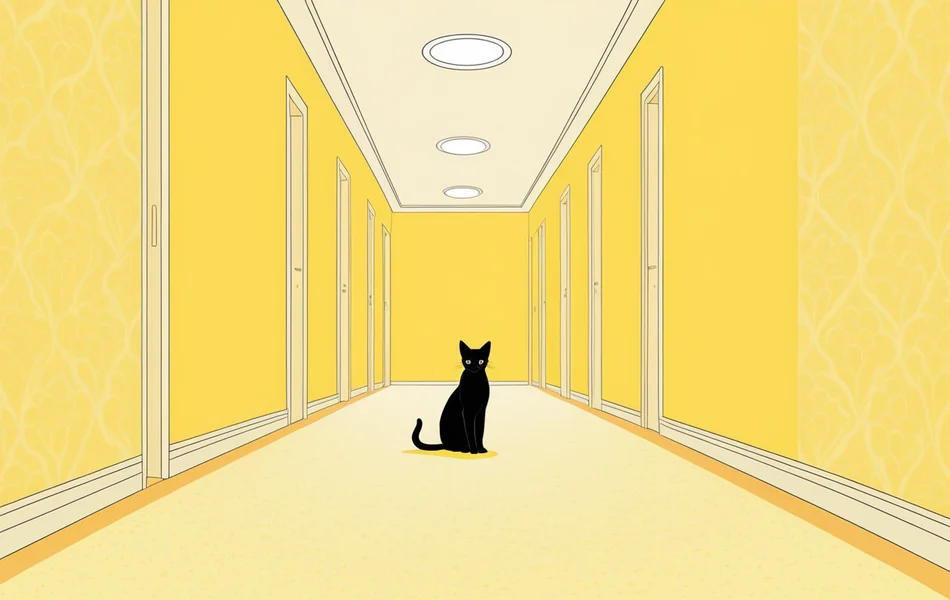
The Backrooms is an internet horror setting built around a wonderfully unpleasant idea: you slip out of ordinary reality and land in an apparently endless maze of empty, yellowish rooms. The lighting works. The carpet looks damp. Whoever designed the place has declined to provide reception.
An anonymous image-and-caption post helped establish the premise in 2019. Since then, writers, filmmakers, and game developers have made their own versions. With an A24 film scheduled for May 29, 2026, here is a guide to the original story, its expanding mythology, and the real photograph behind it.
Table of Contents
- The Origin: An Image and a Caption
- What Is the Backrooms, Exactly?
- Liminal Spaces and the Empty-Hallway Feeling
- How the Levels Work
- Entities and the Monster Catalog
- Kane Parsons and the YouTube Breakout
- The Real Photo and the A24 Film
- Why the Backrooms Stuck
- FAQ
The Origin: An Image and a Caption
The familiar starting point is a May 2019 post on 4chan’s paranormal board, /x/. A photograph of a drab, carpeted interior became attached to a warning about slipping through reality into an enormous expanse of empty rooms. The story supplied sensations as much as geography: yellow surroundings, fluorescent hum, unpleasant carpet, and the possibility that something might hear you.
The Backrooms Wiki’s Level 0 page credits that original post while identifying later contributors to its own adaptation. That is an important part of the history: the first premise and the much larger fiction that followed were not all written at once.
Online communities could pass the idea around, embellish it, and build connected stories. If you want the broader background to that kind of collaboration, our history of internet forums follows the places where strangers have been doing it for decades.
What Is the Backrooms, Exactly?
Think of it as a shared horror premise with several branches. A wiki entry, a game, and a Kane Pixels video may use the same yellow-room vocabulary while telling different stories. They need not share every creature, exit, organization, or rule.
The Wikidot community’s FAQ describes an alternate dimension entered through “noclipping,” alongside the real-world project of writing and sharing fiction. In games, noclipping means moving through surfaces that would normally stop a character. Here, the frightening joke is that the same failure happens to a person.
It is a superbly rude travel arrangement. You have not opened a cursed book or offended an ancient king. You have simply gone through the floor wrong.
Liminal Spaces and the Empty-Hallway Feeling
A hotel corridor at an odd hour, a vacant school hallway, a shopping center before opening: these are useful ways to picture the aesthetic. Such spaces normally lead somewhere. In a Backrooms image, the destination feels missing.
For me, the unsettling contrast is between ordinary design and impossible scale. One dull corridor is a minor inconvenience. An endless supply of them turns boredom into a threat. The wallpaper offers familiarity; the lack of an exit takes it back.
There is room for a cat joke here, naturally. A cat staring into an empty hallway can make a perfectly normal home feel like the opening shot of a horror film. Whether it has spotted a moth or received a message from the landlord of another dimension, it is keeping the explanation to itself.
How the Levels Work
Fan wikis organize many settings into numbered levels. The early sequence from 0 through 8 is a familiar introduction, but it is not a universal map binding every adaptation. Names, descriptions, and connections can change between projects and revisions.
A few Wikidot examples show how much room the idea has to grow:
- Level 0: the yellow, office-like maze associated with the original image.
- Level 4, “Abandoned Office”: an empty office environment with supplies and dangers described through the wiki’s fictional exploration reports.
- Level 5, “Terror Hotel”: a seemingly infinite hotel with early twentieth-century furnishings.
- Level 6, “Lights Out”: passages in complete darkness, where brought-in lights do not work.
- Level 7, “Thalassophobia”: an immense ocean beyond an entrance room, under an impossibly large ceiling.
The contrast between a hotel and an indoor ocean is the fun of the format. Each writer can begin with a recognizable place and choose which reassuring feature to remove.
Entities and the Monster Catalog
Some versions fill the spaces with creatures, often called entities. Wikidot’s Smilers, for example, are hostile presences recognized by eyes and teeth in the darkness. Other entries include Facelings, creatures built around an unsettling resemblance to people.
The catalog format turns a monster into something you might research before encountering it: a habitat, a behavior, a warning. That can be enjoyable worldbuilding. It also produces a different kind of fear from the original anonymous warning, where the absence of an explanation does much of the work.
You can prefer either approach. Some readers want a field guide. Others would rather the thing at the far end of the corridor remain spectacularly underdocumented.
Kane Parsons and the YouTube Breakout
In January 2022, Kane Parsons, known online as Kane Pixels, released The Backrooms (Found Footage). It presents its impossible environment through the visual language of an old recording. Subsequent videos expand that particular version of the story.
In his May 6 conversation with James Wan, Parsons describes building environments in Blender and moving a camera through them. The convincing recorded-footage appearance does not mean somebody filmed those endless rooms in a real office building.
Found footage makes the camera feel like a limited witness. It cannot conveniently show everything, and the viewer is stuck with its uncertainty. Our history of found-footage horror explores that trick across the genre.
The Real Photo and the A24 Film
The photograph itself does come from a real place. Reporting from May 2024 traced it to the HobbyTown location in Oshkosh, Wisconsin, through an archived renovation website. The photographed space was being transformed for the Revolution Raceway facility. Discovering an ordinary commercial history behind an extraordinary internet image is a satisfying twist of its own.
The A24 adaptation was already reported in February 2023. Its March 2026 trailer coverage gives a May 29 theatrical release, with Chiwetel Ejiofor and Renate Reinsve starring. It is still an upcoming release as this article is published.
In the May 6 A24 podcast, Parsons says the crew built about 30,000 square feet of Backrooms sets. He also describes using Blender to design and plan them. The digital maze has acquired a construction crew, which feels like the most literal possible expansion of an internet idea.
Why the Backrooms Stuck
The setting gives people several ways in. A photograph can be enjoyed in a second. A short film can build suspense through sound and movement. A wiki can keep a curious reader following links for an evening. None of those requires the same commitment from the audience.
The ordinary surfaces help, too. Horror can begin with elaborate mythology, but it can also begin with a carpet you vaguely recognize. The Backrooms makes the second approach unusually flexible: every doorway offers another place to imagine.
That flexibility matters more than a definitive monster list. The central invitation is easy to understand, and difficult to exhaust: take somewhere familiar and make it refuse to end.
FAQ
Is the Backrooms real?
The alternate dimension is fiction. The photograph that inspired the yellow-room imagery depicts a real interior in Wisconsin.
Who created it?
The original premise circulated anonymously. Later communities and creators built distinct expansions; Kane Parsons created the Kane Pixels screen version, rather than the original 2019 idea.
How many levels are there?
There is no single total shared by every version. A particular wiki can count its own entries, but that count does not determine what appears in a film or another creator’s story.
When is the movie due?
The announced U.S. theatrical date is May 29, 2026.
If you have only seen the yellow hallway, you already have the essential invitation. The rest is a choice of doors. We would recommend one with an exit sign, but the management has been difficult to reach.