Why do we get goosebumps? You step out of a hot shower into a cold room, or a song hits the exact note that punches you in the sternum, and suddenly your arms look like a plucked chicken. The bumps can appear briefly and then disappear, leaving you to wonder what your forearms were trying to accomplish. They are one of the most honest leftovers our body still carries from an ancestor that had a lot more hair than you do.
The science name is piloerection. Tiny muscles attached to each hair follicle, called arrector pili, yank the hair upright. In a furry animal this puffs the coat, traps warm air, and makes the body look bigger. In a mostly bald human it just produces a polite little dot on your forearm. The old hair-raising mechanism remains, though our sparse body hair makes a rather unimpressive winter coat.
Table of Contents
- What Goosebumps Actually Are
- Why Cold Triggers Them
- Why Fear and Music Trigger Them Too
- The Evolutionary Hangover
- The Surprise Bonus: Stem Cells Live There
- Other Animals That Get Goosebumps
- When the Brain Joins In: Frisson
- FAQ
What Goosebumps Actually Are
The raised dots form when small muscles associated with hair follicles contract, tugging on the surrounding skin and making hairs stand more upright. No special ninety-degree position is required. The technical name for the response is piloerection; “goosebumps” is the more memorable description of what you can see.
These arrector pili muscles are smooth muscle, normally controlled without a conscious decision through sympathetic nerves. Noradrenaline is involved in the nerve-to-muscle signal. You do not ordinarily give each hair an instruction, which is fortunate: the paperwork would be unbearable.
Why Cold Triggers Them
In a furry mammal, raised hairs can help maintain an insulating layer of air within the coat. Piloerection is one response to cold, not the same thing as growing a seasonal winter coat. A wolf’s changing appearance across the year cannot be explained simply by whether its tiny skin muscles are contracting at that moment.
The Human Problem
Human body hair offers much less of that insulation. Goosebumps do not puff us into a useful fur jacket, though calling the thermal effect “exactly zero” is unnecessarily absolute. It is a little like requesting winter mode from a device whose thick outer casing has been discontinued.
Shivering is a different response: repeated skeletal-muscle contractions generate heat. Goosebumps raise hairs. The two can occur together, but a bumpy forearm is not doing the same work as shaking muscles. The distinction becomes useful whenever the everyday word “chills” is used for several different sensations.
Why Fear and Music Trigger Them Too
This is where it gets weird. Goosebumps also appear when you are scared, angry, deeply moved, or listening to a chord progression that hits the right wrong way. Cold makes sense. A violin solo making your forearm hair stand up does not, until you remember how the system is wired.
Emotion can recruit autonomic responses as well. A 2011 study of visible piloerection examined the response during emotionally evocative material. That is more specific than saying every sympathetic surge automatically causes goosebumps. Likewise, dopamine activity associated with musical pleasure should not be described as dopamine travelling to the skin and directly pulling the hairs upright.
The Cat Comparison
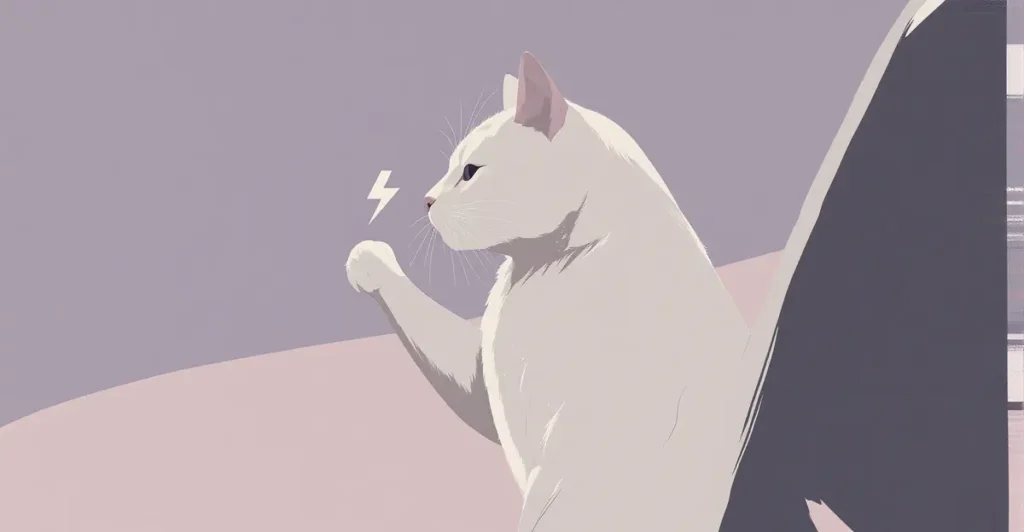
A frightened cat offers an excellent visual comparison: raised fur and an arched posture can make its outline more imposing. Your much less impressive arm hairs cannot pull off the same trick. You are essentially attempting to look intimidating to a horror movie. The horror movie does not care.
The Evolutionary Hangover
Goosebumps are often described as vestigial because raising sparse human body hair has lost much of the obvious function it serves in a thick coat. But vestigial does not have to mean every associated structure is useless. Evolutionary history and present-day function are different questions, and the machinery can participate in more than one process.
Why humans became relatively hairless is a separate evolutionary question. Heat loss and sweating are important to the discussion, but we cannot turn a proposed scenario into a precisely dated story of one successful endurance hunt. Nor does evolution simply add new features without ever removing anything. The “old code” analogy is a joke, not a complete theory of biological change.
Biology is full of arrangements that do more than their most visible job. That makes the next finding particularly interesting: the tiny muscle is part of a neighbourhood of interacting cells, rather than an isolated lever attached to a hair.
The Surprise Bonus: Stem Cells Live There
In a 2020 study described by the Harvard Stem Cell Institute, researchers working in mice found that the muscle helps maintain the connection between sympathetic nerves and hair-follicle stem cells. Under prolonged cold, increased nerve activity promoted stem-cell activation and hair growth. The short-term hair-raising response and longer-term growth regulation involve the same cellular neighbourhood.
This does not show that a musical shiver grows human hair, or that cold exposure is a hair-loss treatment. It does show why “the visible bump seems unimpressive, therefore all the machinery is useless” is too quick a conclusion. Sometimes the tiny lever has another job.
Other Animals That Get Goosebumps
Hair-raising responses occur in other mammals too; the puffed cat is the familiar household example. But coat structure and defensive behaviour differ between species. A list that treats sea-otter insulation, porcupine quills, and a hedgehog rolling up as one identical action would hide those differences.
A bird fluffing its feathers offers a visual analogy, not mammalian piloerection: feathers are not hairs. The cold sparrow becoming a small sphere with a beak is a wonderful image, but a shared appearance does not make every detail of the mechanism the same.
The cat’s sideways stance adds posture to raised fur. It can look spectacular without needing a claim that it doubles the animal’s apparent size. Anyone who has watched a kitten discover its own reflection has already seen an ambitious demonstration of amateur theatre.
When the Brain Joins In: Frisson
The pleasurable shiver associated with music is often called frisson. Subjective chills and visible goosebumps overlap, but they are not identical measurements. A 2016 brain-imaging study compared 20 participants selected for differing chill responses and found associated differences in white-matter connectivity. It did not directly demonstrate that their signals travelled “faster and stronger,” or establish what proportion of all people gets musical chills.
Other emotionally moving experiences can produce similar sensations. But a response does not tell us that one person appreciates art more deeply than someone whose skin stays smooth. Your forearm is not an admissions test for the orchestra.
Music-related reward has its own research history. A 2011 study by Valorie Salimpoor and colleagues found dopamine release associated with intensely pleasurable music. That finding concerns reward processing in the brain; it is not a complete account of how a particular note produces a visible bump. For a different musical puzzle, see why songs get stuck in your head.
For another small biological surprise, see our account of the geometric patterns in Chinese money plant leaves. Sometimes the ordinary-looking surface is where the interesting questions begin.
FAQ
Can you get rid of goosebumps?
Ordinary goosebumps generally ease as the stimulus changes—for example, when you get warmer. There is no fixed ten-second countdown. Most people do not directly control the response, but a 2020 study objectively documented voluntary piloerection in people able to produce it intentionally. “Involuntary” describes the usual experience, not an exceptionless rule.
Why do some people get them all the time and others almost never?
People differ in their responses to cold and emotional material, and in what they notice or report. The research does not support diagnosing someone’s personality, anxiety, or overall emotional depth from how often they see goosebumps. Sometimes the most useful answer is simply that the response varies.
Are goosebumps the same as the chills you get when you are sick?
No. MedlinePlus distinguishes goosebumps from shivering chills. Shivering involves repeated muscle contractions and can accompany fever or cold exposure. The raised skin bumps are a different response, even when both occur together.
Do animals get the music kind of goosebumps?
A sound can arouse an animal without showing that it experiences musical pleasure in the same way a person does. Raised fur alone cannot answer that question. Establishing an aesthetic experience would require more than observing the hairs or borrowing a human label for them.
Why do goosebumps come and go?
The response changes with the stimulation and state of the nervous system. It can be brief or sustained, and repeated emotional moments can produce repeated episodes. A claim that smooth muscle simply fatigues after ten to twenty seconds is not an adequate explanation of that variation.
Conclusion
Goosebumps are small and strangely expressive. The muscle contracts, the skin puckers, the hair rises. Cold, fear, a chord change, a sentence in a book: the body can respond with a couple of square centimetres of forearm. The reflex has an evolutionary history, and the machinery beneath it still rewards a closer look. A tiny bump turns out to be a rather good starting point for curiosity.