
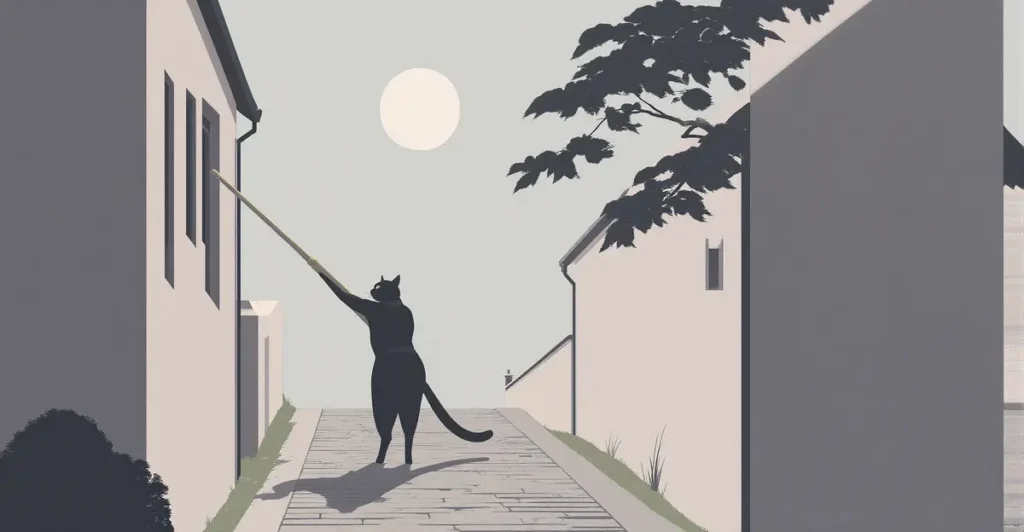
The History of Knocker-Uppers: How Britain’s Human Alarm Clocks Tapped on Windows Until 1973
For over a century, the history of knocker-uppers ran on a very simple deal. You paid a few pence a week, and a person with a long stick walked up to your window before dawn and tapped on it until you swore at them. That was the job. No app, no battery, no snooze button. Just a tired human standing in the rain with a bamboo pole, poking the glass of a third-floor flat in Manchester at 4:30 in the morning, because the cotton mill opened at five.
The strange part is not that this job existed. The strange part is that it survived the mechanical alarm clock by nearly two hundred years, and the last working knocker-upper in Britain only retired in 1973. That is later than the moon landing. People were watching colour TV and listening to Pink Floyd’s Dark Side of the Moon, and someone in the north of England was still getting paid to walk down a terrace street with a stick, waking up factory workers one window at a time.
Table of Contents
- What Is a Knocker-Upper
- Origins in the Industrial Revolution
- The Tools of the Trade: Sticks, Pea Shooters, and Soft Hammers
- A Day in the Life of a Knocker-Upper
- Who Knocked Up the Knocker-Upper
- Famous Knocker-Uppers and the Last Holdouts
- Why the Job Survived So Long After Alarm Clocks Existed
- Cultural Legacy and the Phrase That Got Awkward
- FAQ
What Is a Knocker-Upper
A knocker-upper (sometimes “knocker-up”) was a working-class profession in industrial Britain and Ireland, roughly from the 1830s to the 1970s, whose entire purpose was to wake up other working-class people in time for their shift. The job description was simple: walk a route, tap on assigned windows, do not leave until you see a face. If the face did not appear, the knocker-upper kept tapping. If the face looked angry, that was confirmation of a job well done.
The role appeared most densely in northern English mill towns, in the Welsh and Yorkshire coalfields, in dockside communities like Liverpool, and in the East End of London. Anywhere with shift work and shared walls, the knocker-upper had a route. They were paid by the household, a few pence per week, and kept lists chalked on slate or scrawled in a notebook so they knew which window to hit at which minute. Some routes had more than a hundred customers across a few streets.
If you have ever read a Victorian novel and noticed a strange figure standing in a fog-bound street before sunrise, that figure was probably a knocker-upper. The history of cat memes traces back to Victorian cabinet cards, and the knocker-upper fits perfectly inside that same texture of weirdness.
Origins in the Industrial Revolution
The history of knocker-uppers starts in the early nineteenth century, when entire towns reorganised themselves around the schedule of a steam engine. Cotton mills, coal pits, glassworks, and dockyards all ran on shifts. Some started at 5 a.m., some at 4 a.m., some at 3 a.m., and missing one meant losing a day’s wages or getting sacked and replaced by the next person at the gate.
Alarm clocks did exist. Levi Hutchins of Concord, New Hampshire, built a personal one in 1787, and Antoine Redier patented an adjustable mechanical alarm in 1847. The problem was distribution and price. A reliable alarm clock in 1850s Manchester cost more than a working family could justify, and the cheaper ones were famously unreliable. They rang at the wrong time, or wound down silently in the night. If you missed your shift because your clock failed, the clockmaker did not pay your rent.
A knocker-upper, by comparison, was a person. Persons can be yelled at. Persons can be held accountable. If you missed your shift because the knocker-upper did not show up, you stopped paying the knocker-upper, and the knocker-upper lost a customer. That feedback loop was tighter and faster than any spring-driven mechanism, and for working communities it was simply more trustworthy. The job took off in the 1840s and 1850s and kept growing until the start of the twentieth century.
The Tools of the Trade: Sticks, Pea Shooters, and Soft Hammers
The signature instrument was a long stick, usually bamboo or light cane, between three and five metres long. The length mattered because you needed to reach upper-floor windows from street level without ringing the bell of the ground-floor flat, which would wake the wrong tenant and risk a flying boot. A good knocker-upper could tap a specific pane of glass three storeys up without scraping the brick.
The Pea Shooter Variant
For taller buildings, or for clients who liked a sharper sound, some knocker-uppers used a pea shooter. A pea shooter knocker-upper carried a tin of dried peas and a length of brass tube, and would fire peas at upstairs windows in short bursts. The pea hits the glass with a clean click that travels through a thin Victorian sash window like a snare drum. It was reportedly accurate up to about four storeys and surprisingly hard to ignore.
Soft Hammers, Rattles, and Whatever Worked
Other variations depended on region and personal taste. Some used a soft hammer with a padded head, designed to make a low thudding sound rather than a sharp crack. Others carried a wooden rattle, the kind used in football matches a century later, and spun it under a window until the sleeper accepted defeat. A few yelled. The instrument was less important than the route, the timing, and the willingness to do this in February at 3:45 a.m. in horizontal rain.
A Day in the Life of a Knocker-Upper
A typical day, reconstructed from oral histories collected by the BBC and from local archives in Lancashire and the East End, looked like this. The knocker-upper went to bed by 8 p.m. and woke up around 2:30 or 3 a.m. They walked a route of thirty to one hundred houses, hitting each window at a pre-arranged time. The first stop might be a baker due up at 3:15. The next, a dockworker due at the gate by 4. Later in the route, mill workers, tram drivers, and shop staff.
Each customer paid weekly. The going rate in late Victorian London was three to six pence per house, which sounds tiny until you realise a hundred-house route added up to a modest skilled wage. Some routes were inherited like a butcher’s round, passed from parent to child, and there were quiet territorial disputes between neighbouring knocker-uppers over which streets belonged to whom. No contracts, no unions, only the route.
By 6 a.m. the knocker-upper was done. Most went home and slept again until lunchtime, then did a daylight side job, something flexible like rag-and-bone collecting or shop minding. A few worked as nightwatchmen, which fit the schedule. The job paid badly but predictably, and like Italy’s strange cheese bank that holds wheels of parmigiano as loan collateral, it was a niche piece of working-class infrastructure that everyone respected even when it looked absurd from outside.
Who Knocked Up the Knocker-Upper
This is the question every modern person asks within ten seconds of hearing about the profession, and there are several answers. Mostly the knocker-upper relied on being a chronic light sleeper, the kind of person who wakes up if a cat sneezes two streets over. Many were elderly women whose sleep patterns had shifted toward early hours, and the job suited them perfectly. Others used a mechanical alarm at home as a backup, since a personal wake-up failure cost them the entire customer list at once.
In some areas a senior knocker-upper would wake a junior one as the first stop on the route, creating a small chain of mutually obligated insomniacs. There are also documented cases of knocker-uppers sharing a flat with someone on a completely different shift schedule, so that the housemate coming home from a late job effectively served as the alarm for the knocker-upper heading out. The system was held together by sleep deprivation and stubbornness.
Famous Knocker-Uppers and the Last Holdouts
A handful of knocker-uppers became neighbourhood celebrities. The most photographed was Mary Smith of Limehouse in London’s East End, who worked into the 1930s using a long rubber tube to shoot dried peas at upstairs windows. A 1931 newsreel captured her route, and her granddaughter Mary Moore continued the work into the 1940s. They became unofficial mascots of the trade because they were photogenic and willing to be filmed, but their tools were standard for the period.
The last commonly cited working knocker-upper in Britain was Doris Weigand of Manchester, who reportedly continued waking up dock and mill workers in the city’s terraces well into the early 1970s. Other sources point to a man named Caroline Jane Cousins who worked routes in Port Talbot, Wales, into the same decade. Either way, the official extinction date of the profession is usually given as 1973, which is the year the last verifiable working knocker-upper hung up the stick. By then, cheap battery-powered alarm clocks had finally won.
Why the Job Survived So Long After Alarm Clocks Existed
Three reasons keep coming up in the history of knocker-uppers, and all three are about trust rather than technology. The first is reliability. Mechanical clocks before the 1960s genuinely were not great. Springs failed, gears stuck, batteries leaked, the bell jammed. A knocker-upper either showed up or they did not, and either way you knew within five minutes. There was no silent failure.
The second reason is accountability. If a clock failed, you blamed the clock and your boss blamed you. If the knocker-upper failed, you blamed the knocker-upper, and so did everyone else on the street, and they lost half their route. The economic incentive was sharp and immediate. This is the same logic that keeps niche human-mediated services alive today even when an app technically does the same thing, just less reliably and with worse customer service.
The third reason is community. The knocker-upper was woven into the texture of the street. They knew which house had a sick child and needed a softer tap, which window had a loose pane, which family was on holiday. A clock has none of that context. The handover from human service to machine service was slow because the human version was simply better integrated, and people resisted giving it up for the same reason they resisted giving up the local milkman or the corner shop. For more context on how memorable internet phenomena survive long past their technical relevance, the explainer on what the Backrooms actually is and why it spread covers the same dynamic in a different setting.
Cultural Legacy and the Phrase That Got Awkward
The knocker-upper has left two fingerprints on modern English culture. The first is the phrase itself, which has aged into something a British speaker can no longer say with a straight face in front of an American. “Knock me up at seven” was an innocent request in 1880s Bolton. Today it means something completely different on the other side of the Atlantic, and the polite confusion is a small linguistic comedy. The British meaning predates the American slang by at least a century, but slang wins, and the original phrase has retreated into period drama.
The second fingerprint is in fiction. Knocker-uppers appear in the background of countless novels set in industrial Britain, from Hard Times by Dickens to more recent period thrillers, in Peaky Blinders, in BBC dramas, and increasingly in TikTok history accounts that discover the job and act personally offended that it was real. There is a niche genre of YouTube videos reconstructing the route of a knocker-upper at dawn in modern Manchester, the same impulse behind long-form pieces like how Longcat travelled from a 2chan thread to a permanent slot in internet history. A small thing, kept alive by people who refuse to let it disappear.
Several British towns have erected small plaques or street art celebrating their local knocker-uppers, including a famous mural of Mary Smith in Limehouse. The job is gone. The respect for it is not. Considering how few professions get any commemoration, that is a quietly remarkable outcome for what was, structurally, a person paid to be annoying.
FAQ
When did knocker-uppers stop working in Britain?
The commonly cited end date is 1973, when the last verifiable working knocker-upper retired. The profession had been in steep decline since the 1950s as cheap reliable alarm clocks reached working-class households, but isolated practitioners in Manchester and South Wales kept routes alive into the 1970s.
How much did a knocker-upper earn?
Three to six pence per house per week in late Victorian London, which translated to a modest but workable income for a route of fifty to one hundred customers. Most knocker-uppers had a second daytime job to round out their earnings, often something flexible like rag-and-bone collecting or watchman work.
Did knocker-uppers really use pea shooters?
Yes, with documentation. The most famous example is Mary Smith of Limehouse, photographed and filmed multiple times in the 1920s and 1930s firing dried peas at upstairs windows through a brass or rubber tube. The pea shooter was a regional specialty for taller buildings and was reportedly accurate up to four storeys.
How did the knocker-upper wake up?
Mostly through being a natural early riser or a chronic light sleeper. Many were elderly women whose sleep patterns suited the schedule. Backup methods included a senior knocker-upper waking a junior one as the first stop on the route, or a flatmate coming home from a different shift acting as an unofficial alarm.
Why did the profession last so long after alarm clocks were invented?
Three reasons. Early alarm clocks were unreliable and failed silently, knocker-uppers were directly accountable and lost customers if they missed a shift, and the human version was woven into the social texture of the street in a way a clock could not match. Once cheap and reliable battery-powered clocks arrived in the 1960s, all three advantages collapsed within a single decade.
Conclusion
The history of knocker-uppers is a small reminder that infrastructure does not have to be electrical to count as infrastructure. For a century and a half, the morning shift in industrial Britain was held together by people with sticks and tins of peas, walking routes through fog and rain, tapping on the glass of strangers. It looks absurd now. It worked then. Imagining a bamboo pole gently knocking your window at 4 a.m., it is hard not to feel a flicker of envy that something so direct ever existed. Like the well-documented Carrington Event of 1859 that set telegraph offices on fire, the knocker-upper is one of those Victorian footnotes that keeps getting weirder the longer you look at it.
Visit the Pudgy Cat Shop for prints and cat-approved goodies, or find our illustrated books on Amazon.


Leave a Reply