The dolly zoom is the shot that makes your stomach drop without anything in the frame actually moving toward you. A character stands still, the background lurches forward or peels away behind them, and the world suddenly feels wrong in a way you cannot quite name. The cat watched the famous beach reaction in Jaws roughly forty times trying to figure out what changed, and the honest answer is: almost everything except the actor. This is the trick directors reach for when a person realizes the floor of their reality just gave out. Here is how the dolly zoom works, who invented it, and why it still rattles audiences decades after its first appearance.
Table of Contents
- What Is the Dolly Zoom?
- How the Dolly Zoom Actually Works
- A Short History of the Shot
- Famous Dolly Zoom Moments in Film and TV
- Why the Dolly Zoom Feels So Unsettling
- How Filmmakers Pull It Off
- When the Dolly Zoom Goes Wrong
- Frequently Asked Questions
What Is the Dolly Zoom?
The dolly zoom is a camera effect that keeps the main subject the same size in the frame while the background appears to expand or compress around them. The camera physically moves toward or away from the subject, traditionally on a dolly, and at the same time the lens zooms in the opposite direction. The two movements cancel each other out on the subject but not on everything else, so the space behind the actor stretches or shrinks while the subject’s apparent size remains unusually stable.
It has a small museum of nicknames. People call it the Vertigo effect, the Hitchcock zoom, the trombone shot, the telescoping shot, and the contra-zoom. The cat prefers “the floor-dropped-out shot” because that is exactly the sensation it produces. Whatever name you use, the goal is the same: take an ordinary frame and make the geometry of it feel hostile.
What makes the effect so striking is the combination: the main subject holds roughly the same size, yet its relationship to the background changes dramatically. A viewer can read that as the world shifting around the character. The cat would like to file a complaint with whoever is responsible for the hallway.
How the Dolly Zoom Actually Works
To understand the dolly zoom, separate focal length from camera position. Zooming changes the framing. Moving the camera changes perspective: the apparent size relationships between near and distant objects. Nikon explains that distinction. A long lens is often paired with a more distant viewpoint to keep a subject framed similarly, which is why people associate it with compressed depth. The viewpoint is doing the perspective work.
Here is the core move. Begin near a stationary subject with a wide view. Move backward while zooming in to keep the subject approximately the same size. The background grows larger relative to that subject and the depth appears compressed, as though the surroundings are closing in. The camera movement and focal-length change need to be coordinated; identical-looking positions on two controls are not the goal.
Reverse the move by coming closer while zooming out. The background becomes smaller relative to the subject and the sense of depth expands, making the space seem to recede or stretch away. Neither direction has one compulsory emotional meaning. Speed, composition, acting, and sound decide whether the moment feels frightening, revelatory, or funny.
Why Depth Is the Secret Ingredient
The effect reads most clearly when the scene contains distinct depths. A detailed background some distance behind a face gives the changing scale relationship something to work with. A wall immediately behind the subject produces much less change; a blank distant wall may simply lack visible detail. Doors, corridors, or objects at different distances can make the movement easier to see.
A Short History of the Shot
The technique is closely associated with Alfred Hitchcock’s Vertigo (1958), with cameraman Irmin Roberts commonly credited for its development. Guinness records that attribution. The film uses the changing appearance of depth to convey Scottie’s acrophobia. The American Cinematographer account of the production describes its in-camera combination of tracking and zooming. It is a memorable piece of engineering in service of a very unpleasant feeling.
The effect did not stay locked inside one film. Steven Spielberg’s Jaws (1975) gives Chief Brody’s beach reaction an unforgettable visual jolt. The character stays our anchor while the world around him changes. Cinema has always loved a good optical trick, and this one proved especially useful for making an internal realization visible.
Famous Dolly Zoom Moments in Film and TV
Once you know what to watch for, the dolly zoom shows up everywhere. A few moments earned their place in the canon:
- Vertigo (1958): changing depth becomes part of the portrayal of Scottie’s fear of heights.
- Jaws (1975): Brody’s reaction on the beach turns a sudden realization into a visual shock.
- Goodfellas (1990): the diner scene makes the background appear to close in during an uneasy conversation.
The effect can work beyond these famous examples, in television, commercials, or a short film shot with friends. Horror and thrillers offer obvious opportunities, but the emotional result depends on context. For another way camera choices shape tension, our history of found-footage horror looks at the expressive use of apparent roughness and immediacy.
Why the Dolly Zoom Feels So Unsettling
The visual surprise is easy to describe without prescribing what every brain must feel. We watch the subject remain a stable anchor while the background changes scale around it. That unusual combination can make a familiar room feel suddenly unfamiliar. The interpretation comes from the scene as a whole, not from a guaranteed neurological switch that turns camera geometry into fear.
There is a reason the shot pairs so well with realization scenes specifically. The character is having an internal experience, a sudden shift in understanding, that has no obvious external movement to show. The dolly zoom externalizes that internal lurch. Nothing in the room changed, but everything feels different, which is exactly what a revelation feels like from the inside. That makes it a useful choice for a decisive beat, though filmmakers can use it in other ways too.
It Pairs With Other Visual Tricks
The dolly zoom can work with a performance, lighting, an off-kilter palette, or a sudden change in the soundtrack. The geometry supplies one ingredient; the surrounding choices tell us what to feel about it. The same collaboration matters in other visual decisions, including presenting a story in black-and-white or color.
How Filmmakers Pull It Off
Shooting a clean dolly zoom takes coordination. A dolly and track can provide smooth motion while the lens changes focal length to hold the chosen subject’s framing. Focus may need adjustment too. Small changes in subject size do not automatically ruin the shot, but rehearsing the move helps the result feel deliberate. American Cinematographer’s guide to camera movement places the technique among the ways tracking and lens movement can work together.
Motorized equipment can help repeat coordinated movements, and digital tools can refine framing afterward. A moving shot can also be resized in editing to compensate for the subject’s changing size. The camera move supplies the perspective change; resizing supplies the counteracting magnification. A simple crop of a stationary shot changes scale without creating that same three-dimensional relationship.
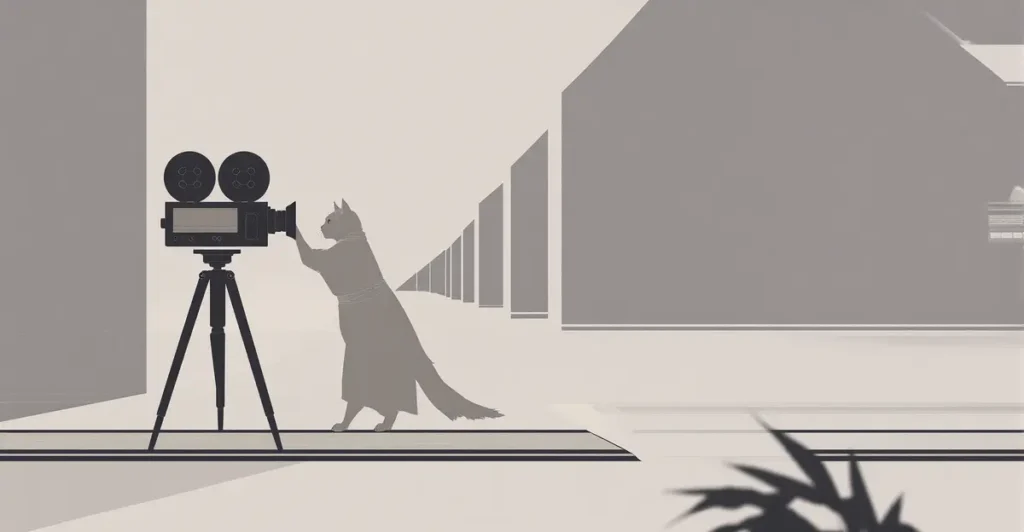
For a small-budget experiment, choose a stationary subject with a clearly separated background, then make a smooth forward or backward camera move. Coordinate the zoom, or record enough resolution to adjust the framing afterward. A stationary tripod with a fluid head will not create the required translation by itself. Adobe outlines filming and editing approaches. Rehearse where the camera will travel, keep the route clear, and compare the background at the beginning and end. The cat volunteers to supervise from somewhere inconvenient.
When the Dolly Zoom Goes Wrong
The shot has a failure mode, and it is overuse. Because the dolly zoom is so recognizable, dropping it into a scene that has not earned the emotional weight feels gimmicky rather than gripping. Audiences register the trick instead of the feeling, and the spell breaks. Comedies have figured this out and now deploy the dolly zoom as a punchline, exaggerating it to mock the dramatic seriousness it usually carries.
Think of it as a strong spice. One well-placed dolly zoom can become the image an audience remembers, while repeated use can be a deliberate stylistic choice or simply distract from the scene. There is no correct quota per film. The practical question is whether the movement adds something worth noticing.
Frequently Asked Questions
What is the difference between a dolly zoom and a regular zoom?
A regular zoom changes only the focal length, so everything in the frame, including the subject, grows or shrinks together. A dolly zoom combines a physical camera move with an opposite zoom so the subject stays the same size while the background distorts. The result is a warping of depth that a plain zoom cannot produce.
Why is the dolly zoom called the Vertigo effect?
The name comes from its famous use in Hitchcock’s Vertigo (1958). Changes in the apparent depth of the scene help convey the protagonist’s fear of heights, and the film’s title became shorthand for the effect.
Can you do a dolly zoom on a phone?
Yes. You can move the phone while changing magnification, or adjust the scale of moving footage in editing to hold the subject’s size. Digital enlargement has a resolution cost, and switching between a phone’s cameras may create a visible jump. Smooth physical movement and suitable background depth matter more than a particular app label.
Why does the dolly zoom make me feel uneasy?
It can feel unsettling because the subject remains a stable reference while the surroundings appear to expand or close in. Acting, music, and the situation reinforce that impression. It need not make everyone uneasy: the same conspicuous move can also be used for comedy.
What was the first movie to use a dolly zoom?
Vertigo (1958) is the standard historical reference and the film credited in Guinness’s record, with Irmin Roberts named for the shot’s design. It established the technique’s familiar association with vertigo and dramatic changes in perception.
Conclusion
The dolly zoom survives because it does something no other shot does: it makes a stationary moment feel like the ground is moving. Born in a Hitchcock stairwell and made famous on a Spielberg beach, it turns geometry into emotion and externalizes the exact instant a character understands their world has changed. Use it once, with intent, and it becomes unforgettable. The cat is still trying to get the timing right on the dolly, and has so far only succeeded in knocking the camera off the rails.