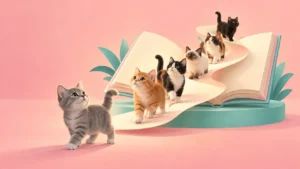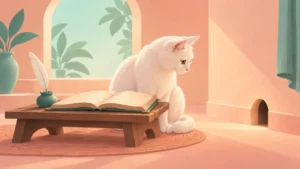
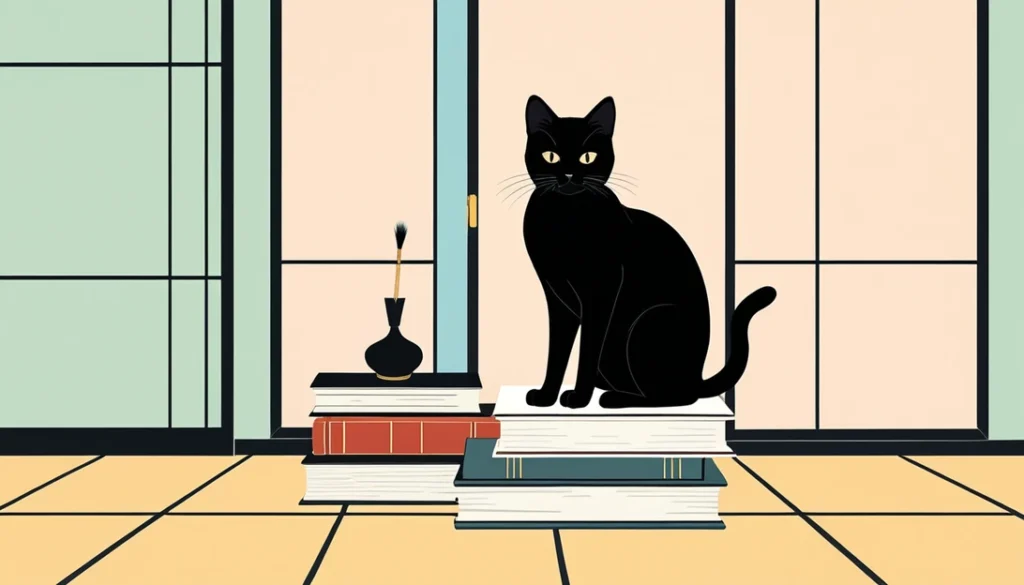
On 11 March 889, a young Japanese emperor sat down and wrote about his cat. Emperor Uda described the animal’s ink coloured fur, the way it curled into a perfect circle when it slept, and its silent movement, which he compared to a black dragon above the clouds. The entry survives in translation from the Kanpyō Gyoki, one of Japan’s earliest court diaries. It is a memorable early portrait of a pet, not a date for the arrival of cats in Japan. It sets the tone for everything that follows. Cats in Japanese literature are almost never just cats. They are observers, escape hatches, and the thing the story is secretly about.
Table of Contents
- Where Cats in Japanese Literature Actually Begin
- Soseki’s Nameless Cat and a Modern Classic
- Tanizaki Wrote a Love Triangle and Let the Cat Win
- The Town of Cats: When the Cat Becomes a Door
- Murakami and the Cat That Always Goes Missing
- The Folklore Underneath: Bakeneko, Nekomata, Maneki Neko
- Japan’s Cat Novels Are Now a Global Export
- How to Read Cats in Japanese Literature
- FAQ
Where Cats in Japanese Literature Actually Begin
Uda says the cat had been given to the previous emperor by Minamoto no Suguru, an official returning from Dazaifu, the southwestern port region that handled contact with the continent. That gift history does not establish where this particular animal was born or reconstruct the introduction of domestic cats to the islands. Uda himself compares his pet with other cats: even his extravagantly proud description is not a claim to own Japan’s first one.
What makes the record unusual is the register. Uda was not filing an inventory. He was writing the kind of thing a person writes about a pet at two in the morning, and eleven hundred years later the emotional grammar has not changed. For the older, stranger half of the human and cat story, our piece on cats in ancient Egypt covers the part where the relationship became religion.
Soseki’s Nameless Cat and a Modern Classic
A landmark of the modern literary line begins in the January 1905 issue of Hototogisu, a haiku journal. Natsume Soseki, then an English literature lecturer, was encouraged by Takahama Kyoshi to write something. He produced a short piece narrated by a cat living in the house of a dyspeptic schoolteacher, meant to be one chapter and nothing more.
The intended short piece grew into a much longer work. The Sōseki Memorial Museum’s bibliography dates the serial from January 1905 to August 1906. The first book volume appeared from Okura Shoten and Hattori Shoten in October 1905, before the serialisation had finished. Soseki went from academic to national author on the strength of a cat with no name.
What “Wagahai wa Neko de Aru” Actually Means
Much of the joke is in the opening pronoun, and a plain English title cannot carry it all. Wagahai is a first person pronoun with a grand, self-important register, rather than the everyday modesty you might expect from a nameless stray. The sentence translates as “I am a cat,” but the pronoun makes it closer to “I, the undersigned personage of consequence, am a cat.” The animal then admits, in the next breath, that it has no name.
That gap between the voice and the creature holding it is the engine of the book. The cat has full access to a household of pretentious Meiji intellectuals and no stake in their arguments, which makes it the perfect satirical camera. It is also a masterclass in narration you cannot fully trust, a technique we break down in our guide to the unreliable narrator.
The ending is bleak and funny at once. The cat drinks the beer left over from a household celebration, gets drunk, falls off the veranda into a pottery jar used to collect rainwater, cannot climb out, and stops fighting. Its last thoughts are a prayer and a calm insistence that it is happy. A comic novel closes with a drowning.
The Real Cat and the Grave in the Garden
There was an actual animal. A black stray walked into the Soseki household when the writer was 37 and stayed, moving house with the family twice and ending up at the Waseda Minami-cho residence. It died on 13 September 1908. Soseki sent a feline death notice to his literary circle, buried the animal in the garden and wrote about the loss. The museum preserves a death-notice postcard sent on 14 September 1908. Affection and humour coexist in it: Sōseki excuses friends from attending because he is busy writing Sanshirō. The real death mattered, but the novelist had not suddenly lost his comic voice.
Soseki’s standing in Japan is hard to overstate. His portrait was on the 1000 yen note on the series first issued in 1984. Issuance stopped in 2007, but the Bank of Japan lists these notes as still valid. A stray with no name is, indirectly, on national currency.
Tanizaki Wrote a Love Triangle and Let the Cat Win
Junichiro Tanizaki published the novella known in English as A Cat, a Man, and Two Women in the magazine Kaizo in 1936. The setup reads like standard domestic comedy. Shozo is caught between Shinako, the wife he has been manoeuvred into discarding, and Fukuko, the younger woman who replaced her. The complication is Lily, a tortoiseshell cat.
Shinako’s plan is to demand custody of the cat, correctly guessing that Shozo loves Lily more than he has ever loved either woman. Both women understand this. Shozo half understands it. The novella is a comedy of jealousy where the only party with real romantic power has four legs and no interest in the outcome. Tanizaki, a writer associated with obsession and fetish, aims all of that machinery at a housecat.
The Town of Cats: When the Cat Becomes a Door
In 1935 the poet Hagiwara Sakutaro published Nekomachi, “The Town of Cats,” a rare venture into short fiction by a writer best known as a poet. The narrator is a poet and former drug user who gets the sensation of travel by deliberately losing his sense of direction in familiar streets. One day the trick works too well. He arrives in a beautiful, orderly town, and then the population resolves into cats. Jeffrey Angles’s English translation first appeared in the 2008 anthology Modanizumu: Modernist Fiction from Japan, 1913–1938.
Hagiwara is not writing an animal story. He is writing about perception coming loose, and the cat is the signal that reality has slipped a gear. That puts him in the territory covered by our explainer on weird fiction. The English-language weird tradition already existed by 1935; this is a comparison of literary effects, not a claim that Hagiwara invented the genre.
The echo arrives 74 years later. In 1Q84, Haruki Murakami gives Tengo a train journey and a story to read on it, a piece called “Town of Cats,” attributed inside the novel to an invented German writer working between the wars. An excerpt appeared in The New Yorker’s September 5, 2011 issue. The two works invite comparison through their strange feline towns. The resemblance is worth reading closely, but it does not by itself demonstrate that Murakami borrowed the device from Hagiwara.
Murakami and the Cat That Always Goes Missing
Murakami’s relationship with cats predates his fiction. In 1974, while still at university, he and his wife Yoko opened the jazz café Peter Cat in Kokubunji, in Tokyo’s western suburbs, naming it after their own animal. In 1977 they moved it to Sendagaya. The interior was cats all the way down: figurines on the tables and the piano, pictures, coasters, matchbooks. The Haruki Murakami Library at Waseda describes him writing his first novel at the café’s kitchen table after closing. The bar belongs to the practical history of the writing, as well as to its atmosphere.
The cats then walked into the books and started disappearing. The Wind-Up Bird Chronicle, published in Japan in three parts across 1994 and 1995, opens with a missing cat the narrator has named Noboru Wataya after the brother-in-law he despises. The search unravels a marriage, a dry well, and a chunk of buried wartime history in Manchuria. In Kafka on the Shore, Nakata, an old man who lost most of his mind to a strange childhood event, earns small money finding lost cats because he can talk to them. Their conversations are the most matter of fact scenes in a novel that also has fish falling out of the sky.
Why the Cat Always Leaves First
One useful way to read this recurring move is structural. A missing cat is a problem small enough to be believable and open ended enough to justify wandering. Nobody calls the police, and the search has no deadline and no defined territory, so the protagonist can drift for two hundred pages without the plot looking lazy. The cat is the excuse the story needs to get lost. For the vocabulary covering what Murakami is doing to reality while the cat is gone, our comparison of magical realism and surrealism sorts out the terms most reviewers use interchangeably.
The Folklore Underneath: Bakeneko, Nekomata, Maneki Neko
None of this weirdness comes out of nowhere. Japanese folklore offers cats that change shape, speak and disturb the boundary between household companion and supernatural visitor. Bakeneko is a broad name for a transformed or uncanny cat; nekomata is especially associated with a forked tail in familiar later imagery. Details vary across stories and periods. There is no universal thirteen-year or 3.5-kilogram admission test, and no dependable rule that one is merely mischievous while the other is always murderous. Your cat has enough loopholes already.
Running alongside the horror is the luck. The maneki neko, or beckoning cat, is associated with several Edo-period origin stories. In Gotokuji’s own version, Ii Naotaka follows a cat’s invitation into the temple, avoids a thunderstorm and becomes its benefactor. That is a temple tradition, not proof of a single inventor of every beckoning-cat figure. The same animal can carry reassurance or menace: one cat brings you luck, another makes you reconsider the noises upstairs. For the western branch of that contrast, see our history of black cat superstitions.
Japan’s Cat Novels Are Now a Global Export
A later wave has brought quieter cat stories to readers around the world. The poet Takashi Hiraide wrote The Guest Cat, a short novel about a married couple in a rented Tokyo cottage and a neighbour’s cat that adopts them on its own terms. It won Japan’s Kiyama Shohei Literary Award, was a bestseller in France, and reached the New York Times bestseller list in Eric Selland’s English translation for New Directions.
Hiro Arikawa’s The Travelling Cat Chronicles follows Nana and his human across Japan in a silver van; Philip Gabriel translated it into English. Genki Kawamura’s If Cats Disappeared from the World, translated by Eric Selland, imagines a dying man offered extra life in exchange for making things disappear. They share feline company and questions about loss, but they get there by very different roads.
These books make room for everyday attachment, humour and grief. “Quiet” does not mean there is no plot, conflict or emotional release, and it is too simple to treat every Japanese cat novel as one national recipe. The attention to impermanence can be read alongside wabi-sabi, but that comparison is a lens, not an explanation of every author’s intention.
How to Read Cats in Japanese Literature
One useful habit: ask what the cat has that the human narrator does not. In Soseki it is detachment, the freedom to watch a room of clever men and find them ridiculous. In Tanizaki it is being loved without effort. In Hagiwara it is belonging to the other side of the membrane. In Murakami it is the ability to leave without explanation, the one thing his men cannot do. In the later novels it is companionship made more precious by the possibility of loss.
A reading order that follows the argument, not the calendar: I Am a Cat for the voice, A Cat, a Man, and Two Women for the comedy, “The Town of Cats” for the vertigo, The Wind-Up Bird Chronicle for the disappearance, The Guest Cat for the quiet. Five books, one animal, a century of fiction using the same creature to say five different things. The internet later took the Japanese cat somewhere else entirely, as our history of Longcat shows, but the literary line was there first.
FAQ
What is the most famous cat novel in Japanese literature?
Natsume Soseki’s I Am a Cat, serialised in the journal Hototogisu from January 1905 into 1906. It is narrated by a nameless housecat observing a circle of Meiji era intellectuals, and it made Soseki a national figure. It was intended as a single standalone chapter until reader demand turned it into a novel.
Why do cats appear so often in Haruki Murakami’s books?
Partly biography, partly structure. Murakami ran a Tokyo jazz bar named Peter Cat after his own animal from 1974. In the fiction, a missing cat is a low stakes problem that licenses long, undirected searching, a useful way to read the searching and uncertainty in his fiction. This is an interpretation of the device, rather than a single explanation Murakami has supplied for every cat.
What is a bakeneko and how is it different from a nekomata?
Both names belong to Japan’s supernatural-cat traditions. A bakeneko is a transformed or uncanny cat; a nekomata is commonly represented with a forked tail. Their attributes and behaviour vary between accounts, so they are better understood through particular stories than as two species with fixed ages, weights and temperaments.
Where does the maneki neko lucky cat come from?
Its origins are associated with several Edo-period traditions. Gotokuji tells of a cat beckoning Ii Naotaka into the temple before a thunderstorm. This is one important origin legend, rather than a securely documented invention date for the entire lucky-cat tradition.
What did Emperor Uda write about his cat?
In an entry dated 11 March 889, Uda praised his black cat’s appearance and habits. The black-dragon comparison describes its silent movement, not its cry. The entry also mentions other cats and says he had cared for this one for five years: it should not be mistaken for the arrival of Japan’s first domestic cat.
The Cat Was Always the Point
An emperor in 889 wrote that his cat slept in a circle. Sōseki’s fictional narrator drowned at the end of a novel completed in 1906; the real household cat died in 1908 and was mourned in its own right. A poet lost his way and found a town of cats. A novelist named his bar after one, then spent thirty years writing men who go looking for animals that have already left. The through line is not sentimentality. A cat in a Japanese book is usually the only character with somewhere else to be, and the story belongs to the people who notice too late.