At 8:09 in the morning on 18 October 1963, a rocket lifted off from a French test range in the Algerian Sahara carrying a small black and white cat from Paris. She had implanted electrodes for recording brain activity, a number instead of a name, and less than a quarter of an hour to live through the strangest experience any domestic cat has ever had. She came back alive. She holds the record as the first cat to reach space and return alive, and for most of the following fifty years the world could not even get her name right. This is the story of Félicette, the first cat in space, and of the messy, uncomfortable, genuinely remarkable French program that put her there.
What You Will Find Here
- The Cat Who Was Only a Number
- France Built a Spaceport in the Sahara
- A Brief Flight Above the Atmosphere
- The Second Flight and the Other Cats
- How the First Cat in Space Got Called Félix
- The Statue 1,141 Strangers Paid For
- Frequently Asked Questions
The Cat Who Was Only a Number
The French aviation-medicine research centre CERMA prepared a group of fourteen cats for possible flight. The black-and-white female selected for the successful mission was known as C 341. Her exact life before the laboratory is less securely documented than the launch: retellings describe either a Paris stray or a cat acquired through a dealer. An alleyway origin makes a good opening scene, but the surviving story does not give us her autobiography.
The numbering was deliberate. The researchers avoided giving the animals names, on the assumption that people who name a cat tend to become attached to it, and attachment was not useful in an invasive research programme. It is a small detail that tells you everything about the ethical temperature of animal spaceflight in the early sixties.
The Training Programme
Accounts of the programme describe female candidates and a preference for animals judged able to tolerate restraint. That should not be turned into a general biological rule that female cats are always calmer. Coat genetics is a separate subject, explored in our piece on calico and tortoiseshell coats; Félicette herself was black and white, not calico.
Preparation included confinement and centrifuge work intended to accustom the cats to flight conditions. The INA archive’s contemporary television report documents preparations at CERMA, the rocket and the capsule’s recovery. Cats, as anyone who has tried to put one in a carrier knows, do not necessarily share the human enthusiasm for a carefully prepared journey.
Recording the Brain in Flight
The part people flinch at is the surgery. Implanted electrodes allowed neural activity to be recorded during the flight, alongside physiological monitoring. Electrical stimulation was also part of the experimental setup. This was a restrained research animal carrying instruments, not a cat floating freely around a cabin.
The scientific aim was neurophysiology under acceleration and weightlessness. A 2018 history paper by Kerrie Dougherty, Philippe Jung and Jean-Jacques Serra places Félicette’s mission after CERMA’s earlier work recording activity from the rat Hector. The experimental purpose does not make the animal’s experience any less uncomfortable to consider.
France Built a Spaceport in the Sahara
The launch site was Hammaguir, in what is now Béchar Province, Algeria, southwest of the town of Béchar. Hammaguir formed part of France’s Saharan rocket-testing infrastructure, used until 1967. Algeria became independent in 1962, and the postcolonial agreements let France keep using the range for a few more years, which is why a French cat was launched from Algerian sand a year after Algerian independence.
The rocket was a Véronique, a liquid-fuelled sounding rocket descended from German V-2 engineering developed for atmospheric research. Félicette flew on Véronique AGI 47. The same family of vehicles had already carried French biological payloads: on 22 February 1961 a rat named Hector reached an apogee of about 110 kilometres from Hammaguir and came back alive, making France the third nation to launch an animal into space and recover it.
Hammaguir also carried France into orbit, as the CNES historical timeline records. On 26 November 1965 a Diamant rocket launched the satellite Astérix from the same range, making France the third country to put a satellite in orbit on a vehicle of its own. Two years later the site was handed over and the French program moved on. The cat flight sits right in the middle of that arc, at the moment when France was proving it could do this without American or Soviet help.
A Brief Flight Above the Atmosphere
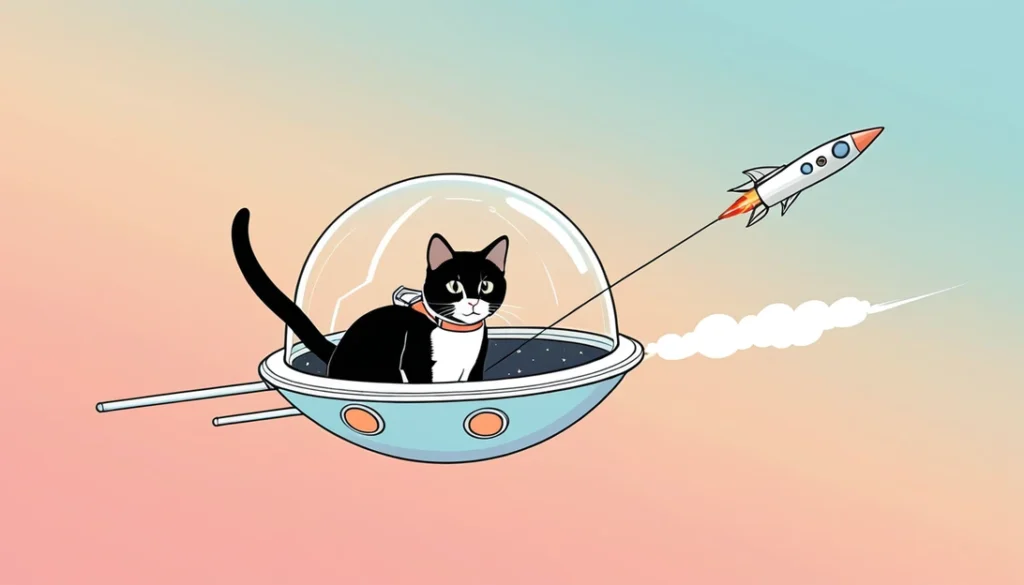
C 341 was loaded into the nose cone and launched at 8:09 a.m. on 18 October 1963. She experienced roughly 9.5 g during ascent: a load about nine and a half times her ordinary weight, not an increase in her mass. Sensors transmitted physiological readings back to the team. The windowsill comparison does not begin to cover the change in working conditions.
The capsule rose to roughly 150 kilometres, well beyond the conventional 100-kilometre Kármán line. Published summaries give slightly different exact altitudes; the important distinction is that this was a suborbital flight, not an orbit. Roughly five minutes of weightlessness formed part of the short journey. That is not the same as saying the whole launch-to-recovery interval took place in space.
A cat can reorient itself while falling without pushing against an external surface, as explained in the physics of the righting reflex. But Félicette was restrained inside a capsule, and a normal jump is a poor analogy for the sensory conditions of prolonged free fall.
The capsule descended by parachute and Félicette was recovered alive. NASA’s history of animals in space records the successful 18 October mission, and Guinness recognises her as the first cat in space. Surviving the flight was a real result. It did not mean the experiment ended there.
The Second Flight and the Other Cats
Six days later, on 24 October 1963, France launched a second cat. The mission failed and the animal died. NASA records the failed recovery, while accounts of the programme describe a rocket that went badly off course. This unnamed animal rarely appears in the memorial version of the story. It belongs in the record too.
Not every cat prepared for the programme flew. Scoubidou, whose electrode had to be removed, became a laboratory mascot and was later adopted, according to Patrick Roberts’s account drawing on contact with CERMA surgeon Gérard Chatelier. The neat claim that nearly the whole group was killed is not something the accessible accounts establish consistently enough to repeat as a headcount.
Félicette Survived the Flight, Not the Study
Félicette was subsequently euthanised for further examination of her brain and the implanted electrodes. Accounts commonly place this a few months after the flight. Her survival at recovery and her later death in the study are separate facts: neither should be allowed to hide the other.
It is worth sitting with that rather than skipping past it. The animal spaceflight programs of the fifties and sixties were built on the premise that a certain number of dogs, monkeys, rats and cats would be used to buy information that would keep human crews alive. Laika, launched by the Soviet Union on 3 November 1957, died in orbit and was never coming back by design. Fruit flies sent above the atmosphere on a V-2 in February 1947 were recovered by parachute. Albert II, a rhesus monkey, reached space in 1949 and died on impact when his parachute failed. Belka and Strelka launched on 19 August 1960 and returned alive the following day. Félicette belongs in that line, and the line is not a comfortable one.
How the First Cat in Space Got Called Félix
Here is where the historical record became entangled with a cartoon. The names Félix and Félicette circulated in accounts of the mission, with the feminine name linking the actual female cat to the familiar cartoon tomcat. A more elaborate tale had a male candidate escaping just before launch and leaving Félicette to take his place. A tidy story is not the same thing as a documented one.
In correspondence reported by Patrick Roberts in 2014, Dr Gérard Chatelier said there had been no cat named Félix in the programme. That participant’s recollection is a reason to reject the escaped-tomcat story, rather than to keep retelling it as a charming prelude. The real black-and-white cat had enough happen to her without an invented understudy plot.
The Stamps That Made It Worse
The name confusion even reached commemorative stamps: examples from Comoros, Chad and Niger label the space cat Félix. These tributes helped preserve the muddle as well as the memory. It is an unusually literal example of an error being given an official-looking stamp of approval. Cats have been reimagined by public iconography in rather different ways too, as with the temple traditions discussed in cats in ancient Egypt.
The Statue 1,141 Strangers Paid For
A particularly visible effort to commemorate Félicette came from Matthew Serge Guy, who launched a statue campaign in 2017. Its Kickstarter record shows 1,141 backers pledging £43,323 against a £40,000 goal, during a campaign that ran from 18 October to 17 November 2017. The target and the final total are different numbers; so are the campaign’s close and the later installation.
British sculptor Gill Parker produced a bronze showing Félicette sitting on top of a globe, head tilted upward. It was unveiled in December 2019 at the International Space University in Strasbourg, during celebrations for the 25th anniversary of the university’s Master of Space Studies program. The report of its unveiling places her on a campus full of people studying spaceflight, which is a better ending than a mislabelled stamp.
What the statue really corrects is an accounting error. Space history keeps a careful ledger of firsts, and for over half a century one entry in that ledger was filed under a name that belonged to a cartoon. Getting it right matters for the same reason it matters that the Voyager Golden Record lists what humanity actually chose to send outward, rather than what we would prefer to say we sent. The record should match what happened.
Frequently Asked Questions
Has any cat been to space since 1963?
Félicette remains the recognised first cat to reach space and return alive. A second French cat was launched six days later and died after a failed mission. Its fatal flight should not be erased merely because Félicette is the one whose name became famous.
Did Félicette actually reach space?
Yes. The capsule reached roughly 150 kilometres, above the conventional 100-kilometre boundary. It was a suborbital hop, with a few minutes of weightlessness, rather than a journey around Earth.
Was Félicette a stray?
Her pre-laboratory history is uncertain. She is often described as a Paris stray, while other accounts mention acquisition through a dealer. The mission is documented much more clearly than the circumstances in which she first entered the programme.
Why did they choose a cat instead of a dog or a monkey?
The experiment was neurological, and the feline nervous system was unusually well mapped in mid-century research, which made it a practical model for reading brain activity under acceleration and weightlessness. A cat is also small enough for a sounding rocket nose cone. If you are curious how differently that nervous system processes the world in ordinary conditions, see how cats actually see.
Where can I see the Félicette memorial?
At the International Space University campus in Strasbourg, France, where the bronze has stood since December 2019.
A Cat, a Rocket, and a Corrected Record
Félicette did not volunteer, did not understand, and did not get a long life out of it. She got a brief suborbital journey, a set of readings that fed into what France learned about keeping nervous systems functional under launch loads, and then a scalpel. What she has now is a bronze statue on a campus in Strasbourg and a name spelled correctly, both funded by strangers who thought the ledger deserved fixing. For a cat who spent her whole flight as an identification code, being remembered accurately is the closest thing to a happy ending the story allows. Cats have been quietly shaping human history for a long time, from the streets of Istanbul onward, usually without being asked.