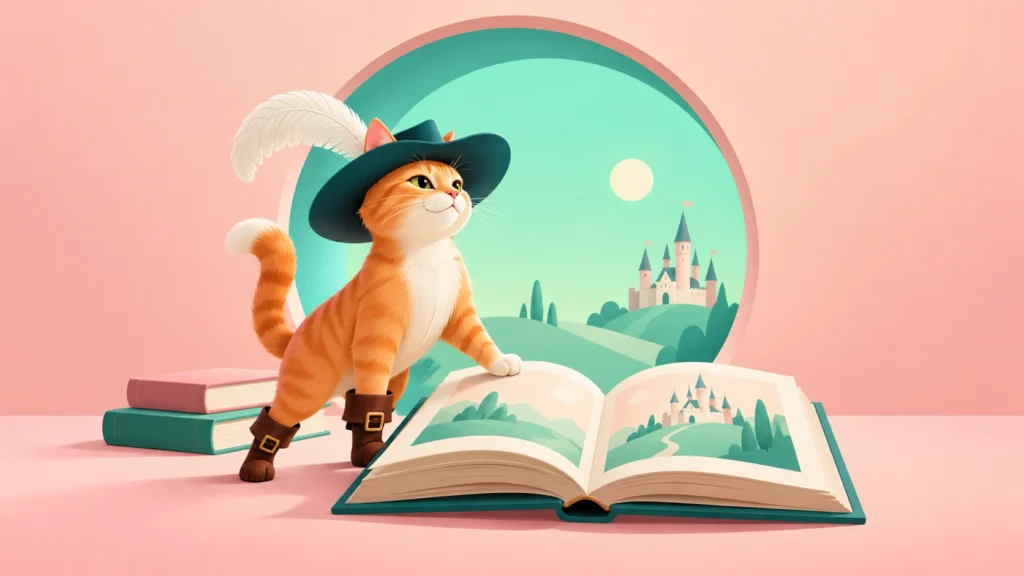
A cat inherits nothing, owns nothing and somehow ends up arranging a royal marriage. The appeal of Puss in Boots starts with that imbalance: the smallest character understands the social machinery better than everyone who supposedly runs it.
The familiar fairy tale is not the invention of an animation studio. Nor does its history reduce to one author having one idea. Surviving books let us compare versions; they cannot show us every story that circulated before somebody wrote it down.
A useful cat before the famous costume
Earlier Italian relatives of the story include Straparola’s Costantino Fortunato and Basile’s Cagliuso. Andrew Lang discusses those predecessors in his historical edition of Perrault’s tales. That is a better starting point than treating the oldest surviving printed example as proof that its author invented every element.
Basile’s version gives the relationship an especially sharp ending. After the cat has helped Cagliuso become wealthy, she tests his promised gratitude by pretending to be dead. His response exposes how little he values her. The helper is not merely a device that disappears once the human gets a wedding: she can judge what kind of person she has helped.
Perrault makes the performance visible
In Perrault’s version, the youngest son of a miller receives the cat while his brothers receive more obviously useful property. The cat requests equipment, including boots, then constructs a convincing public identity for a master who has no estate to match it.
Gifts, borrowed clothing and coached witnesses do the work. The ogre episode adds a different deception: the cat turns a display of power into a fatal mistake by encouraging the shapeshifter to become something small enough to eat. The solution is persuasion rather than physical strength.
One way to read the story is as a comedy about credibility. Clothing makes the invented nobleman look plausible; repeated claims make his supposed ownership sound established. The cat does not discover a hidden fortune so much as persuade powerful people that a fortune already exists. That interpretation is not a recommendation to imitate him.
A manuscript you can actually inspect
The Morgan Library preserves a 1695 manuscript of the Mother Goose tales containing Puss in Boots. Its text and illustrations provide evidence of a particular version before the familiar 1697 printed collection.
A dated manuscript is valuable because it gives the history a firm anchor. It does not settle the entire relationship between oral storytelling, earlier Italian publications and the Perrault family. Those are separate questions, and a confident timeline should not pretend otherwise.
When the helper becomes a studio mascot
Toei’s animated Puss ‘n Boots reached Japanese cinemas on 18 March 1969. Its hero, Pero, became the company’s mascot. Toei explains that connection itself, making this part of the cat’s commercial afterlife unusually easy to verify.
The costume helps explain why adaptations can differ so widely while remaining recognisable. A clever talking animal is a broad story idea; a cat in boots has a silhouette. Animation can change the voice, pace, companions and stakes while keeping that immediate visual signal.
What survives across these versions is not a single tidy moral. It is the pleasure, and sometimes the discomfort, of watching a little helper manipulate a much larger hierarchy. For another feline character whose history is less simple than its image, explore our Books & Reading archive.
🐾 Find Pudgy Cat merchandise in our shop.