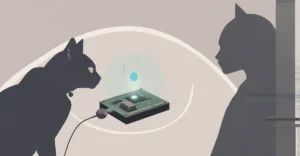
A microchip cat flap puts an access-control system in your kitchen door. The credential is already inside the cat: a tiny identification chip that has acquired a second job as a house key. Your pet approaches, the reader checks the number, and a latch decides whether to admit management.
It sounds like a small convenience. Underneath it sits a surprisingly rich engineering problem: how do you admit the right animal, reliably, without admitting everything that follows it? Add a camera, and there is another question. Is the approved visitor carrying something the household would rather not meet?
From a cat hole to a selective entrance
People were making openings for cats long before anyone could put electronics inside one. In Chaucer’s Miller’s Tale, a servant peers through a low opening used by the cat. It is a pleasingly ordinary detail in a medieval story: the cat has its own entrance, and someone else has found an unauthorized use for it.
A hole solves access. A flap helps close the opening again. Selective entry requires a further decision about who gets through. Different designs can base that decision on a collar token, an implanted identifier or an image. These are alternative ways to collect evidence, rather than a neat ladder on which every newer product makes all older ones obsolete.
The domestic problem behind SureFlap was suitably unglamorous. According to Sure Petcare’s company history, physicist Nick Hill wanted to stop neighbouring cats entering his home and frightening Flipper. He developed a reader for the cat’s existing microchip, with the first SureFlap range launched in 2008. An ambitious technology story, driven by someone else eating the cat food.
How a microchip becomes a door key
The American Veterinary Medical Association’s explanation describes the implanted chip as a small electronic device in a glass capsule, roughly rice-grain sized. It has no battery. A nearby scanner supplies the activating field, and the chip returns its identification number.
For reunification, that number can lead to registered owner information. For a flap, the immediate job is simpler: compare the number with the permitted list. Enrolling the cat in the door and keeping the pet’s microchip registration up to date are separate tasks. The door recognizing a number does not ensure that a shelter can reach you after a move.
FDX-B is a common animal-identification format operating at 134.2 kHz. The reader and tiny transponder need to be close enough to communicate; this is not a miniature GPS tracker broadcasting the cat’s whereabouts around the neighbourhood.
The useful mental picture is a door checking a badge at the entrance. It does not need to know where the cat spent the afternoon. It needs a readable credential at the moment the cat wants to pass.
Why installation and everyday reliability matter
Range is not a universal number shared by every scanner, implant and flap. The reader arrangement, chip position and installation all matter. Nor does every product provide the same control in both directions. A door that recognizes authorized arrivals is not necessarily equipped to enforce individual exit permissions.
The SureFlap Microchip Cat Flap Connect manual gives a useful view of the unglamorous failure modes: registration and access settings, low batteries, dirty sensors and interference associated with metal installations or nearby electrical equipment. These are checks for that product, not proof that every reluctant cat needs a replacement chip.
Before buying, use the manufacturer’s microchip compatibility information, measure the opening and check the installation requirements. If reading remains unreliable, the flap supplier and a veterinary scan can help distinguish a door problem from a chip-detection problem.
There is also the user interface, which in this case has whiskers. A latch click and unfamiliar tunnel may take getting used to. Observe how the cat uses the door and follow the model’s introduction guidance. A product that passes an electronics test but leaves the household’s main user protesting outside has not finished the job.
A camera asks what the cat is carrying
Ben Hamm’s project for his cat Metric became a memorable example of computer vision applied to household chaos. In Amazon’s 2019 account, Hamm used an AWS DeepLens camera and collected more than 23,000 images. He sorted them into categories covering Metric carrying a rat, approaching without one, appearing without trying to enter, and not appearing at all.
The goal was to block rodent deliveries. The striking part is how much work happened before the apparently clever moment at the door: gathering and labeling examples of an animal that had not volunteered to be a training dataset.
Commercial products pursue the same problem. In a 2024 interview, Flappie co-founder Denis Widler described camera-based prey detection and claimed accuracy above 90 percent. That is an attributed company claim, not an independent household reliability test.
Prey detection is also different from facial recognition. One asks whether the image appears to show an animal carrying prey; the other tries to establish which individual animal is present. A product doing the first should not automatically be assumed to do the second, or to include a microchip reader.
What an accuracy percentage leaves out
There are two especially relevant mistakes: rejecting a cat carrying nothing and admitting one carrying prey. Owners experience those very differently, and an overall accuracy figure does not tell you how often each happens.
Consider a deliberately simplified example: out of 100 visits, 99 are empty-mouthed. A useless system that always admits the cat could score 99 percent overall accuracy while missing the only prey delivery. The arithmetic is real; the numbers are illustrative, not measurements of a particular door.
Useful testing therefore needs to describe the examples, the two error types, lighting and how performance changes between animals. A leaf, a toy and a partly hidden mouse create different visual questions. You cannot turn an advertised percentage into a reliable forecast of monthly lockouts by multiplying it by your cat’s visits.
And blocking a delivery does not prevent the hunt that preceded it. The technology changes what enters the house, not everything that happens outside.
An identifier is not a secret
In a 2022 demonstration, researcher Roald Nefs showed that compatible rewritable transponders could present animal-identification data that ordinary readers accepted. A static identifying number is different from a credential that cryptographically proves possession of a secret.
That distinction also appears in our explanation of what devices such as Flipper Zero can and cannot do. It is a reason to understand the system’s limits, not a claim that every flap has been tested for the same attack or that electronic identification is useless.
Physical access has its own limits too. Once a flap opens, another animal may try to follow; resistance depends on the design and circumstances. Think of these products as selective pet entrances, and assess household security separately.
The engineering is an ongoing negotiation between identity, sensing, mechanics and an impatient customer. A chip helps answer “is this an enrolled visitor?” A camera may help answer “what is in its mouth?” Neither can explain why the visitor has decided the door must be inspected with one paw before every use.