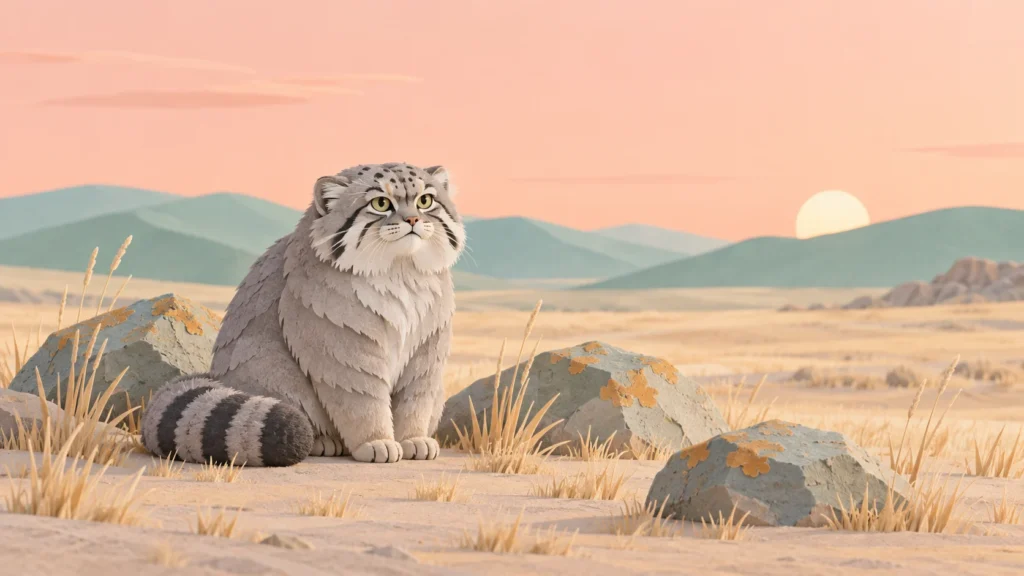
Pallas’s cat has the expression of an animal that has just inspected your plans and found them inadequate. Its broad face, low ears and thick coat have made the manul easy to recognise online. They also belong to a small wild predator whose life is considerably harder than a photograph suggests.
The familiar face is a useful starting point. Follow it out of the meme and you arrive in the rocky grasslands and cold, open country of Central Asia.
A body suited to staying low
The Pallas’s Cat International Conservation Alliance describes an animal with short legs, dense fur and small, rounded ears set low on the head. These features help explain its distinctive outline. Much of the apparent bulk comes from the coat.
Rocks and burrows provide essential shelter in a landscape where an animal needs protection from weather and larger predators. The manul’s home therefore depends on more than an area looking empty and remote to us. The arrangement of cover matters.
Picture the difference between looking at a hillside from a road and crossing it at cat height. From above, scattered stones may barely register. Close to the ground, a crevice can be the difference between exposure and a place to disappear. A landscape photograph seldom tells the whole story of an animal’s habitat.
What is behind the expression?
The IUCN Cat Specialist Group’s species account notes several features that distinguish the manul from a domestic cat, including round pupils and its flattened-looking head. The face can seem stern to a human observer without providing evidence that the animal is angry.
That distinction is easy to forget when a photograph arrives with a funny caption. We supply the bad mood, the disapproval and the imaginary complaint about Monday mornings. The animal supplied the face.
There is no harm in enjoying the joke, provided it does not become our understanding of the species. A still image cannot tell us whether a wild cat is relaxed, alert to a sound or watching something just outside the frame. Those possibilities become more interesting once we stop treating every photograph as the same expression.
A predator connected to smaller neighbours
Pikas and small rodents are important prey. Conservation accounts describe a close connection between the cat, the animals it hunts and the shelters available in its habitat. Poisoning programmes aimed at prey species can consequently affect more than their intended target. Habitat degradation and encounters with dogs add other pressures.
The conservation alliance brings together research and conservation work on these relationships. Its material offers a better next step than a collection of unusually fluffy portraits, particularly if you want to understand what field researchers need to learn about the species.
It is also worth being careful with conservation labels copied from older web pages. Assessments have dates, and different systems measure different things. A dramatic adjective attached to a photograph is no substitute for checking the assessment itself.
Our look at the Tilcayo story shows another reason to follow unusual-cat headlines back to their evidence. With the manul, there is plenty to appreciate without inventing anything: a small hunter, a remarkably insulating coat and a life organised around finding prey while staying out of sight.
The next time one appears in your feed, look beyond the eyebrows. Notice how close the ears sit to the head and how little of the body needs to rise above the rocks.