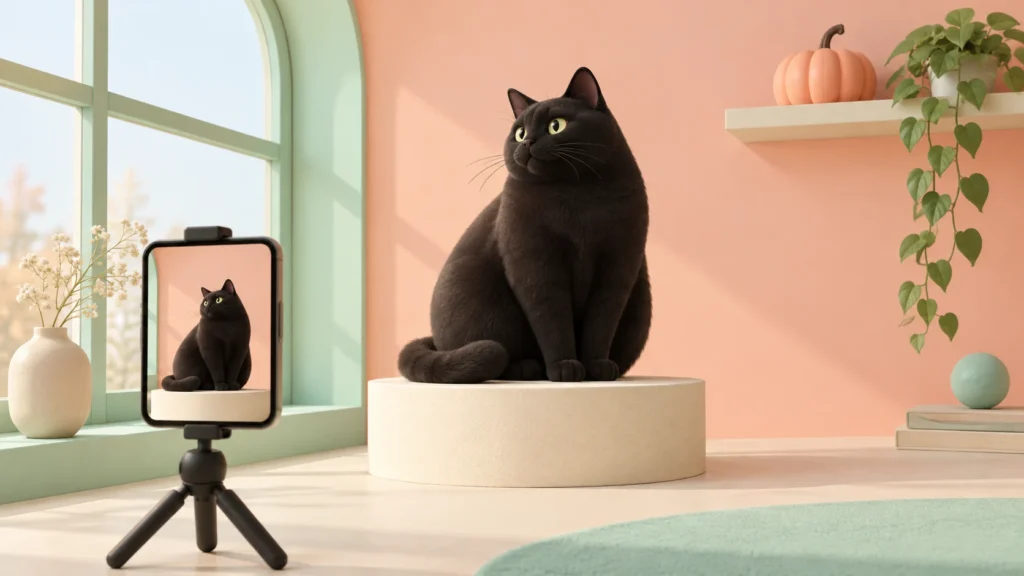
You can see the whiskers, the curve of an ear and the expression on your black cat’s face. Your phone produces two bright eyes floating in a dark patch. Add a glowing Halloween decoration in the background and the difference becomes even more obvious.
Before changing equipment, change the light and the position of the camera. A few small adjustments can make the photograph look much closer to the cat you can actually see.
Give the coat some soft light
Cat Care Society’s black-cat photography guide recommends natural light and attention to the background. A window can provide a useful starting point. Look for a place where the face is lit softly, without strong direct sun producing a sharp divide between bright and dark fur.
If the window is behind the cat, the camera may favour the bright background and leave the face too dark. Change your own position so that more light reaches the side of the cat you are photographing. You do not need to move an animal that has finally settled into a comfortable pose.
A pale wall or a quiet patch of sofa can help separate the outline from the background. For a Halloween picture, a pumpkin can remain a secondary shape behind the subject. It does not have to compete with the cat’s face for attention.
Tell the phone where to look
Tap the face or eye area to set focus. Many phones then let you adjust exposure with an on-screen control. Make a small change, take a photograph and check whether the fur still has detail. The aim is a visible black coat, rather than turning it grey through excessive brightening.
Take a second look at the eyes. A bright decoration may be sharp while the part of the photograph you care about is soft. Refocusing on the cat is usually more useful than taking several more versions of the same mistake.
Cats Protection’s photography advice favours natural light, avoiding flash and working with the cat’s behaviour. Burst mode can help when a turn of the head or a brief glance happens too quickly for a single carefully timed press.
Get lower and simplify the frame
A photograph from standing height often includes a great deal of floor. Lowering the camera towards the cat’s level changes the relationship immediately. Check what is behind the ears before pressing the shutter: a chair leg apparently growing out of the head is easier to avoid now than remove later.
Move closer when the cat is comfortable with your presence, rather than relying on heavy digital zoom. Leave room in the direction it is looking. Take a few frames, then stop and see what you have. A short session can be enough.
If your camera offers animal-eye autofocus, its manufacturer’s guidance can explain the relevant mode. Such tools help with focus; they cannot compensate for every awkward angle or an animal that would prefer to leave.
Keep the seasonal props optional
A cat needs no costume to belong in a Halloween photograph. Keep flames, loose threads and chewable decorations away from it, and let it walk out of the frame. A comfortable pose is worth waiting for.
Our article about black coats and their sometimes-visible stripes gives you another detail to look for when the light changes. Good lighting can reveal far more than a pair of eyes, even when your subject insists on remaining mysterious.