
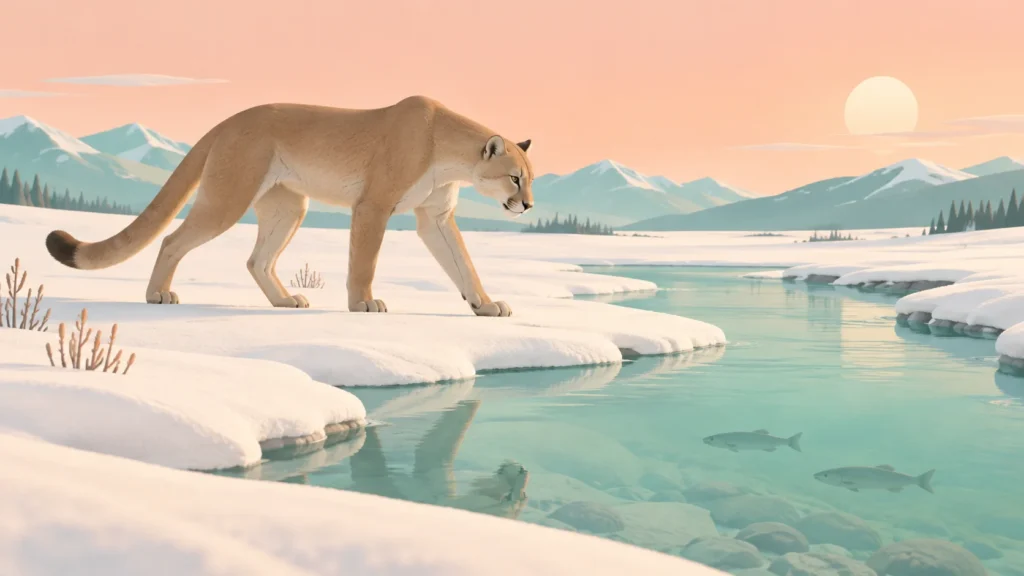
The name American cheetah suggests an animal racing across open country. New research on Miracinonyx trumani adds a very different setting: the Arctic Yukon, where chemical evidence in ancient remains points towards a diet that included fish.
The study, published online in Current Biology on September 4, 2026, combines ancient DNA with stable-isotope analysis. Those approaches ask different questions about the same vanished animal: where it belongs in the cat family, and how different populations lived.
DNA puts the nickname in perspective
The paper’s abstract describes nuclear genomes recovered from specimens about 23,000 years old from Wyoming and about 31,000 years old from the Yukon. The analysis places Miracinonyx alongside the puma lineage, with a split estimated at roughly 2.6 million years ago.
Its cheetah-like body therefore does not make it a member of the modern cheetah lineage. Similar physical features can evolve along different branches of a family tree. The scientific name keeps the extinct animal distinct even when the popular nickname encourages a familiar mental picture.
The Yukon specimens also extend the known range more than 20 degrees of latitude northwards. That geographical change gives researchers a much wider set of environmental conditions to consider.
The fish clue comes from chemistry
According to UC Santa Cruz’s account of the study, stable isotopes indicate differences between northern and southern animals. The northern results are consistent with feeding at a high level in an aquatic food chain, likely involving fish such as salmon that migrate between sea and fresh water.
This is an inference from the remains, not an observation of a hunt. It does not show exactly how the cats obtained fish, or turn every Miracinonyx into a specialist fisher. The Wyoming population appears to have occupied a more general terrestrial predatory role.
The distinction between populations is part of what makes the result interesting. A single familiar nickname can hide different ways of making a living across a species’ range.
Earlier anatomy had already raised questions
The puma connection did not first appear with this headline. In research reported by the University of Málaga in 2023, scientists examined the elbow joint and other anatomical features. They argued that the animal retained a greater ability to grapple with prey than the highly specialised running anatomy of a modern cheetah suggests.
The new genomic work strengthens the family-tree evidence and adds information about range and diet. Treating it as part of an accumulating investigation gives a clearer account than announcing that every earlier idea has suddenly been overturned.
A fuller animal emerges
UC Santa Cruz also reports low genetic diversity in the sampled animals, with evidence of a long decline rather than a simple recent collapse through inbreeding. That may help researchers consider vulnerability around extinction, but it does not identify one proven cause of the species’ disappearance.
What makes this study rewarding is how the evidence changes the questions. A fast-looking skeleton invites questions about running. A genome opens questions about ancestry. Isotopes add the possibility of a very different meal beside a northern river.
Our article on the Tilcayo and feline classification explores another case in which a name and a family relationship need careful handling. Here, keeping Miracinonyx in view as its own animal gives the research room to reveal more than the nickname promises.
The featured image is an artistic reconstruction. Details of appearance and the depicted riverside moment are illustrative.