 English
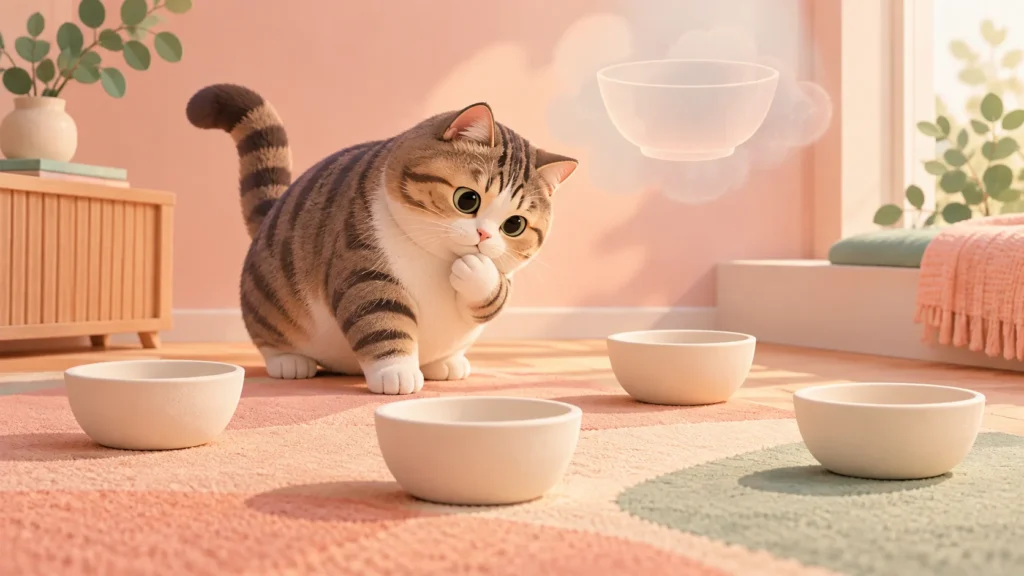
A cat returns to a place where something interesting happened earlier. Does it remember that particular event, or has a familiar routine simply brought it back?
Separating those possibilities takes more than watching an animal wait beside its food bowl. Researchers need a situation in which repetition cannot explain everything.
A meal with an unexpected follow-up
In a 2017 study led by Saho Takagi, cats encountered food containers and later returned for an unexpected exploration test. The researchers were interested in information about what had been where during a single earlier experience.
One experiment used four baited containers, with cats allowed to eat from two. After a delay, the animals explored replacement empty containers. Their behaviour indicated memory for locations associated with food they had not eaten.
A second arrangement varied what the cats encountered at the containers. The results supported the use of incidentally acquired information about both content and location.
The important word is incidentally. The cats had not first been drilled to memorise those particular details for a later examination.
Why an empty container helps
A freshly available food smell could explain an animal's choice without requiring much memory. Using replacement empty containers helps researchers ask whether earlier information still influences exploration when the immediate situation changes.
The design also shows why a single observation at home is hard to interpret. In a kitchen, food smells, familiar movements, time of day and repeated experience can all overlap.
You can appreciate your cat's apparent recollection without pretending those alternatives have been excluded. The experiment is useful precisely because it narrows the question.
Memory has more than one job
Knowing a feeding routine and retaining information from a particular encounter are both useful capacities. They need not operate in exactly the same way.
The study does not establish that cats mentally replay autobiographical scenes as people describe doing. We cannot ask the animals what remembering felt like. Behaviour gives access to what information they can use, with less direct access to the experience behind it.
A similar distinction appears in research on whether cats recognise their names. A response can demonstrate discrimination without answering every larger question about understanding.
The phrase single experience deserves attention of its own. Learning a routine over many repetitions and retaining something from one encounter pose different experimental questions. Both might influence what a cat does, but a study has to find a way to distinguish them.
When reading a summary, look for what the researchers allowed the animals to experience beforehand and what changed at the later test. Those details explain why the result is interesting. Without them, an apparently impressive memory story can become little more than an account of a cat returning to a familiar food source.
Notice without setting an exam
There is no need to hide meals or frustrate a cat to test the result in your living room. Ordinary routines offer plenty to observe: a return to a recently interesting place, a pause at a changed doorway, or renewed investigation of an object.
Those moments are worth noticing on their own terms. The food-container study gives one carefully bounded reason to think a cat's earlier experience can remain useful even when nobody told it there would be a test.