 English
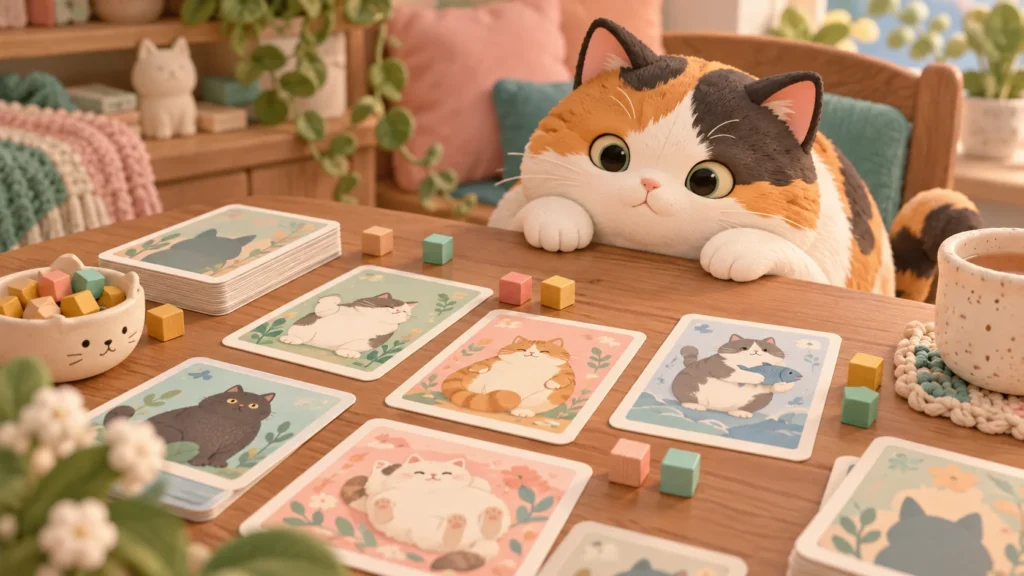
There is a lovely cat in the middle of the table. You can take it. Unfortunately, dinner has become a more complicated calculation than you expected.
Cat Lady, designed by Josh Wood and published by AEG, builds its decisions around that temptation. You collect cats and the things associated with caring for them, while keeping an eye on what your collection will need at the end.
Three cards come as a package
The official rulebook starts with a three-by-three grid. On a turn, you take a complete row or column of three cards. A cat token blocks one available line, and taking cards changes which line is blocked next.
You cannot simply select the three objects you like best. The attractive cat may share a row with something less useful, while the food you need sits in another column.
That constraint does a great deal of work. It turns the display into a small planning problem and gives the other players' choices immediate relevance. A desirable combination may disappear before your next turn.
Every new cat changes the calculation
At the end, cats must receive the food indicated on their cards. Fully fed cats score their stated points; an unfed cat costs two points. Partially meeting a cat's requirement does not earn a partial reward.
Consider a simple choice. One line improves your collection, but another makes your existing cats easier to feed. The first looks more exciting. The second may prevent a penalty you have quietly been building towards for several turns.
That makes restraint part of the theme. The question is not only whether a cat is worth points, but whether you can support the choice you are making.
At the table, explain one scoring decision before dealing the first hand. A new player may understand what a card depicts while still missing why its position in the grid matters.
It helps to use an imaginary row as an example: one attractive card beside two that do little for your current collection. Compare it with a less exciting row that supplies something you need. The choice becomes clearer when the group sees the whole selection as a package. That is the small puzzle the game keeps returning to.
Read the table as well as your own cards
AEG's game page presents Cat Lady as a compact card-drafting game. Its open display encourages attention to what other players take, while the different types of collectible cards offer competing priorities.
Before taking a new cat, check the food you already hold. Before taking food, check whether you are solving an actual shortage. It is easy to become so interested in a future combination that you overlook the requirements already in front of you.
The title also plays with a familiar cultural label. Our history of the cat lady stereotype follows that phrase outside the game. Here, everybody at the table can take the role.
The original AEG game is for two to four players. Its food cubes and exaggerated collection theme belong to the rules, rather than offering a guide to real feline nutrition. What it captures very neatly is the moment when wanting one more cat meets the practical question of caring for it.