A photograph of a cat peering through a hole in a ceiling became an unlikely figure of internet theology. By the late 2000s, Ceiling Cat had an adversary, a following, and a role in a collaborative Bible parody. The escalation is the interesting part: a watchful face became a reusable character, and strangers kept adding to the joke. Imageboards, cat-picture rituals, and lolspeak all helped furnish the little feline universe.
This is the theology side of the story. If you want the anatomy of one single stretched cat, we already covered the history of Longcat and Catnarok, and Longcat only appears here as a comparison. What follows is about how Caturday, Ceiling Cat, Basement Cat, and lolspeak turned into a shared belief system with its own scripture, its own grammar, and eventually its own museum acquisition.
Table of Contents
- Where Feline Mythology Started: Futaba Channel and 4chan
- Caturday: The Weekly Ritual That Made Cats a Genre
- Ceiling Cat: From Watchful Photograph to Internet Deity
- Basement Cat and the LOLCat Bible Translation Project
- Lolspeak Is a Grammar, and Linguists Went and Checked
- January 11, 2007: A New Home for the Cats
- Frequently Asked Questions
- Ceiling Cat Is Still Watching
Where Feline Mythology Started: Futaba Channel and 4chan
Futaba Channel, often called 2chan, was one of the Japanese imageboards that influenced 4chan. Imageboards put pictures and replies together in fast-moving threads, often with anonymous participation. They offered a different setting from a personal blog: a picture could become part of a collective exchange rather than remain attached to one author’s page.
The handoff from 2chan to 4chan
Christopher Poole, known as “moot,” launched 4chan in 2003 while still a teenager, drawing on the Japanese imageboard model. For a fuller account of the site’s beginnings, see our history of 4chan. Its influence on cat memes is one part of a much wider and often abrasive culture.
Three properties help explain the setting: anonymity, rapid thread turnover, and the combination of images with text. A 2011 study of 4chan’s /b/ board documented mostly anonymous posting and short-lived threads. Users could still save images and preserve material elsewhere. A joke’s survival could depend on repetition, remixing, and those outside archives, not memory alone. The caption template, explored in our guide to image macros, made variation easy.
Caturday: The Weekly Ritual That Made Cats a Genre
Caturday is where the schedule comes in. Saturday became an occasion for posting cat pictures on imageboards and beyond. An Urban Dictionary entry dated October 2006 already associates the word with 4chan and its adoption elsewhere. It is a period trace of the custom, rather than a definitive certificate of the first Caturday.
Such traces matter because much of this activity was informal and poorly preserved. A dictionary submission records that someone knew a term by then; an archived thread records one surviving conversation. Neither captures every earlier joke passed between users. The cat has left footprints, but not a complete visitor book.
A recurring slot gave people a reason to return with another image or another variation. That helps explain how familiar characters could become part of the fun: “another cat” becomes “that cat again, doing the thing.” Calling Caturday a ritual is a useful way to describe that repetition. It does not mean cats were forbidden from being funny on weekdays.
Ceiling Cat: From Watchful Photograph to Internet Deity
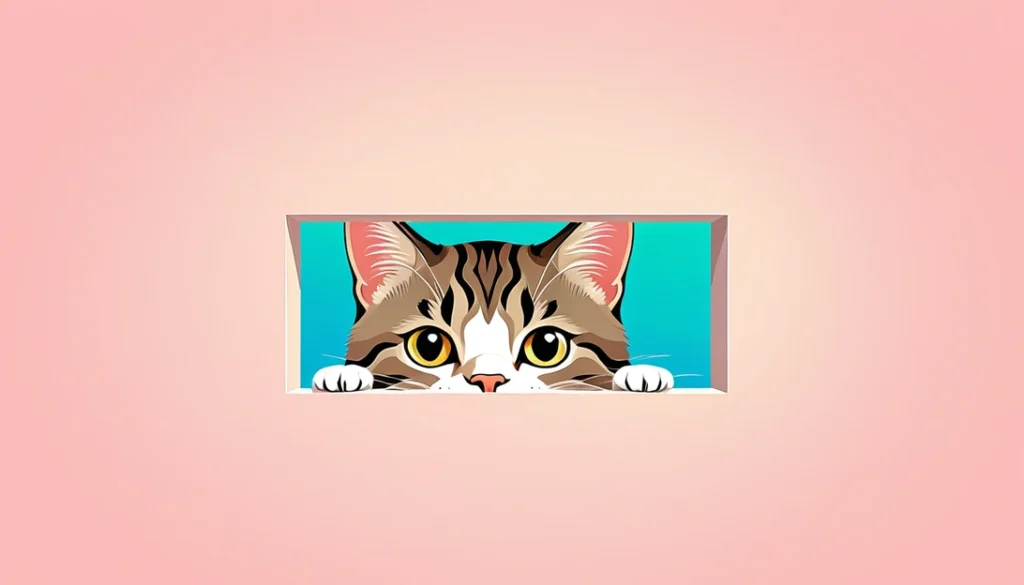
The Ceiling Cat photograph shows a cat peering through a rectangular hole in a ceiling. Its early circulation is difficult to reconstruct precisely. Artists Eva and Franco Mattes describe the photographer as unknown in their account of the meme that inspired their later sculpture. The memorable composition mattered more to the remix culture than a reliable credit line.
The caption format that built a deity
During the mid-2000s lolcat wave, the image became associated with captions about what Ceiling Cat was watching the viewer do. Some were crude; others simply assigned a different activity to the person below. The watchful face and the repeatable sentence supplied a template. The viewer did not need an elaborate backstory to understand the joke.
The step from “watching you” to “omniscient” is short, and the internet took it fast. A cat that sees everything you do, that you cannot see back, that lives above you and never comments, is functionally a god with the theology already written into the image. The composition itself did most of the work. In later macros the cat was often superimposed into the top left corner of unrelated photos, a small watchful head in the ceiling of someone else’s living room.
Basement Cat and the LOLCat Bible Translation Project
This particular joke-god acquired an adversary. Basement Cat arrived as the inversion of every Ceiling Cat property: black instead of pale, below instead of above, malicious instead of merely watchful. Ceiling Cat lives in the attic and represents good. Basement Cat lives in the basement and represents evil in the parody. Once both existed, the community had a cosmology with a vertical axis and a moral polarity, which is more structure than most joke formats ever acquire.
A Wiki Becomes Feline Scripture
Martin Grondin’s LOLCat Bible Translation Project invited volunteers to recast biblical text in lolspeak. Ceiling Cat took the divine role, and the familiar language of cat macros expanded into long passages. The Library of Congress’s 2014 discussion of its web-culture archive includes the project as a substantial record of that online vernacular. Which is a sentence worth sitting with.
Ulysses Press published Grondin’s LOLcat Bible in 2010; the library catalogue record identifies the book and publisher. It draws selected biblical stories into the feline parody rather than being a conventional scholarly translation. Whatever else it is, it is a real book in which an internet cat has been promoted to a remarkably senior position.
Lolspeak Is a Grammar, and Linguists Went and Checked
The dialect looks like typing errors, but there are patterns in the play. Lauren Gawne and Jill Vaughan’s “I can haz language play”, published in the proceedings of the 2011 Australian Linguistic Society conference, examined how participants reshape words, sentences, and vocabulary in LOLspeak.
Their analysis describes shared tendencies that users can follow or deliberately bend. The point is not that someone issued an official grammar and every cat obeyed it. Recognizable patterns make a playful departure meaningful. There is a difference between an ordinary typo and a form readers recognize as part of the joke.
Gawne and Vaughan connect that play with the construction of identity. Using a recognizable style can signal familiarity with a community, while bending it can add another layer of humor. Our explainer on copypasta looks at a related pleasure: recognizing a format and understanding what someone has done with it.
January 11, 2007: A New Home for the Cats
I Can Has Cheezburger became a prominent new home for captioned cats in 2007. The site’s own account dates its beginning to 11 January and the familiar British Shorthair image with a cheeseburger request. It did not invent every ingredient of the lolcat. It helped make the format easy to find and share beyond its earlier communities.
A dedicated cat-humor site presented the images in a different context from a fast-moving imageboard. Readers could visit for the cats without following the surrounding board culture. That broadened access, although it did not make all users identical or erase earlier versions. Our history of cat memes places this change in a longer timeline.
What happened when the audience changed
A named destination also made the joke easier to package as a media brand. The experience of encountering a recurring cat on a dedicated humor site could be very different from encountering it in a chaotic board thread. The same picture could now arrive with different expectations about what was funny and who belonged.
Kate Miltner’s 2014 study in First Monday, based on interviews with thirty-six lolcat enthusiasts, explored those differences. Participants used the memes in distinct ways and could disagree about what counted as a proper example. The research supports a story of overlapping audiences and contested meanings, rather than one united internet congregation. Ceiling Cat could be funny for quite different reasons depending on who was looking up.
Limor Shifman’s Memes in Digital Culture (2013) offers a useful frame: related pieces of content are copied and transformed with awareness of one another. Ceiling Cat fits that idea well. A photograph, a caption pattern, and a fictional role can each invite variations. Similar collaborative expansion appears in the story of the Backrooms, though that mythology has a different history and tone.
The mythology has one more resting place. Eva and Franco Mattes made Ceiling Cat in 2016, using a taxidermy cat and a custom-made hole. SFMOMA’s collection record dates its acquisition to 2019. A meme about being watched from above had become an object for a museum collection. The cat had escaped the screen and found another ceiling.
Frequently Asked Questions
Who took the original Ceiling Cat photo?
The photographer is not reliably established in the accounts cited here. The image’s many reposts and adaptations make its early history difficult to reconstruct. A date attached to one copy should not automatically be treated as the date the photograph was taken.
Is Caturday still a thing?
Yes. Caturday continues as a recurring excuse to share cats beyond its imageboard setting. A weekly tradition can coexist with cat pictures being available every day; abundance does not stop people enjoying the familiar name.
What is the difference between Ceiling Cat and Basement Cat?
In the playful mythology, Ceiling Cat is the watchful figure above and Basement Cat is the dark adversary below. They supply a simple good-versus-evil contrast, reused in different images and in the Bible parody.
Was the LOLCat Bible an actual published book?
Yes. Ulysses Press published Martin Grondin’s LOLcat Bible in 2010, drawing on the collaborative online project. It recasts selected biblical stories in lolspeak, with Ceiling Cat in the divine role.
Why did cats specifically become the internet’s mythology?
A caption can assign intentions to an expressive animal face, and cats supplied plenty of reusable poses. Their popularity, the habits of particular communities, and the ease of remixing all helped. No single photograph or platform mechanism fully explains why people joined in.
Ceiling Cat Is Still Watching
The imageboard era produced something stranger than a popular joke. It produced a joking folk religion with a pantheon, a scripture, a liturgical calendar in Caturday, and a liturgical language that linguists later documented as a real variety. No single person designed the whole thing. Participants built on pictures and phrases across boards, blogs, and a deliberately organized wiki project. That is a good reminder of what platform mechanics actually do. They do not just host culture, they shape which culture can survive on them. Ceiling Cat is still watching. He just has a museum salary now.