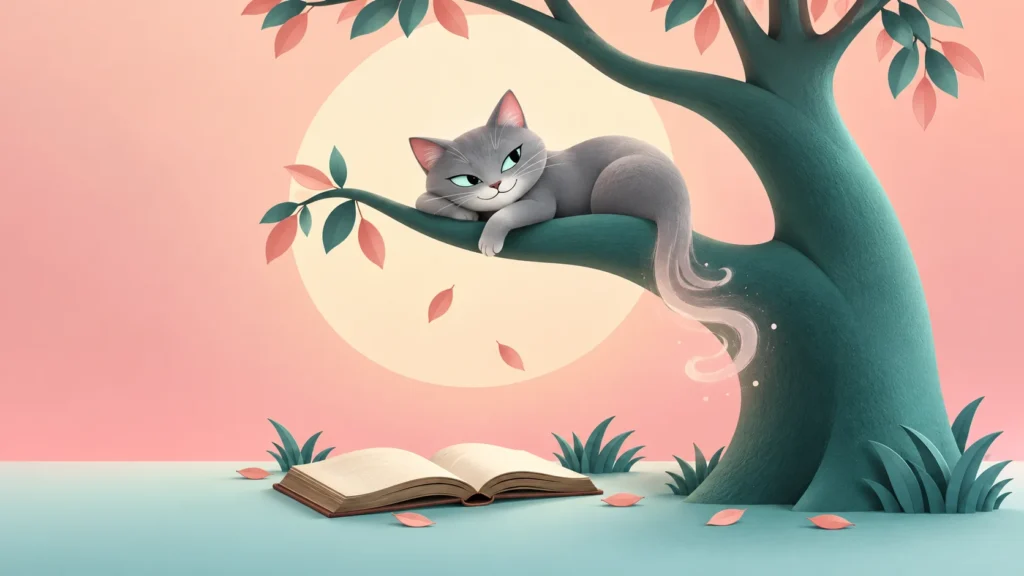
Lewis Carroll created the disappearing Cheshire Cat of Alice’s Adventures in Wonderland. He did not invent the older expression about grinning like a Cheshire cat. Separating the character from the saying is the first step toward understanding the origin question.
The saying existed before Wonderland
The expression appears in the 1811 edition of the Dictionary of the Vulgar Tongue, where it describes someone showing teeth and gums while laughing. That is direct evidence of a pre-Carroll expression, without requiring us to identify the first occasion on which anyone ever used it.
A dictionary entry tells us that a phrase was in circulation. It does not necessarily explain how it began. An earliest surviving citation is not a birth certificate for an idiom.
A cat added during revision
The British Library’s manuscript catalogue compares Alice’s Adventures Under Ground with the expanded Wonderland. It identifies the Cheshire Cat and the Mad Tea-Party among the additions.
The catalogue also warns against inaccurate word counts repeated in earlier reference works, giving totals of 12,715 and 26,211 for its comparison. The important literary point is the expansion itself: a character now inseparable from Alice was not present in the shorter manuscript.
That does not establish Carroll’s private motive for creating the Cat. The idea that he deliberately invented a disappearing creature as a joke about a missing etymology is an appealing interpretation, not a documented statement of intent.
What the Cat does on the page
In Carroll’s text, the Cat’s grin is initially explained simply by its being a Cheshire cat. Later, its conversation with Alice makes the usefulness of directions depend on where she wants to go.
The disappearance turns a familiar expression into an impossible spectacle: the grin remains after the rest of the animal has gone. At the croquet ground, the Cat’s disembodied head creates a different problem for an executioner ordered to behead it.
My reading is that the Cat makes language behave like a physical object. Expressions that are harmless in ordinary conversation become awkward when taken literally. The scenes work even if the original reason for the county’s association with grinning remains uncertain.
How to read the competing origin stories
Stories about cheese, inn signs and church carvings are often offered as explanations. A resemblance or a geographical connection can suggest a possibility, but it does not by itself demonstrate that Carroll saw an object and used it as a source.
The reverse argument needs care too. A family’s move after a book’s publication does not prove the author never visited that area earlier. And failing to locate an old object does not prove that no such object ever existed.
For that reason, this account does not rank a favorite origin theory as the winner. Establishing a specific inspiration would require stronger evidence, such as a dated letter, diary entry or contemporary account that makes the connection.
A grin large enough for astronomy
The name has traveled beyond literature. The Chandra observatory’s account of the Cheshire Cat galaxy group describes a face-like arrangement in which gravitationally lensed light forms a grin. The nickname is a visual analogy, not a claim that the astronomical system behaves like Carroll’s character.
This is a useful distinction whenever literary names migrate into science: the familiar image can help introduce an idea without replacing the actual mechanism.
What we can say with confidence
The grinning expression predates Wonderland. Carroll turned it into a character with extraordinary abilities. The manuscript record shows that character arriving during the story’s expansion. The original cause of the saying is a separate question.
The Cat does not become less interesting when we stop pretending every detail of its ancestry is settled. A grin can be perfectly recognizable even when its history is difficult to pin down. Our history of black-cat superstitions explores another case in which stories about cats accumulate meanings over time.
Visit the Pudgy Cat Shop for cat-inspired goodies, or find our illustrated books on Amazon.