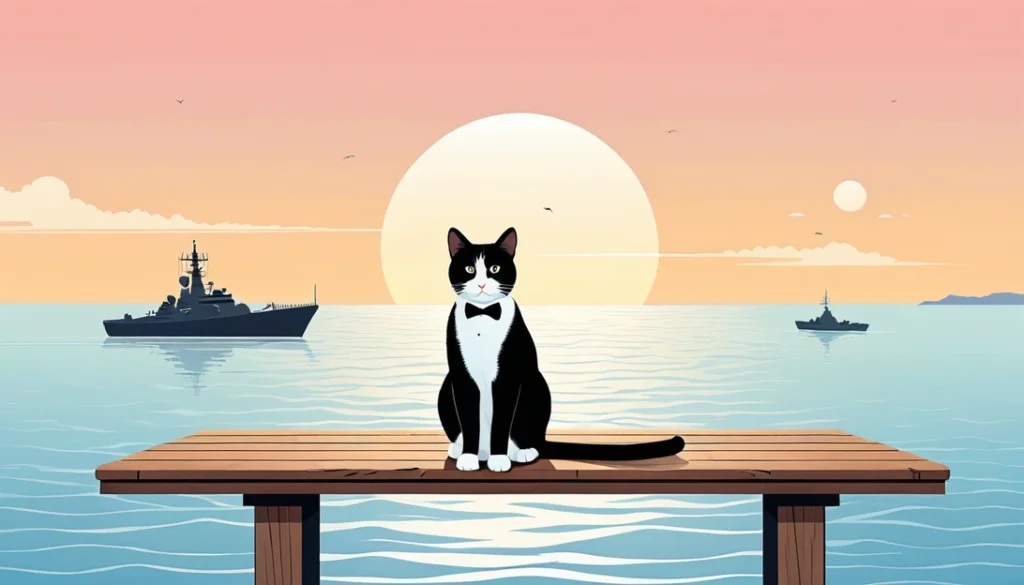
Unsinkable Sam has a naval career that would make a ship’s insurer quietly close the office. The familiar story follows one cat from the German battleship Bismarck to the British destroyer HMS Cossack, then to the aircraft carrier HMS Ark Royal. All three ships sank in 1941. The cat, naturally, was unavailable for comment.
It is tempting to file the whole thing as either a miracle or a myth. Neither label does the evidence much justice. There are wartime newspaper references to a cat called Oscar. There are also serious gaps in the claim that the same animal survived every disaster. A good sea story can have a real cat at its centre and still acquire a rather ambitious CV.
The Legend, as It Is Usually Told
The standard version begins aboard Bismarck. After the battleship sank on 27 May 1941, HMS Cossack supposedly retrieved a black-and-white cat from floating wreckage. Nobody knew his original name, so he became Oscar, sometimes spelled Oskar. He then survived the loss of Cossack in October and moved to Ark Royal, just in time for another sinking in November.
At this point, most employees would request a transfer. In the story, Oscar becomes Unsinkable Sam, leaves seagoing service and eventually retires to a sailors’ home in Belfast, where he dies in 1955. That is the familiar narrative, including its tidy ending. It should not be mistaken for a continuous service record checked at every transfer.
Three Ships That Really Did Sink
The ships are the solid part of the scaffolding. Their losses happened within six months, although not in one convenient patch of sea around Gibraltar.
Bismarck, 27 May 1941
Bismarck was destroyed in the North Atlantic after the Royal Navy’s pursuit. More than 2,000 men died. The small number of human survivors and the interruption of the rescue operation make this a particularly grim setting for a cheerful animal anecdote. The cat story sits beside that history; it should not erase it.
HMS Cossack, October 1941
Cossack, a Tribal-class destroyer already famous for the Altmark rescue, was torpedoed by U-563 on 23 October while escorting a convoy. Attempts to save the damaged ship failed, and she sank on 27 October west of Gibraltar. Geoffrey B. Mason’s service history separates the torpedo attack from the later sinking, a distinction that compressed versions of the cat story often lose.
HMS Ark Royal, November 1941
Ark Royal was torpedoed by U-81 on 13 November and sank the following morning near Gibraltar. Almost everyone aboard escaped; one sailor died. The Imperial War Museums photograph of the evacuation records men leaving the carrier for HMS Legion. A ship’s documented loss and an individual animal’s full itinerary are different questions.
The Story Was Already in the Wartime News
The claim that no contemporary newspaper mentioned Oscar is too strong. The account and newspaper references collected here identify a Reuters report printed in the Belfast Telegraph on 18 November 1941. It described Oscar’s rescue after Ark Royal and repeated his supposed connection to Bismarck. A Yorkshire Post interview on 25 November named Oscar and another ship’s cat, Parry, among the survivors.
Those references matter because they place the story in circulation during the war, not decades after it. The archive scans were not available to inspect for this article, so the detailed newspaper reconstruction remains dependent on that secondary account. It is still a reason not to declare that the contemporary press was silent.
There is another distinction hiding in plain sight. A newspaper reporting that sailors called a cat a survivor of Bismarck establishes what was being said. It does not independently witness the earlier rescue. A wartime story can already contain hearsay. Rumours did not have to wait for Wi-Fi.
Where the Evidence Becomes Thin
The difficult link is the beginning of the journey. Cossack participated in the pursuit of Bismarck, but its presence in the operation is not itself proof that it recovered a cat. Equally, a list of ships that rescued human survivors cannot, on its own, prove that no animal was picked up separately.
This is where scepticism needs brakes. An unofficial pet might leave little paperwork. That possibility does not verify Oscar’s presence aboard the German ship, but missing paperwork does not make the story impossible either. We need a connection between the animal and each event, rather than treating either charm or doubt as evidence.
The question is not whether cats can survive shipwrecks. It is whether the cat identified after one sinking can be securely connected to the earlier ones. Even an exceptionally determined cat cannot fill in his own transfer forms.
The Portrait in Greenwich
The National Maritime Museum at Royal Museums Greenwich holds a framed pastel by Georgina Shaw-Baker, catalogued as PAJ2744 and titled Oscar, cat from the German battleship ‘Bismarck’. It shows a black-and-white cat on floating wreckage. The museum’s description recounts the story while acknowledging doubts about the Bismarck connection and conflicting photographs.
A drawing is a historical document, just not the same kind as a log entry or a dated eyewitness statement. It tells us that Oscar was represented and remembered this way. It cannot, by itself, certify all three rescues. Having a catalogue number is excellent for being found in a collection; it is less useful as a naval passport.
The museum’s own caveat is worth keeping attached to the story. Institutional recognition does not require every detail of a subject’s biography to be beyond dispute. That distinction also helps when reading about the supposed medieval European cat massacres: repetition and certainty are not the same thing.
The Photograph Problem, and a Different Cat Named Simon
One identification problem is unusually easy to spot. Royal Museums Greenwich notes an image circulated as Oscar in which the cat wears a tag marked HMS Amethyst 1949. That points to Simon, a different naval cat. It does not mean that every photograph labelled Sam is necessarily the same misidentified image; captions need checking individually.
Simon’s own record does not need embellishment. The PDSA’s award account describes his service aboard HMS Amethyst during the Yangtze Incident, his wounds, continued rat-catching and contribution to morale. He received the Dickin Medal in 1949 and remains its only feline recipient. The April fighting and the later award should not be compressed into one date.
Borrowing Simon’s photograph gives Sam an air of documentary certainty without supplying the missing connection. A uniform, even a very small one, is persuasive. The label on the collar is more useful.
Why Unsinkable Sam Refuses to Sink
Sea stories are a genre with rules, and this one knows them. There is threefold repetition, a memorable nickname and a retirement that finally keeps the hero away from torpedoes. The cat provides a small, stubborn survival story inside a history of enormous loss. It is easy to understand why people want to keep it.
Several cats’ experiences could have become tangled in the retelling. So could a real rescue and an already circulating rumour about an earlier ship. Those are possibilities, not a solved alternative history. We cannot calculate the odds from a handful of anecdotes, then announce that the version we prefer must be what happened.
Animals accumulate this kind of narrative gravity constantly. It happened to Félicette, the first cat sent into space, whose story is often retold with the wrong name. It happens to black cats and their supposed historical bad luck. The enjoyable story and the checkable record are allowed to be different sizes.
What Ship’s Cats Actually Did for a Living
The reason Oscar’s career is conceivable is that cats aboard ships were ordinary. They could hunt rodents and be pets, companions or mascots at the same time. There is no rule requiring a useful mouser to refuse affection on principle. Simon’s award recognises both work and morale.
Rodents threatened stored food and shipboard equipment; cats offered one practical response. That relationship belongs to a much broader history, from cats travelling through the Roman world to library cats with unofficial job descriptions. Different institutions, similar opportunities to sleep somewhere inconvenient.
For the wider maritime story, see the history of ships’ cats. And for a port city where feline belonging does not require enlistment papers, there is Istanbul.
Frequently Asked Questions
Did Unsinkable Sam really exist?
A cat’s existence, his identification as Oscar and the complete three-ship biography are separate claims. The safest conclusion is that the full itinerary remains uncertain. Neither a confident retelling nor a confident dismissal resolves the missing links.
Where is the portrait of Oscar?
It belongs to the National Maritime Museum’s collection at Royal Museums Greenwich, under reference PAJ2744. It is Georgina Shaw-Baker’s pastel of a black-and-white cat on wreckage. Consult the museum if you want to know whether it can be seen during a visit.
Are Simon and Unsinkable Sam the same cat?
No. Simon served aboard HMS Amethyst and received the Dickin Medal in 1949. A photograph bearing that ship’s name should not be used as proof of Sam’s wartime itinerary.
Were all three ships lost near Gibraltar?
No. Bismarck sank in the North Atlantic. Cossack was lost west of Gibraltar, and Ark Royal near Gibraltar. The connection is the proposed journey of the cat, not three wrecks in the same small area.
Enjoy the Story; Keep the Uncertainty
Unsinkable Sam does not need a courtroom verdict to remain a wonderful sea story. He does deserve better than an invented certainty in either direction. The ships sank, the legend travelled and the full feline itinerary is harder to pin down. Enjoy the cat with the extraordinary career. Just leave a little room on his record for “details disputed”.