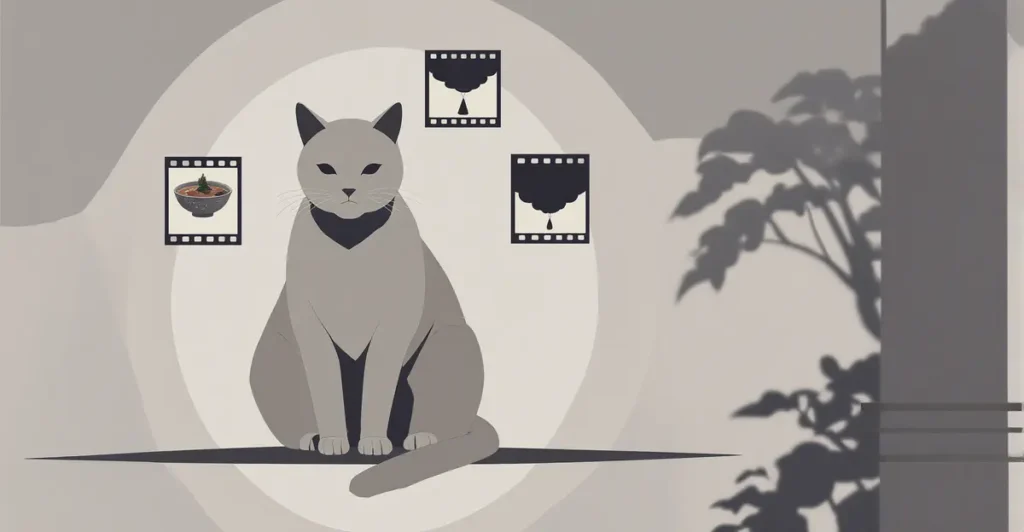
The Kuleshov effect is the quiet engine running underneath almost every film you have ever loved. It is the idea that two shots placed side by side create a meaning that neither shot holds on its own. A face. A bowl of soup. Suddenly the face looks hungry, even though the actor did nothing at all. A century ago a Soviet filmmaker named Lev Kuleshov explored the power of putting shots together and helped expose the secret machinery of cinema. Editing, he showed, is not just stitching footage together. It is where emotion is manufactured. We are a cat-shaped corner of the internet, so naturally we find this fascinating: the same blank stare reads as calm, smug, or murderous depending entirely on what comes before it. Anyone who has ever watched a cat decide whether to knock a glass off a table already understands the principle intuitively.
Table of Contents
- What Is the Kuleshov Effect?
- The Original Experiment, and Why Nobody Can Find the Footage
- How Context Changes the Reading
- Kuleshov, Eisenstein, and the Birth of Montage Theory
- Where You See the Kuleshov Effect in Modern Film and TV
- When Directors Break the Rule on Purpose
- How to Spot It (and Test It Yourself)
- Frequently Asked Questions
What Is the Kuleshov Effect?
The Kuleshov effect is a film editing phenomenon in which viewers derive more meaning from the interaction of two sequential shots than from either shot alone. Put plainly, the cut tells you how to feel. A neutral close-up of a person reads as sad if it follows a coffin, hungry if it follows food, and tender if it follows a sleeping child. The actor’s face never changes. Your interpretation does all the work, and the edit points it in a direction.
This matters because it overturns a tempting assumption about acting. We like to believe a great performance lives entirely in the actor’s face. Kuleshov suggested something less flattering and far more useful: a chunk of what we read as “performance” is actually authored in the editing room, long after the actor has gone home. Meaning is relational. It can emerge between shots as well as within them. The actor still has a job; the editor gets a share of the credit.
The Original Experiment, and Why Nobody Can Find the Footage
The familiar story places Kuleshov’s demonstration around the end of the 1910s or early 1920s. An apparently neutral shot of actor Ivan Mosjoukine was paired with different contexts. Accounts disagree about the exact images: soup and a coffin recur, while versions describe either a child at play or a reclining woman. Film scholar Murray Smith’s discussion explains the variations and why the story needs a little care.
In the famous account, viewers credited the actor with emotions suggested by the surrounding shots. The appeal is obvious: apparently wonderful acting, without changing the performance. But we do not have a surviving audience dataset establishing a unanimous response. It is an influential report of a demonstration, not a laboratory result we can inspect shot by shot.
The footage is almost certainly gone
Here is the part that delights film historians and frustrates everyone else: the original experimental footage no longer exists, or at least has never been recovered. Early Soviet film stock from this period was fragile, flammable nitrate, and a great deal of it simply did not survive the century. We know the experiment through Kuleshov’s own writings and through accounts from his students, especially Vsevolod Pudovkin, who described it in detail. So the most famous demonstration in editing history is, fittingly, something we reconstruct in our heads from descriptions. Even the account has acquired a little cinematic mythology. Lost early cinema has a way of becoming legend, a pattern we have written about before, including the first robot in cinema that vanished for 128 years before resurfacing in the most unlikely place.
How Context Changes the Reading
The Kuleshov effect is not magic. A useful way to understand it is that an ambiguous face leaves room for context. A nearby shot supplies a possible situation, and we read the face in light of that situation. The viewer does some of the storytelling. This is an explanation of the experience, rather than a single settled account of everything happening in the brain.
This is the same instinct that makes you assume two people in a frame are looking at each other, or that a sound and an image belong together even when they were recorded years apart. We are pattern-completing animals. Cinema runs on that hunger to connect. The neutral face is a blank space, and we cannot resist filling it.
What Later Experiments Found
Later experiments provide a more qualified picture. Barratt and colleagues’ 2016 study found contextual effects using a redesigned experiment. In a 2017 study using film sequences, fear contexts significantly changed ratings of pleasantness and arousal, while happiness did not show the same pattern on those measures. Viewers also tended to choose emotion labels matching the context. Editing can guide an interpretation; it does not guarantee every viewer the same feeling. The trick is still good without giving it mind-control powers.
Kuleshov, Eisenstein, and the Birth of Montage Theory
Kuleshov was not working alone in a vacuum. He ran a teaching workshop in Moscow during a period when raw film stock was scarce, so his students learned by re-editing existing footage rather than shooting new material. Constraint bred theory. If you cannot afford to shoot, you obsess over the cut, and that obsession became the foundation of Soviet montage, one of the most influential schools of thought in the history of editing.
Another central figure in Soviet montage, Sergei Eisenstein, developed his own influential approach. Eisenstein argued that the collision of two shots produces a third meaning, an idea that does not exist in either image, almost like a chemical reaction. His 1925 film Battleship Potemkin, and especially its Odessa Steps sequence, became the textbook demonstration of editing as a weapon for generating emotion and meaning. The Kuleshov effect is the gentle, foundational version of this principle. Eisenstein’s montage of collision is the dramatic, dialed-up cousin.
It is worth noting how much early film theory clustered around a handful of restless experimenters. The visual grammar of cinema was not handed down on stone tablets. It was argued over, tested, and frequently borrowed across borders, the same way the shadowy look of German Expressionism traveled out of 1920s Berlin and quietly rewired how the rest of the world lit a frame.
Where You See the Kuleshov Effect in Modern Film and TV
Once you know the Kuleshov effect exists, you cannot stop seeing it. It is everywhere, doing invisible labor in scenes you assumed were carried by acting alone.
- The reaction shot. Cut from a shocking event to a character’s face, and we read horror or grief into that face automatically. Television drama lives on this rhythm.
- Suspense and the hidden threat. A calm face followed by a shot of a ticking clock or a closing door becomes dread, even with no change in expression. Alfred Hitchcock built entire careers’ worth of tension out of this.
- Comedy timing. A deadpan stare cut against an absurd image is the backbone of comic editing. The blank face is the punchline because the cut tells us it is.
- The point-of-view sequence. Face, then what the face is looking at, then face again. We instantly believe the character is reacting to that object, even if the shots were filmed weeks apart.
This is also why a single piece of footage can be reframed entirely by recutting it. A trailer can make a comedy look like a thriller, or a thriller look like a romance, purely through the choice of which shots sit beside which. The footage did not lie. The editor just rearranged the neighbors. The found-footage horror genre weaponizes this constantly, building terror out of ordinary domestic shots simply by controlling what comes next, a trick we traced through the history of found footage horror.
When Directors Break the Rule on Purpose
The most interesting filmmakers do not just use the Kuleshov effect. They toy with it, deny it, and weaponize our expectations of it. Because we are trained to assume a cut signals cause and effect, a director can withhold the expected reaction shot to create unease, or insert a “wrong” reaction to unsettle us.
A director can also build a relationship inside a continuous shot, using movement, framing and the actors’ positions instead of cutting between them. Or the expected reaction can arrive late enough to become a joke of its own. Try noticing when a scene makes you wait for a face you want to see. That delay is a choice, just as revealing as the cut that finally gives it to you.
How to Spot It (and Test It Yourself)
The best way to understand the Kuleshov effect is to catch it working on you. Next time you watch a tense scene, pause right before a reaction shot and ask what emotion you expect the face to show. Then watch the face. You will often find it is far more neutral than you remembered, and your brain supplied the rest.
You can also make an informal demonstration with almost no equipment. Take a single neutral photo of a person, or honestly a single neutral photo of a cat, since our test subjects are always nearby. Place it after an image of food, then after an image of a thunderstorm, then after an image of a tiny party hat. Show all three to a friend without explaining. Ask whether the face seems to have a different mood in each version; they may agree, or they may not. The face never moved. That is the whole trick, and it is the reason editing is treated as an art form rather than mere assembly. If you enjoy films that reward this kind of attention to craft, our roundup of underrated movies based on true stories is full of pictures that earn their emotion through restraint rather than spectacle.
Frequently Asked Questions
Who discovered the Kuleshov effect?
The effect is named for Soviet filmmaker and teacher Lev Kuleshov and demonstrations associated with his workshop around the late 1910s and early 1920s. Vsevolod Pudovkin helped circulate the account. The exact date and details are less secure than the tidy textbook version suggests.
Is the Kuleshov effect still relevant today?
Yes. It remains a useful way to understand reaction shots and point-of-view editing. Controlled studies have found contextual effects, but results vary with the sequence, emotion and measurement. It is a principle filmmakers can use, not a guarantee that every cut overrides an actor’s expression.
What is the difference between the Kuleshov effect and montage?
The Kuleshov effect is a specific phenomenon: a neutral shot takes on meaning from the shot beside it. Montage is the broader practice and theory of building meaning through editing. Think of the Kuleshov effect as the single building block, and Soviet montage theory, especially Eisenstein’s version, as the entire architecture built from many such blocks.
Does the original footage of the experiment survive?
No verified original footage is known to survive. The experiment is documented through Kuleshov’s writings and the accounts of his students. Several reconstructions and homages exist, but the actual reels used in the demonstration are considered lost, like a great deal of early silent-era film.
Can the Kuleshov effect work with animals or objects, not just faces?
You can use juxtaposition to suggest a mood or intention in a shot of an animal or object. A cat beside an empty bowl makes an obvious comic demonstration. That broader storytelling device should not be confused with a measured claim that the same psychological effect is equally strong across humans, animals and objects.
The Cut Is Where the Story Lives
A hundred years on, the Kuleshov effect remains one of the most elegant proofs that cinema is more than photographed reality. Meaning is not only in the performance or the script. It is generated in the spaces between shots, in the silent decisions of the edit. Once you learn to watch for it, every film becomes a little more transparent, and a little more impressive, because you finally see the hand doing the work. The face was blank the whole time. You brought the feeling.