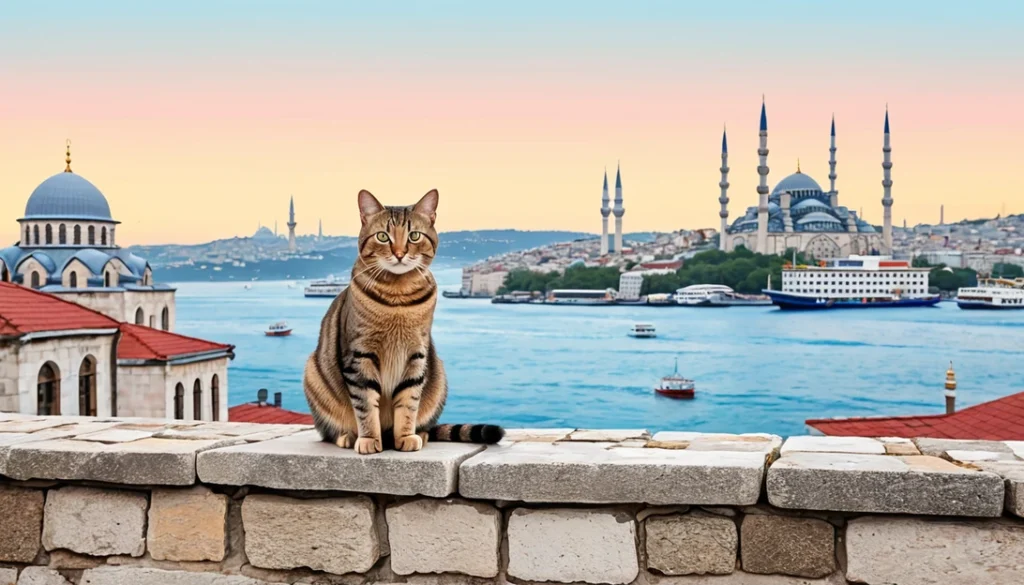
Walk off the Kadıköy ferry and you will step around a cat before you reach the main road. Sit down at a café in Beyoğlu and one will take the chair opposite you with the confidence of someone who paid for the table. The cats of Istanbul are not a tourist-quarter novelty. They are closer to municipal infrastructure with fur, supported by a mixture of religious traditions, charitable giving, neighbourhood routines, and municipal veterinary work. More recently, a documentary made them international stars without asking them to do much more than be cats.
This is the part visitors usually miss. The cats are not tolerated. They are provisioned.
Table of Contents
- A City That Counts Its Cats in Six Figures
- How They Got Here: Ships, Rats and Wooden Houses
- The Ottoman Paperwork That Fed the Cats of Istanbul
- Ritually Pure: Why Cats Walk Into Mosques
- 1910: The Year the City Exiled Its Dogs
- Gli, Tombili and the Cats of Istanbul Who Became Monuments
- Kedi: How a Documentary Made the Habit Famous
- The Law, the Food Vans and the Part the Postcards Skip
- FAQ
A City That Counts Its Cats in Six Figures
There is no single reliable count of every street cat in Istanbul. A 2019 AFP report on the municipal veterinary service quoted an estimated 165,000 cats and 130,000 dogs as the population its work aimed to serve. That is a dated estimate, not a current census or the number treated in one year. The cats are easy to encounter and much harder to count.
Whatever the real total, it is large enough that cat lovers online gave the place a nickname it did not ask for: Catstanbul. In a metro area of roughly 16 million people, the cats are not a rounding error. They ride the ferries, sleep in university lecture halls, and sit in mosque courtyards during prayer while nobody moves them.
How They Got Here: Ships, Rats and Wooden Houses
Shipping is part of the background: cats travelled with people and were useful around cargo threatened by rodents. For a major port, that is a plausible route for repeated arrivals. It does not give us a passenger manifest for Istanbul’s first cat, or a single founding moment for the population living there now. This was a long relationship between a city and an animal that could find work in it.
Then the city gave them a job. Ottoman Istanbul was built largely in wood, and wooden housing is excellent habitat for rats and mice. A dense timber capital with a rodent problem had an obvious use for a small, self-directed predator that required no salary. The cats were not pets in the modern sense. They were pest control that happened to be charming, which is a much stronger negotiating position than being merely charming. Our piece on the history of black cat superstitions covers the European end of the same story, where things went considerably worse for them.
The Ottoman Paperwork That Fed the Cats of Istanbul
The history becomes more interesting when affection acquires a practical routine. Feeding animals could be an everyday kindness, a paid service, or a charitable obligation. Those arrangements overlapped; Istanbul’s cats did not have to choose between sentiment and paperwork.
Ottoman public life included the vakıf, a charitable endowment with a stated purpose and resources to support it. Foundations helped maintain fountains, kitchens, hospitals, and other services. Some arrangements also supported animals. A study of Ottoman animal-welfare law and court records shows that concern for their care could take institutional form. That adds something important to the familiar picture of a neighbour leaving out a bowl.
The scale and organisation varied. It would be too tidy to imagine a single citywide contract feeding every stray for centuries. The more revealing picture is of several kinds of care existing together, with generosity sometimes organised well enough to become a regular service. A hungry animal benefits when somebody remembers tomorrow as well as today.
The Mancacı Was an Actual Job
There was even an occupation associated with this trade. Historical research on the mancacı draws on accounts by travellers to Ottoman cities. The mancacı walked the streets selling liver and offal so that passers-by could buy a portion and feed the animals themselves, or simply hand over coins and have the mancacı do the feeding on their behalf, in God’s name. It is a small detail with a large implication: there was enough steady demand for street-animal feeding to support people who did it for a living.
Ritually Pure: Why Cats Walk Into Mosques
Religious tradition helps explain the familiarity, though it cannot dictate what every person or mosque does. A well-known hadith about a cat drinking from an ablution vessel treats the cat as not impure and as an animal that moves among people. That is an important part of its place in Muslim domestic life. It is a statement about ritual purity, not a claim that cats cannot carry germs. Rules concerning dogs also vary between legal schools.
The tradition has a famous cat-associated figure, too. Abu Hurayra, a companion of Muhammad and a major transmitter of hadith, is known by a nickname commonly translated as “father of the kitten.” It is a small linguistic monument to the connection, without needing every later anecdote about him to tell the story in exactly the same way.
The Muezza Story Comes With an Asterisk
You will hear this one constantly in Istanbul, usually from someone very confident. Muhammad had a cat named Muezza, the cat fell asleep on his sleeve, the call to prayer came, and rather than wake it he cut the sleeve off and went to pray one-sleeved. Lovely story. It is also not in the Quran and does not appear in the canonical hadith collections. It is later tradition, worth knowing before you repeat it as scripture. The habit is real and old. That anecdote is folklore, which has its own value as long as you label it correctly.
1910: The Year the City Exiled Its Dogs
If you want proof that the city’s arrangement with its animals was never guaranteed, look at what happened to the dogs.
In 1910, tens of thousands of Istanbul’s dogs were rounded up and sent to Sivriada in the Sea of Marmara, where they were left to die. The number commonly given is around 80,000. Research presented through Istanbul’s planning agency places this catastrophe within the city’s contested history of modernisation and control of public space. The same streets that supported everyday acts of care could become the setting for mass removal.
The episode is remembered as the Hayırsızada disaster. It is a grim interruption to any story in which the city has always treated all its animals kindly. The contrast with its celebrated cats is striking, but religious status alone cannot explain every political decision or guarantee an animal’s safety.
Gli, Tombili and the Cats of Istanbul Who Became Monuments
Two street cats made the jump from local fixture to civic symbol, and both stories say something about how the city files its animals.
Gli was born in 2004 and grew up inside Hagia Sophia. She became internationally recognisable in 2009, when photographs circulated of Barack Obama and Recep Tayyip Erdoğan stopping to pet her during a visit. She spent sixteen years in one of the most photographed buildings on earth, fell ill in September 2020, and her death was announced on 7 November 2020. Her death was reported by news outlets from London to Delhi, which is not a normal send-off for a stray.
Tombili worked a different beat. He lived in Ziverbey, in the Kadıköy district on the Asian side, and became famous through a single photograph: a heavy-set cat reclining on a step, propped on one elbow, watching the street with the posture of a man who has finished his shift. He died on 1 August 2016. Locals started a petition to have him commemorated, gathered around 17,000 signatures, and Kadıköy approved it. A bronze sculpture by local artist Seval Şahin, showing Tombili in exactly that pose, was scheduled by Kadıköy for unveiling on 4 October 2016.
The Statue Was Stolen, Then Returned
About a month after the unveiling, the statue disappeared. The municipality announced the theft on 8 November 2016, and the reaction was loud enough that on 10 November the sculpture was back in place. Two days. Istanbul has an unresolved civic to-do list as long as the Bosphorus, and it recovered a stolen cat statue within days.
Kedi: How a Documentary Made the Habit Famous
For most people outside Turkey, the entry point is a film. Kedi, directed by Ceyda Torun, premiered at the Istanbul Independent Film Festival on 21 February 2016 and reached North American cinemas on 10 February 2017 through Oscilloscope Laboratories.
The editor’s account of making the film shows how much material the city offers. The team scouted about 35 cats, filmed 19, and cut the final film down to seven: Sarı, Duman, Bengü, Aslan Parçası, Gamsız, Psikopat and Deniz. Custom rigs were built to shoot at cat height, which is why the film looks like it was made by an unusually competent cat rather than about one.
The film found an audience far beyond the neighbourhoods it depicts. Box-office records put its North American theatrical earnings at about $2.8 million. Its feline cast also received a Most Compelling Living Subject honour at the 2017 Critics’ Choice Documentary Awards, a distinction noted by its Australian distributor. That remains an excellent sentence in awards history. The film works as a portrait of a neighbourhood, closer in spirit to slow living than to a wildlife spectacle.
The Law, the Food Vans and the Part the Postcards Skip
Turkey’s Animal Protection Law, number 5199, dates from 2004. The 2021 amendments in Law 7332 strengthened protection, including criminal penalties for specified acts against animals and provisions concerning rehabilitation and identification. It was an important change, but describing it as the moment every animal ceased to be property compresses a more complicated legal framework into a slogan.
The 2024 amendments in Law 7527 made a consequential distinction: rehabilitated dogs taken into shelters must remain there until adoption. The new euthanasia provision also specifically addresses dogs under stated conditions, including certain health and behavioural risks. Other amendments use the broader term “ownerless animals,” and the text also mentions identification of owned cats. Cats therefore are not simply outside the whole law. The dog-specific provisions should not be confused with the scope of the entire framework.
Day to day, care depends on people and services doing the work. The 2019 reporting on Istanbul’s municipal programme described veterinary centres, a mobile VetBus, food distribution, and treatment of tens of thousands of animals. Those figures describe that period rather than a permanently fixed fleet or staffing level. The small cat houses and bowls that visitors notice are one visible part of a larger effort.
The postcard also leaves out illness. A study published in 2025 tested blood from 316 stray cats sampled through municipal shelters between 2018 and 2020. It detected several pathogens, including Hepatozoon, using molecular tests. Those findings are not a census of disease in every Istanbul cat, and a blood test does not tell us how an individual infection was acquired. Different pathogens have different transmission routes; a shared bowl cannot explain them all. Veterinary care, parasite control, and sustained population management belong in the story alongside feeding.
None of that cancels the city’s affection for cats. It means the honest version includes veterinary bills, uneven resources, and difficult choices. A place can be unusually welcoming to animals without being a finished model of welfare. If you like the broader argument about arranging daily life around presence rather than efficiency, our guides to hygge and niksen sit nearby, while wabi-sabi makes room for imperfection.
FAQ
Why are there so many cats in Istanbul?
Several histories overlap: a port city where cats could help control rodents, religious traditions comfortable with their presence, and habits of feeding supported by households, traders, and charitable giving. No single origin story explains every cat or every neighbourhood.
How many street cats live in Istanbul?
There is no single reliable count of all the street cats. A 2019 report quoted a municipal estimate of roughly 165,000, but that should not be presented as a current census or an annual treatment total.
Did Turkey’s 2024 stray animal law apply to cats?
The 2024 law contains dog-specific shelter and euthanasia provisions, but it also changes broader rules concerning ownerless animals. Saying that cats were entirely excluded from the legislation is therefore misleading.
Who were Gli and Tombili?
Gli lived in Hagia Sophia from her birth in 2004 until her death on 7 November 2020, and became internationally known after being photographed with Barack Obama and Recep Tayyip Erdoğan in 2009. Tombili was a Kadıköy street cat famous for a photo of him reclining on a step. He died on 1 August 2016 and got a bronze statue in Ziverbey, unveiled that October after a petition gathered around 17,000 signatures.
Is Kedi worth watching?
If you want the texture of the city rather than a list of facts, yes. Ceyda Torun’s documentary follows seven cats and the people who know them, with a camera often down at feline level. Its appeal is the attention it gives to everyday relationships, rather than any review score.
The Takeaway
Istanbul did not decide one morning to love cats. Religious tradition, practical usefulness, neighbourhood affection, and organised care all helped shape the relationship. None makes kindness automatic; the dogs of 1910 are a terrible reminder of that. What matters is how affection becomes something repeatable: food, shelter, treatment, and somebody showing up again tomorrow. The cats are still there, waiting with the confidence of regular customers. Curious about their smaller daily provocations? Start with why cats knock things off tables.