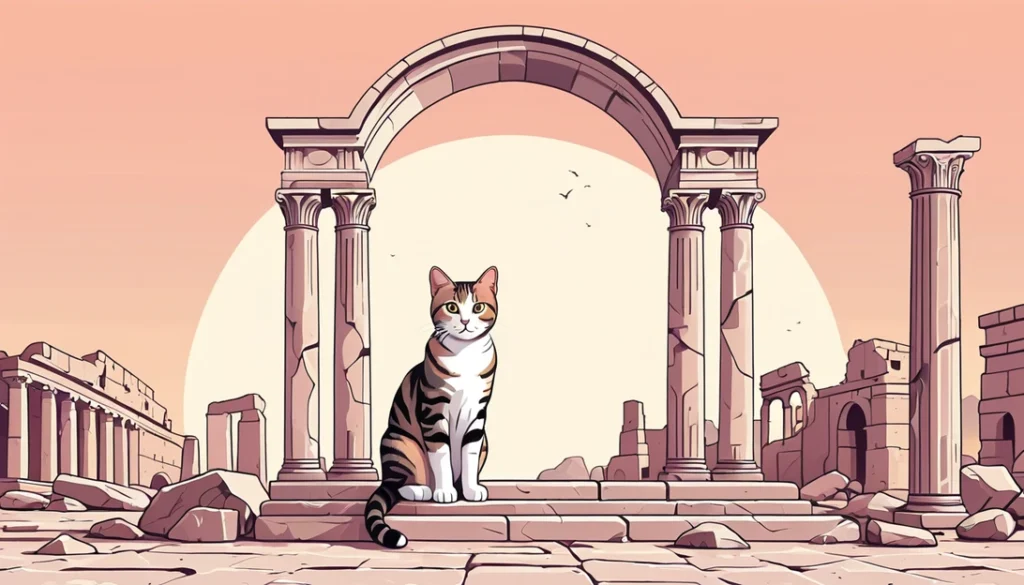
Walk past the Colosseum at dusk and you will probably see one: a tabby stretched along a travertine block, ignoring twenty thousand tourists with the confidence of an animal that knows it has legal standing. The cats of the Colosseum are not a charming accident. They are the visible edge of one of the strangest pieces of municipal policy in Europe, a system in which stray cats have a statutory right to stay put, a registered human caretaker, free sterilisation paid by the state, and a place in Rome’s sense of its own history.
The Torre Argentina sanctuary’s history dates a city proclamation recognising Rome’s cats as patrimonio bioculturale to 2001. It is a lovely description of the relationship. It should not, however, be confused with the legal protection of an ancient building: the concrete rules protecting free-roaming cats come from animal-welfare legislation.
What is in this article
- Why the ruins filled with cats in the first place
- The gattare: Rome’s unofficial cat bureaucracy
- Law 281/1991, the rule that changed everything
- 2001: when the cats of the Colosseum became heritage
- Torre Argentina, a cat shelter on a murder scene
- Does any of it work? Thirty years of data
- How to visit without being the annoying tourist
- FAQ
Why the ruins filled with cats in the first place
Two forces built these colonies, and only one is romantic.
Ancient rubble is excellent cat infrastructure
A collapsed temple platform is, from a cat’s point of view, close to ideal housing. Broken masonry gives dozens of defensible sleeping cavities at different heights, sun-warmed stone holds heat well past sunset, and excavated areas sit below street level, which means fewer dogs, fewer cars, and a clear sightline in every direction. Add the rodents that any dense historic centre generates and you have food, shelter and elevation in one package.
Here, the practical benefits of shelter and pest control are easy to see. For the version where cats were treated as divine rather than as pest control, see our piece on cats in ancient Egypt, Bastet and the mummy trade.
The unromantic half: abandonment
Abandonment is the less charming part of the story. The Torre Argentina volunteers describe people leaving unwanted cats and kittens at the site, adding to the burden of feeding and sterilisation. A ruin with a resident caretaker is not a responsible alternative to finding an animal a home.
Largo di Torre Argentina makes the timeline legible. The square was dug out during the demolition works of the late 1920s and the ruins stood exposed by 1929. Cats moved into the newly opened pit almost immediately, sheltered by the temple columns, and locals started feeding them. The colony has been occupied ever since, which makes it roughly a century old as a feline address.
The gattare: Rome’s unofficial cat bureaucracy
Italian has a word for the person who feeds street cats: gattara, from gatto. The masculine form is gattaro. In English it lands as “cat lady”, which carries a sneer the Italian only partly shares. In Rome the gattara is a recognised civic type, somewhere between eccentric neighbour and unpaid public servant.
The sanctuary traces regular feeding by a succession of gattare from 1929 to 1993. Before the familiar organisation existed, people were already doing the daily work: finding food, keeping track of animals and showing up again tomorrow.
Anna Magnani and the theatre connection
One famous supporter was Anna Magnani, the Oscar-winning face of Italian neorealism. The sanctuary remembers her feeding the cats during breaks while working at the neighbouring Teatro Argentina. It is a good Roman pairing: a great actress upstairs, a demanding audience with whiskers downstairs.
The shopping bags matter as much as the famous name. Whatever the legal framework eventually became, somebody still had to carry dinner down to the cats.
Law 281/1991, the rule that changed everything for the cats of the Colosseum
In 1991 the Italian Parliament passed Law no. 281 on companion animals and the prevention of straying. Article 2 prohibits mistreatment of free-roaming cats, provides for sterilisation by the competent health authority and return to their group, and limits euthanasia to cats that are seriously ill or incurable. Lazio had already legislated in 1988; its later Regional Law 34/1997, Article 11 protects cats and their habitat.
The core provisions are short and unusually blunt:
- Protection replaces routine removal or killing. The national framework treats free-roaming cats as animals to care for.
- Sterilisation and return are central. Local public veterinary services have a defined role, alongside the work of volunteers.
- Organised care is recognised. Animal-protection organisations can manage colonies in agreement with the health authority.
- Local rules matter. Rome sets out registration, caretaking and limited relocation exceptions in its municipal regulation.
What registering a colony actually involves
A colony is not just a vibe; it also has paperwork. Under Rome’s 2005 animal-welfare regulation, Articles 37–41, caretakers apply to the local ASL veterinary service, which issues an attestation if accepted and informs the municipal office. Authorities and volunteers maintain a census. Registration helps organise care; it is not a licence to mistreat cats whose paperwork is missing.
The detail most non-Italians find hard to believe: the municipality has responsibility for protecting free-roaming cats. The city even calls its registered colony cats the mayor’s cats. That describes a public responsibility, not thousands of private pets. If your own cat has ever knocked a glass off a table and held eye contact, imagine that scaled to a city of nearly three million people and one elected official. We looked at the psychology behind that move in why cats knock things off tables.
2001: when the cats of the Colosseum became heritage
The sanctuary’s account of the 2001 recognition captures something that visitors understand immediately: the cats belong in the story people tell about Rome. But “bio-cultural heritage” is not a shortcut around the actual rules, nor proof that a cat has precisely the same legal status as a fresco.
The municipal regulation defines a colony as at least two free-roaming cats habitually using the same place. Relocation is normally prohibited, but Article 41 permits transfers with the competent ASL for documented health needs affecting people or animals, or substantiated public-interest reasons. The rule protects a home; it is not an exception-free ban on every intervention.
The important distinction is between protecting animals where they live and pretending that an archaeological site never needs work. Looking after both requires coordination. Neither the cats nor the columns are improved by treating the other as disposable.
Torre Argentina, a cat shelter on a murder scene
The best-known colony is not at the Colosseum. It is in the sunken square of Largo di Torre Argentina, and its address is one of the most loaded in Roman history.
The square holds four Republican-era temples, labelled A, B, C and D because for a long time nobody could agree which gods they belonged to. The oldest go back to the third century BC. Beside them stood the Curia of Pompey, the hall where the Senate was meeting on 15 March 44 BC when Julius Caesar was stabbed to death.
In 2012 Antonio Monterroso’s team proposed that a concrete structure at the site marked the place of Caesar’s assassination and its later closure. Monterroso discussed the interpretation in a contemporary RTVE interview. That is an archaeological interpretation, not proof that a particular sleeping cat is lying on the exact spot where Caesar fell. The address is dramatic enough without assigning every paw a historical coordinate.
From a relay of gattare to an actual shelter
In 1993, Lia Dequel and Silvia Viviani started helping the one woman still running the colony alone, and the operation became the Torre Argentina Cat Sanctuary. They inherited around 90 cats. The first outside backing came in 1995 from A.I.S.P.A., the Anglo-Italian Society for the Protection of Animals. Dutch animal rescuers built the shelter’s first website in 2000, which is how a hole in the ground in central Rome acquired an international donor base.
The sanctuary’s work includes sterilisation, veterinary care, adoption and support for cats that need continuing care. Its own history describes the move from a difficult underground workspace to an international volunteer and donor network, and the 2003 Cat Pride demonstration. A headcount taken on one visit should not be mistaken for a permanent population figure.
The 2012 eviction fight and the 2023 reopening
Protection for the cats did not settle permission for the shelter’s structures. NPR’s December 2012 reporting described an eviction notice from archaeology officials and opposition from the volunteers. The dispute illustrates the distinction between animal protection and permission to occupy or build within a protected archaeological site. It does not establish that every later planning question was permanently resolved.
On 20 June 2023 the Sacred Area opened with a new accessible visitor route, following works supported by Bulgari. Raised walkways let people approach the temples without walking over the ancient remains. Archaeologists and volunteers had hardly left the place empty before then; the cats simply acquired a larger audience for the same nap.
Does any of it work? Thirty years of data
In February 2019, Eugenia Natoli and colleagues published a thirty-year evaluation in Frontiers in Veterinary Science. Its figures cover different territories and periods: much of the later colony data concerns ASL Roma 3, while some earlier counts and the bite reports cover the whole city. They should not be presented as one current Rome-wide census.
- 1,878 colonies recorded in the ASL Roma 3 dataset by 2017, of which 89 had gone extinct.
- 15,713 cats recorded across those colonies, an average of 8.37 cats per colony.
- 204 colonies made up entirely of neutered cats, labelled stable in the study; new arrivals can still change their size.
- A survey of 103 colonies in the 1991–2000 programme reported a 16 to 32 per cent reduction in cat numbers, offset by roughly 16 per cent new arrivals through abandonment and spontaneous immigration.
- 6 bites from unowned cats out of about 4,600 animal bite reports over a ten-year period.
- 74 suspected poisoning notifications in ASL Roma 3 between 2008 and 2017, of which 21 were confirmed.
The authors favour the programme and stress responsible ownership: abandonment and immigration can offset reductions. But these observational records do not settle every question about TNR in every setting. Six recorded bites are not a measure of all disease risks, exposure or unreported incidents. The useful lesson is that sterilisation, continuing care and preventing abandonment have to work together.
How to visit the cats of the Colosseum without being the annoying tourist
Rules the volunteers repeat constantly, because visitors keep breaking them.
- Ask before feeding. Follow the caretaker’s instructions rather than adding random food to a managed feeding routine.
- Do not pick cats up for a photograph. Give them space and follow the volunteers’ guidance. A cat that wants contact will arrive on its own schedule.
- A neatly tipped ear usually marks sterilisation. A cleanly tipped ear is the international mark of a cat that has been trapped, neutered and returned. It means the system worked.
- Do not take a colony cat home on your own initiative. Ask the caretaker or sanctuary about adoption. If an animal appears injured or in immediate danger, contact the caretaker, local veterinary service or appropriate rescue service for help; colony protection does not mean withholding necessary care.
- Give money, not tuna. The shelters run on donations and on merchandise made by volunteers.
Nobody optimised these colonies and nobody scaled them. A century of feeding cats in a ruin produced a functioning institution, slowly, mostly by refusing to stop. That is the instinct behind slow living, applied to municipal policy instead of a Sunday morning.
FAQ
Are there still cats inside the Colosseum itself?
Cats are associated with the Colosseum and its surrounding archaeological area, but a sighting inside the monument is not guaranteed. For a visit specifically focused on the cats and their care, the sanctuary at Largo di Torre Argentina is a more straightforward destination. Respect access restrictions at both sites.
Is it legal to remove a stray cat from a Roman ruin?
You should not take one away on your own initiative. Colony protection includes restrictions on relocation, with specific authorised exceptions. Necessary veterinary care and organised adoption are different from simply removing a cat because it looks ownerless. Contact the caretaker or local veterinary service.
Who pays to neuter the cats?
Public veterinary services carry out colony sterilisation under the legal framework. Volunteers and sanctuaries also contribute trapping, transport, aftercare and other veterinary expenses. Ask the relevant ASL or sanctuary about the procedure rather than assuming every private appointment is publicly funded.
What does “gattara” actually mean?
It is the Italian word for a person, usually a woman, who feeds and looks after street cats, from gatto. The male form is gattaro. In Rome it carries affection alongside the teasing, partly because figures like Anna Magnani made it part of the city’s self-image. The English “cat lady” is meaner, and the folklore behind that is a separate history, traced in black cat superstitions.
Did the 2023 restoration hurt the sanctuary?
The 2023 project added a visitor route through the archaeological area. That is separate from the 2012 dispute over the shelter’s occupation and structures. A restoration opening should not be used as proof that all questions about the sanctuary’s tenure have been permanently settled.
The short version
Rome’s cats have national, regional and municipal protection, backed by the daily work of caretakers. The city’s bio-cultural heritage story gives that relationship a memorable name, but the practical details are sterilisation, suitable care, limits on removal and people who keep turning up with shopping bags. The cats provide continuity. The humans provide dinner and, eventually, the paperwork.