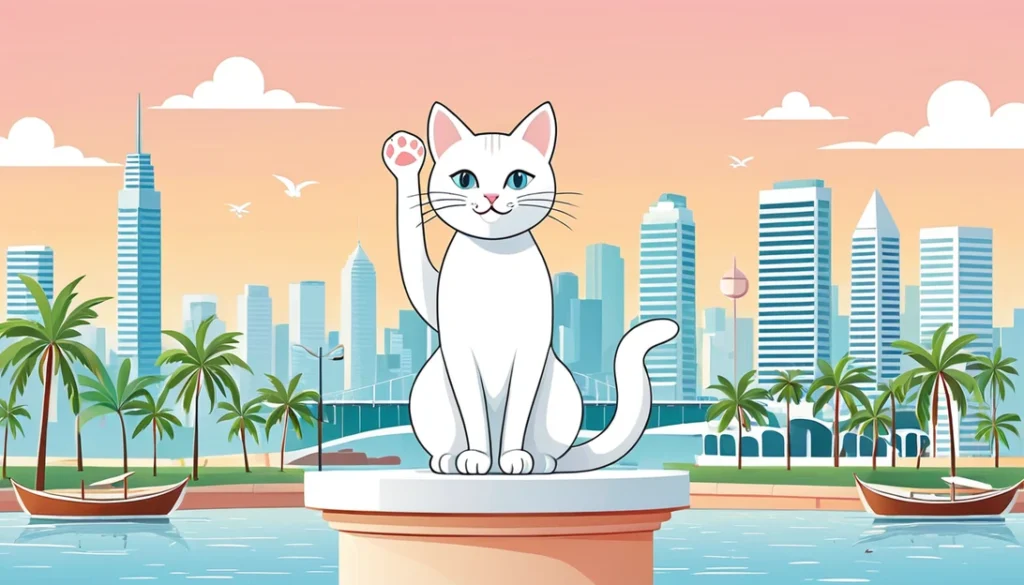
On the eastern end of Jalan Padungan, in the capital of Sarawak, on Malaysian Borneo, a white cat two and a half metres tall waves at traffic. It has wire whiskers. At Chinese New Year somebody dresses it in red. During Gawai, the Dayak harvest festival, it gets an Iban vest. At Christmas, a Santa suit. That statue is the front door to the Kuching city of cats story, and the story is stranger, and far more deliberate, than the postcards let on.
The short version everyone repeats is that Kuching means cat in Malay, so the city adopted cats. The longer version is that nobody knows where the name came from, several competing explanations circulate, and the city committed to it anyway, with public money, a museum, a festival and a coat of arms. That last part is the interesting bit.
What This Article Covers
- Where the name Kuching actually comes from
- The Kuching city of cats timeline is shorter than you think
- The cat statues, ranked by sheer commitment
- A cat museum inside a city hall
- The wild cats nobody puts on the postcards
- Why the Kuching city of cats identity actually works
- Frequently asked questions
Where the Name Kuching Actually Comes From
Kuching’s rise as an administrative centre is associated with Pengiran Indera Mahkota, the Sultan of Brunei’s representative sent there in 1827; a study of the Sarawak River settlement places this in the history of trade and antimony extraction. The name was already in circulation by the time the English adventurer James Brooke sailed up the river in 1839, which matters, because it rules out the tidy idea that a colonial administrator invented it. Whoever named the place, they did it before the White Rajahs arrived.
Several explanations compete, and resemblance between words is not enough to settle the question.
The cat theory and its inconvenient problem
In standard Malay, kucing means cat. It is an irresistible association for a city mascot, but it does not by itself establish how the place-name originated. Local usage, changes in spelling and older names all matter. The Sarawak Tourism Board presents both a cat-related naming legend and an alternative involving the mata kucing fruit. They are competing stories, not a solved etymology.
The three rivals: a fruit, a port, and a well
The botanical explanation points to mata kucing, literally cat’s eye, and the hill called Bukit Mata Kuching. A name associated with fruit trees is less photogenic than a city founded by cats, but quite plausible as a way a place could acquire its name.
A second explanation links the name to a trading-port term. The Tourism Board’s Chinese-language introduction mentions this alongside the fruit explanation. That is evidence that the account circulates, rather than proof of a single word travelling unchanged from an Indian port to Borneo.
The “old well” explanation is another popular account, connecting the sound of the name to Chinese words for an old well. It is charmingly mundane, but a story about a useful well is not enough to establish when the city acquired its name. The well deserves its place in local storytelling; the etymological victory parade can wait.
So the honest answer is that Kuching’s name has several proposed parents and no birth certificate. What happened next is the part worth studying.
The Kuching City of Cats Timeline Is Shorter Than You Think
The institutional milestones are much easier to date than the name. The late 1980s brought city status and a public cat collection; later came permanent displays and more monuments. That does not mean nobody associated the place with cats before a council put them on the letterhead.
Kuching was granted city status on 1 August 1988. The South City Council’s administrative history also records the split into Kuching North and Kuching South. The names are misleading if you imagine one council neatly occupying each riverbank: the northern authority includes central areas as well as land across the Sarawak River. One city, two municipal administrations, plenty of room for cats.
Cat imagery became part of the city’s official visual identity, and the public collection was displayed in Kuching on 1 August 1988. The important distinction is between the age of these institutions and the much older, less easily dated association between the name and cats. The monuments give that association a very solid public address.
That is not a criticism. It is the point. A city took an unresolved etymology, embraced the most charming reading, then spent decades making it true in concrete and bronze.
The Cat Statues, Ranked by Sheer Commitment
Kuching does not have a cat statue. It has a portfolio.
The Great Cat of Kuching is the famous one, a 2.5 metre white cat with a raised paw on the traffic island at the eastern end of Jalan Padungan, beside the Chinese ceremonial gate. The seasonal costumes (red for Chinese New Year, green for Hari Raya, Santa at Christmas, an Iban vest for the harvest festival) are the clearest signal that this is a civic object rather than a tourist prop.
The Cat Column, sometimes called the Chan Chin Ann cat tower, sits at the junction of Jalan Chan Chin Ann and Jalan Padungan. Four small white cats wave from a column decorated with Sarawakian motifs and rafflesia flowers, which is a very specific combination of the world’s largest flower and four grinning cats.
The cat fountain on the waterfront, near the Grand Margherita, holds a whole family: kittens mid-tumble with two adults watching. It lights up at night. It is a strong contender for the most endearing of the group: a litter of kittens does more emotional work than a single waving figure.
Nine bronze cats lounge around a pole near the James Brooke Bistro on the waterfront, one of them in the middle of catching a rat. That one, at least, acknowledges cats have a job.
A pair of cats installed in 2005 marks the Malaysia China Friendship Garden in the Tabuan Jaya area. Diplomatic cats, effectively.
The scrap metal cat at the Esplanade, by the India Street entrance, arrived in 2015. The 2015 project announcement describes the collaboration: DBKU would supply scrap metal and UiTM Sarawak’s arts and design students would construct the sculpture. Locals call it Kucing Transformers, which is objectively a better name than anything a tourism board would have approved.
A Cat Museum Inside a City Hall
This is where the commitment stops being cute and starts being institutional. The Kuching Cat Museum occupies the lobby floor of the DBKU building, on Bukit Siol in Petra Jaya, a hill about 60 metres above sea level. It is owned and run by the city hall. Not a private collector, not a foundation. A municipal government operates a cat museum the way other cities operate a water treatment plant.
The museum covers 1,035 square metres across four galleries and holds more than 4,000 cat related items: paintings, advertising, ceramics, photographs, taxidermy. The museum’s own history says the objects were previously displayed at the National Museum in Kuala Lumpur, then shown in Kuching on 1 August 1988 and handed to DBKU when its headquarters was completed in 1992. DBKU promotes it as the world’s first museum of its kind.
Two objects do the heavy lifting. One is a mummified cat from ancient Egypt, which connects Kuching to the deepest layer of human cat history, the world of Bastet and industrial scale cat mummification. The other is a preserved bay cat specimen, featured in the museum’s own overview of its collections. Five wild cat species native to Borneo are covered in the galleries.
Do not plan a visit on the assumption that entry is free. DBKU publishes admission charges in its fee schedule. Check the applicable visitor category and any photography conditions with the museum before visiting; old guidebook prices are not a reliable ticket.
The Wild Cats Nobody Puts on the Postcards
Here is the irony at the centre of the whole project. Kuching has cats on its roundabouts, its letterhead and its souvenirs, and almost nobody who lives there has seen the island’s most remarkable cat.
The bay cat (Catopuma badia) is endemic to Borneo and exists nowhere else on Earth. It was first described in 1874, from the skull of a poorly preserved specimen collected in 1855, and for well over a century afterwards scientists worked with scraps. It has been listed as Endangered on the IUCN Red List since 2002. The IUCN Cat Specialist Group explains that the often-quoted estimate of about 2,200 mature animals rests on an assumed density, not a census. Its abundance remains poorly known. Records are scattered across Borneo. Gaps in confirmed records should not be treated as proof that the species is absent from an entire region.
A camera trap image of a bay cat is still a minor event among field biologists. It is a forest-associated species of Borneo, not a promised sighting just outside Kuching. Those forests also make visitors reach for words about the calming effect of time spent among trees, but a rare wild cat is under no obligation to appear for the visitor. The mascot cats wave at traffic. The real endemic cat does everything it can to avoid being photographed, which, frankly, is the more authentically feline behaviour of the two.
Why the Kuching City of Cats Identity Actually Works
DBKU’s cat events carry the theme beyond statues. Its report of the 2025 Cat Parade describes 67 participating cats at the waterfront on 27 September. For 2026, the mayor announced a festival planned for 2–4 October, as reported in coverage of the August City Day celebrations. Those are scheduled dates, so visitors should still check the organiser’s arrangements. A city council putting a cat parade on the calendar has certainly committed to the theme.
The strategic logic underneath is sharper than it looks. Kuching is a genuinely plural city: Malay, Chinese, Iban, Bidayuh, Indian and more, with three or four religious calendars running at once. Its historical symbols can carry complicated associations. The Brooke dynasty ran Sarawak as a private kingdom from 1841 until the cession to the British Crown in 1946, with the Japanese occupation from December 1941 in between and the Astana, built in 1870 as a wedding gift for Charles Brooke’s wife, still sitting across the river. Every one of those threads carries an argument.
A cat offers a lighter point of connection. It can appear in different communities’ daily lives and wear different festival outfits without becoming a portrait of one particular ruler. That is my reading of why the mascot works, not proof that every resident feels the same way. Compare the cheerful public cats with the baggage explored in black cat superstition: context does an enormous amount of the work.
What other cities could take from this
Plenty of places have a folk etymology sitting unused in a tourism brochure. Very few do what Kuching did with it, which came down to three choices.
The first was to embrace an association people enjoy without waiting for historians to settle its origin. Historians can keep arguing about the well and the fruit. The statues went up regardless. The second was to fund it municipally instead of leaving it to gift shops. Statues, a museum inside the city hall, an international festival and a coat of arms are budget line items, not merchandise.
The third was to keep it light. Nothing about a scrap metal cat nicknamed Kucing Transformers is solemn. That refusal to take itself seriously is what makes the identity durable, and it rhymes with a broader idea about finding value in things that are imperfect and unpolished rather than waiting for a flawless brand strategy. It is also a decent argument for doing fewer things on purpose and doing them properly over forty years.
Frequently Asked Questions
Does Kuching actually mean cat?
Kucing means cat in standard Malay, but that resemblance does not settle the origin of the place-name. Cat, fruit, trading-port and old-well explanations circulate. It is safer to distinguish the city’s very visible feline identity from an etymology that remains debated.
When did Kuching become the City of Cats?
City status dates to 1 August 1988, the same date as the first display of the cat collection in Kuching. DBKU’s history records its transfer to the city hall headquarters in 1992. Those are milestones in the institutional identity, rather than an exact birthday for every local association with cats.
What is inside the Kuching Cat Museum?
More than 4,000 cat related items across four galleries and 1,035 square metres, including a mummified cat from ancient Egypt, a preserved bay cat specimen and material on the five wild cat species native to Borneo. It is on Bukit Siol in Petra Jaya, on the ground floor of the Kuching North City Hall building. Admission charges apply; consult DBKU’s visitor information for the relevant category and photography conditions.
How many cat statues does Kuching have?
There are several prominent installations, including the Great Cat of Kuching at the Padungan roundabout, the Cat Column at Jalan Chan Chin Ann, the waterfront cat fountain with its kitten family, nine bronze cats near the old waterfront, the 2005 pair at the Malaysia China Friendship Garden and the 2015 scrap metal cat at the Esplanade.
Are there wild cats in Borneo?
Yes. Five wild cat species live on the island, and the bay cat (Catopuma badia) is found nowhere else. It has been listed as Endangered since 2002, with a rough estimate of about 2,200 mature individuals based on assumed density rather than a complete count, and it is one of the least observed cats on Earth. Domestic cats in Kuching, by contrast, behave exactly like domestic cats everywhere, including the habit of pushing objects off flat surfaces.
The Verdict From the Roundabout
Kuching took a name with several proposed origins, chose the one with whiskers, and then backed it with statues, a municipal museum, an international festival and a coat of arms. Nearly forty years on, the choice looks less like a marketing gimmick and more like good civic design: a playful shared symbol that photographs well in every season. The real Bornean cat still hides in the forest, unbothered and largely unphotographed. The concrete one keeps waving at traffic. Both, in their own way, are doing the job properly.