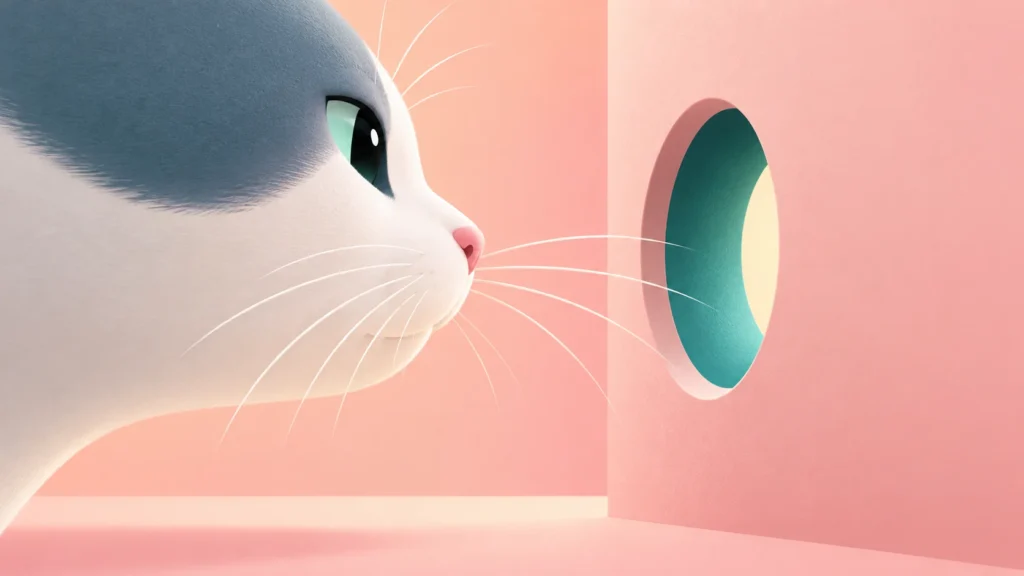
A whisker is a hair with a specialised sensory job. Its importance comes from the sensitive structures around its root, not from being a tiny antenna with a nerve running through the visible shaft.
That distinction helps separate a remarkable biological system from the more extravagant claims made about it. Whiskers contribute information; they are not a flawless measuring tape for every gap a cat considers entering.
Movement becomes a signal
VCA’s veterinary explanation describes whiskers as specialised hairs that add sensory information when touched or moved by air. Movement stimulates nerves associated with the follicle. Whiskers occur beyond the familiar rows beside the nose, including above the eyes and on the forelegs.
Think of this as another stream of information alongside vision, hearing and smell. A whisker touching an obstacle can provide information that a distant view cannot. That does not mean every movement gives the cat an exact numerical description of the object’s dimensions.
What was actually tested about bowls?
The popular term “whisker fatigue” often appears in advertisements for wide feeding bowls. A 2020 study tested feeding behaviour with ordinary bowls and bowls marketed to avoid whisker contact. Forty cats were enrolled; 38 completed the study.
The researchers found no significant improvement in food eaten, time spent eating or food dropped under the tested conditions. More cats chose the new bowl in a preference comparison, but preference alone did not demonstrate the proposed fatigue mechanism.
This was a relatively small, short study with limitations, including owner involvement and aspects of the preference-test setup. It neither established whisker fatigue as an explanation for feeding problems nor proved that bowl shape can never matter to an individual cat.
Comfort and diagnosis are different questions
You can notice that a cat prefers one dish without knowing why. Shape, material, location, cleanliness and the surrounding environment can change together when a bowl is replaced. A before-and-after improvement does not isolate one cause.
If eating becomes difficult or appetite changes, a product label should not take the place of veterinary assessment. Describing the actual behaviour—when it happens, what the cat eats and whether other signs have changed—is more useful than arriving with a diagnosis borrowed from an advertisement.
Leave the sensory equipment intact
Whiskers should not be trimmed for appearance. VCA advises preserving them because they contribute to the cat’s sensory world. Their position can also be one part of interpreting behaviour, but no single whisker angle reveals a complete emotional state.
The interesting story is already strong enough without exaggeration: an apparently simple hair is connected to a sensitive system that helps an animal investigate its surroundings. For more carefully explained feline science, browse our Science & Space archive.