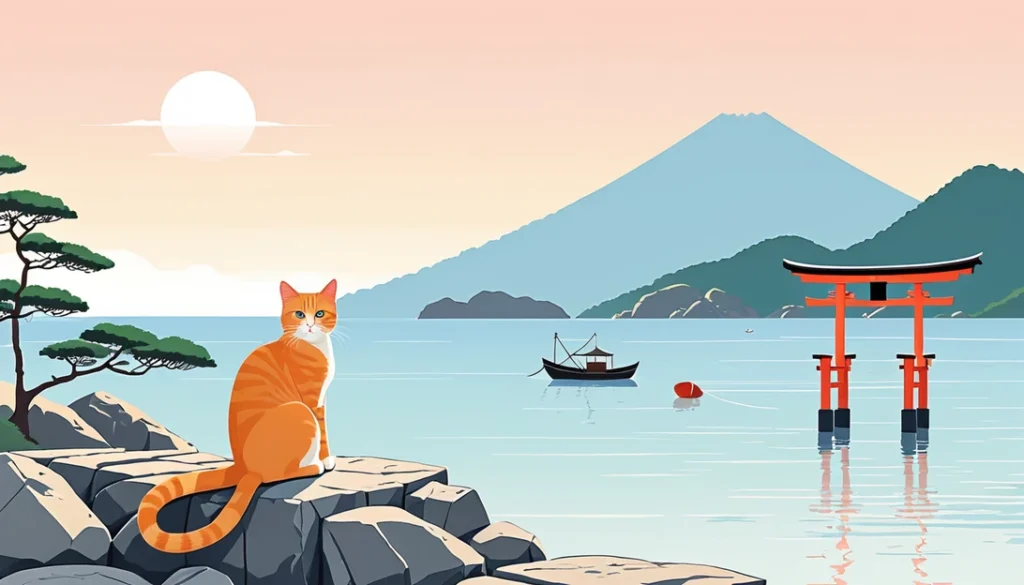
Aoshima occupies less than half a square kilometre in Japan’s Seto Inland Sea, yet its cats have managed an impressive international publicity campaign. Photographs of a visitor surrounded by whiskers turned the island into a fixture of travel wish lists. Behind those pictures is a small community dealing with ageing, depopulation, and the continuing work of caring for animals. The cats are photogenic. The logistics are less so.
The internet version of Japan’s cat islands often looks like a giant outdoor cat café. The actual places are inhabited islands, with homes, working harbours, transport constraints, and distinct histories. Their appeal is real, but visiting well means remembering that nobody built the village as a backdrop for your camera.
Table of Contents
- Where Japan’s Cat Islands Are, and How Many There Actually Are
- Aoshima: A Small Community with Many Cats
- Tashirojima and the Shrine Built for a Dead Cat
- Silk, Fishing, and the Cats People Kept Nearby
- Japan’s Cat Islands Are Not All the Same
- Sterilization and the Work of Caring for a Colony
- What Tourism Did to Japan’s Cat Islands
- Frequently Asked Questions
Where Japan’s Cat Islands Are, and How Many There Actually Are
“Cat island” is a nickname, not a standardized category with a minimum feline-to-human ratio. Aoshima and Tashirojima are two well-known examples; other guides include places such as Sanagishima and Enoshima. Different lists use different criteria, so a neat total of ten or fifteen tells you more about the list than about an official national inventory.
Aoshima lies off Shikoku and belongs to Ozu in Ehime Prefecture. Tashirojima belongs to Ishinomaki in Miyagi, off northeastern Honshu. Both have fishing connections and prominent cat populations, but they are far apart and have different facilities, access routes, and community needs. They are not interchangeable stops on one small island circuit.
Aoshima: A Small Community with Many Cats
Aoshima is reached by boat from Nagahama. The Ehime remote-island council’s guide describes the small island and its ferry connection. Plan around the boat, rather than assuming frequent departures or resort facilities. For actual travel dates, check Ozu’s ferry information and operating notices before setting out. A cat will not arrange the return crossing for you, however confidently it occupies the pier.
How the cats arrived
The familiar explanation links Aoshima’s cats with rodent control in a fishing community. Rats could damage nets and stored supplies, making cats useful companions around human work. That practical relationship provides a more grounded starting point than the idea of an island created for cat tourism. The animals were there before the cameras made them famous.
The numbers, and why they disagree
Aoshima’s small resident population is best understood through dated figures. The island council lists five residents in the 2020 census. That is a historical count, not a live register of everyone on the island. It illustrates the scale of the community without turning every change of residence into a dramatic countdown.
Cat counts require similar care. A population estimate from one year and a veterinary-operation total from another measure different things. Births, deaths, arrivals, visibility, and counting methods can all affect the numbers. A photograph caption is not a census, but neither does a later, larger number automatically prove the earlier report was wrong. The colony has a history, not a permanently fixed headcount.
A 2023 study by S. K. Kholin examined coat patterns in three overlapping groups photographed in 2015. It estimated the frequencies of visible colour-related traits and argued for a founder effect: a small starting population can leave a distinctive pattern in its descendants. This was photographic inference, not DNA sampling of every cat. The paper discusses particular variants, rather than claiming the cats have no tabby markings or white patches. It also does not establish that one third of the colony is ill because of inbreeding. Ginger fur is striking; it is not a medical record.
Tashirojima and the Shrine Built for a Dead Cat
Tashirojima offers a different scale of island life. Ishinomaki’s introduction describes its two settlements, fishing industry, and visitor facilities. It is reached through the Ajishima ferry route. Check the service and destination port before travelling, since a crossing time quoted without its starting point can be misleading.
The Japan National Tourism Organization’s account links Tashirojima’s cats to silk production: they helped protect silkworm cocoons from rodents. Fishing households also fed them. That history mixes practical usefulness with affection, rather than fitting cats neatly into either the “pet” or “equipment” box. A working cat can still be somebody’s favourite neighbour.
Neko-jinja, and reading cats for weather
Local tradition also connects cat behaviour with fishing fortunes. Ishinomaki’s tourism page recounts the belief that watching cats could help judge the catch. It is part of the island’s relationship with its animals, rather than a tested forecasting method. Cats have always been good at looking as though they know something.
Near the island’s centre is Neko-jinja, the cat shrine. The traditional account describes a cat killed by a falling rock and a shrine established in its honour. Told as an origin story, it helps explain the respect attached to the island’s animals. It is one local example of the many meanings people give cats; our history of black cat superstitions follows some others.
Visitor guidance asks people not to bring dogs. Tashirojima also has a manga-themed accommodation area, Manga Island, and guesthouses, so an overnight stay may be possible with advance arrangements. These are limited local services, not a reason to arrive without checking availability. The cat-shaped buildings are a bonus, not a booking confirmation.
Silk, Fishing, and the Cats People Kept Nearby
Fishing and silk production help explain why cats were valued in some of these communities. Both brought people into regular contact with materials that rodents could damage. An island could therefore acquire cats for practical reasons long before anyone thought of marketing the result as an attraction.
That does not give every cat island the same origin. A local account of cats protecting cocoons is not evidence that one national decree created all the colonies. Transport links, households, livelihoods, and later care arrangements shaped each place differently. The simple story is memorable; the local details are usually more interesting.
The useful thread is coexistence. People made room for cats, supplied food, and sometimes gave them religious significance. Later, visitors arrived for the cats themselves. The relationship changed without becoming effortless. A colony still needs care even when its most visible job is being photographed.
Japan’s Cat Islands Are Not All the Same
Flattening them into one destination is the standard travel-media error. They differ in ways that matter.
Sanagishima in Kagawa is another island associated with cats, but its prefectural tourism guide also introduces shrines and local heritage. Enoshima is a very different setting: Fujisawa’s tourism information presents it within a well-connected coastal sightseeing area. Reducing either place to a cat count misses most of the destination.
Depopulation is a serious part of Aoshima’s story, but it should not be pasted onto every island in a roundup. Nor are residents merely supporting characters waiting for their cats to outlast them. These are communities with their own choices and needs, including the right to a quiet afternoon without a stranger leaning over the garden wall.
Sterilization and the Work of Caring for a Colony
Aoshima’s 2018 neutering effort addressed the difficulty of caring for a large colony with few ageing residents. The animal-welfare organization Doubutsu Kikin’s October 2018 account of its own operation reports surgery on 172 cats in a day, while estimating more than 210 cats on the island. The treatment total and the population estimate are not the same number.
The organization described preventing further growth and allowing the population to decline over time as intended outcomes. Fewer births do not automatically mean the intervention failed or created a new crisis. The continuing question is how to provide food, monitoring, and treatment for the cats already there. A quieter colony still comes with responsibilities.
The same account describes weather forcing the team to compress its planned work, a reminder that veterinary care on a small island has practical constraints. It is misleading to call the programme a terminal diagnosis: sterilization prevents reproduction, while the welfare of living animals remains a separate matter. The cats are individuals needing care, not a tourist attraction that must reproduce to maintain a target attendance figure.
What Tourism Did to Japan’s Cat Islands
The photographs that spread widely in the mid-2010s introduced Aoshima to a much larger audience. Yet the tension between visitors and everyday island life was visible early. In Ozu’s June 2014 council proceedings, officials discussed tourists entering private property, photographing residents’ living spaces, and the need for clearer visitor guidance. Popularity arrived with some decidedly unglamorous paperwork.
Attention can bring donations and volunteers, but it does not make every visitor’s food offering helpful. Follow the local feeding rules and the wishes of the people caring for the cats. Ozu’s early guidance designated a feeding area, asked visitors not to obstruct harbour work, and emphasized residents’ privacy. The best souvenir is a photograph taken without making somebody else’s day harder.
On Tashirojima, the presence of accommodation gives visitors different options, but facilities remain limited. Bring what you need, take rubbish away, and let the cats choose whether to approach. Neither island should be treated as a guaranteed interactive exhibit. For the slower pace these places invite, our guide to slow living is better preparation than an insistence on collecting every possible cat photo.
Frequently Asked Questions
How many cat islands does Japan have?
There is no standardized total behind the nickname. Aoshima and Tashirojima are famous examples, while other travel lists include different islands with visible cat populations. Check the individual destination rather than treating a list of ten or fifteen as an official register.
Can you stay overnight on Aoshima?
Do not plan on finding a hotel after you arrive. Aoshima is normally approached as a day visit, with limited services. Confirm ferry operation and the return journey, bring water and your own provisions, and follow local visitor guidance.
Why are the cats on Aoshima mostly ginger and tortoiseshell?
A small founding population can make certain inherited traits unusually common. The 2023 study inferred colour-related allele frequencies from photographs and found a pattern consistent with a founder effect. It did not DNA-test the whole colony or show that every cat shares the same appearance.
Why is there a shrine to a cat on Tashirojima?
According to the shrine’s traditional origin story, a cat was killed by a falling rock and was honoured there. The story sits within the island’s longer association of cats with protection and good fortune.
Are Japan’s cat islands going to disappear?
Some small island communities face serious demographic and animal-care challenges. Aoshima’s declining colony is one example, but predicting a precise ending for all “cat islands” goes too far. Their futures depend on different local circumstances, care arrangements, and decisions.
What the Photographs Leave Out
Cat islands can be delightful without being uncomplicated. Their histories connect animals with work, belief, companionship, and tourism. The challenge is to enjoy the encounter while respecting the people and care that make it possible. A photograph records the cat on the pier. It rarely records who brought the food, cleaned up, or arranged the next veterinary visit. Those parts of the story deserve a place too.
More on the animals than the geography: why cats knock things off tables, and forest bathing in Japan, both good company on a slow ferry.