An old couple would like a cat. The old man goes looking and discovers a problem: every time he chooses a beautiful animal, he sees another he cannot leave behind. His kindness, indecision and enthusiasm begin to fill the landscape.
Wanda Gág’s Millions of Cats, first published in 1928, starts from a wish almost anyone can understand. Then it keeps adding to it until the wish becomes impossible to manage. The result is funny, visually exuberant and rather darker than a shelf of cute kittens might suggest.
One request becomes a procession
The Library of Congress’s digitised first edition lets readers follow the story through its original pages. A clean little house and a lonely couple give way to hills crowded with cats.
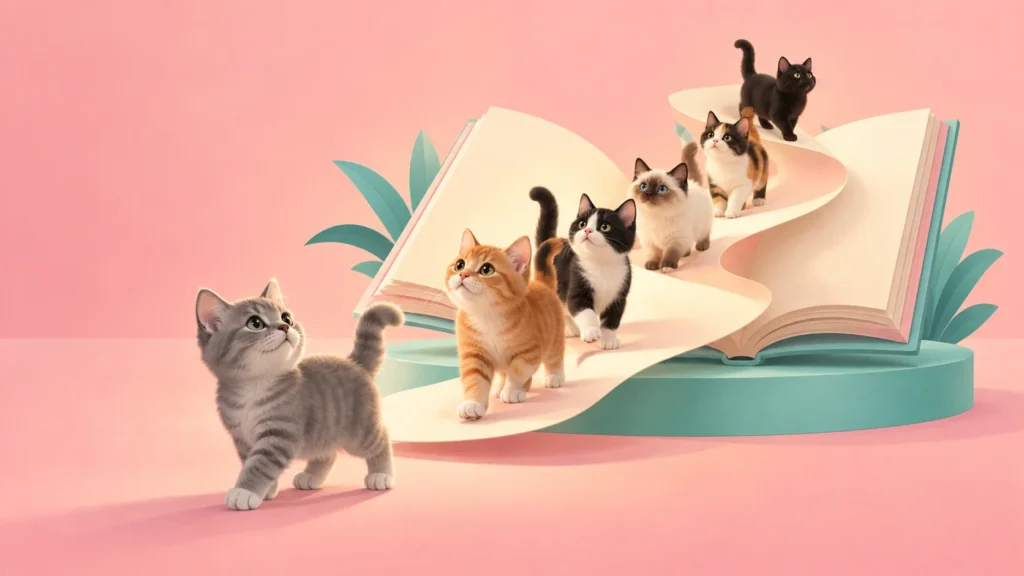
The man repeatedly decides that one more animal is too appealing to abandon. The decision feels manageable each time. Its cumulative result is not. By the time the cats follow him home, the landscape seems to have become a moving population.
That is the story’s first good joke about wanting things. Every individual addition can sound reasonable while the total becomes absurd. The old man has considered each cat’s beauty more carefully than he has considered the size of his household.
The pictures give excess a shape
Gág’s black-and-white drawing does more than illustrate the words. Lines of cats carry the eye across hills and valleys, turning quantity into movement. The procession has a rhythm before the reader has finished counting the repeated promises of enormous numbers.
The hand-lettered text belongs to that visual world. Words, curves of land and crowded animals feel like parts of the same designed page. Reading aloud supplies another rhythm, so the book can be enjoyed through voice and looking at once.
The numbers are deliberately beyond practical counting. A child need not picture a literal trillion to understand that this is more than the couple could possibly accommodate. The exaggeration makes the problem visible.
A beauty contest turns the story dark
The ending is discussed below. Once the cats arrive, the couple must choose. Asking the animals to decide which is prettiest produces a quarrel, not a sensible selection process.
The cats disappear after their fight, and the old woman supposes they have eaten one another. One frightened little cat remains because it did not enter the competition. The book’s fable logic is brisk and unsettling, a useful reminder that an old picture book is not necessarily a gentle one.
That turn deserves space when reading with a child. There is no need to smooth it into a cheerful lesson before hearing how the listener responds. The combination of repetition, humour and sudden darkness is part of what gives the story its force.
Care changes what the couple sees
The surviving cat receives attention and grows into the animal the couple finds most beautiful. The final judgement emerges from a relationship, after the contest to identify the finest specimen has collapsed.
Read that way, the ending changes the original question. Instead of asking which cat is objectively best, the couple discovers what it means to care for this one. The book’s feeding and bathing details belong to a 1928 fable, not a modern pet-care guide.
The book received a Newbery Honor in 1929. Its continued appeal is easy to locate in the pages themselves: an irresistible procession, a question that becomes a trap and a small animal left outside the argument.
For a different feline presence in children’s literature, see the history of the Cheshire Cat’s grin. Gág’s cats create their own lasting image, filling the world until the story finally has room for just one.