On 19 August 1843, a Philadelphia weekly printed a story about a man who gouged out his cat’s eye, hanged the animal from a tree, then buried an axe in his wife’s skull and bricked her into a cellar wall. Poe’s The Black Cat keeps the supernatural possibility alive without letting it explain away the human violence. It is a confession written by a man scheduled to die the next morning, and it gives the household pet a devastating role in his downfall. The horror is not simply that a cat might know something. It is that this man has so much to hide.
Table of Contents
- What Actually Happens in Poe’s The Black Cat
- 19 August 1843: Where It First Appeared
- The Fiend Intemperance: Alcohol in Poe’s The Black Cat
- Poe Lived With Cats, and Wrote About Them First
- The Spirit of Perverseness: Poe’s Theory of Self-Sabotage
- Why the Cat Had to Be Black
- The Birth of the Horror Cat on Screen
- FAQ
What Actually Happens in Poe’s The Black Cat
The narrator opens by saying he neither expects nor asks for belief. The 1843 text is available through the Edgar Allan Poe Society of Baltimore. “FOR the most wild, yet most homely narrative which I am about to pen, I neither expect nor solicit belief.” He then describes a childhood full of animals and a marriage to a woman who shared the habit. Their household inventory is a small zoo: “We had birds, gold-fish, a fine dog, rabbits, a small monkey, and a cat.”
Pluto, the eye, and the tree
The cat gets a name loaded with intent. “Pluto, this was the cat’s name, was my favorite pet and playmate.” Pluto is the Roman god of the underworld, which is the kind of joke Poe makes with a straight face. Years pass, the narrator’s drinking gets worse, and one night he comes home convinced the cat is avoiding him. He grabs it, the cat bites his hand, and he cuts one of its eyes out of the socket with a penknife.
The cat recovers and starts fleeing the room whenever he enters. That flinch is what finishes it. He slips a noose over Pluto’s neck and hangs the animal from a tree in the garden, weeping while he does it, believing the act could put his soul beyond forgiveness. That night the house burns down. Everything is destroyed except one interior wall, still standing, with a crowd around it. “I approached and saw, as if graven in bas relief upon the white surface, the figure of a gigantic cat.” There is a rope around its neck.
The second cat and the cellar
Months later, in a tavern, he finds a second black cat, nearly the twin of Pluto except for a splash of white on the chest. He takes it home. Then he notices two things. First: “That, like Pluto, it also had been deprived of one of its eyes.” Second, he becomes convinced that the white patch is taking a particular shape. “It was now, I say, the image of a hideous, of a ghastly thing, of the GALLOWS!”
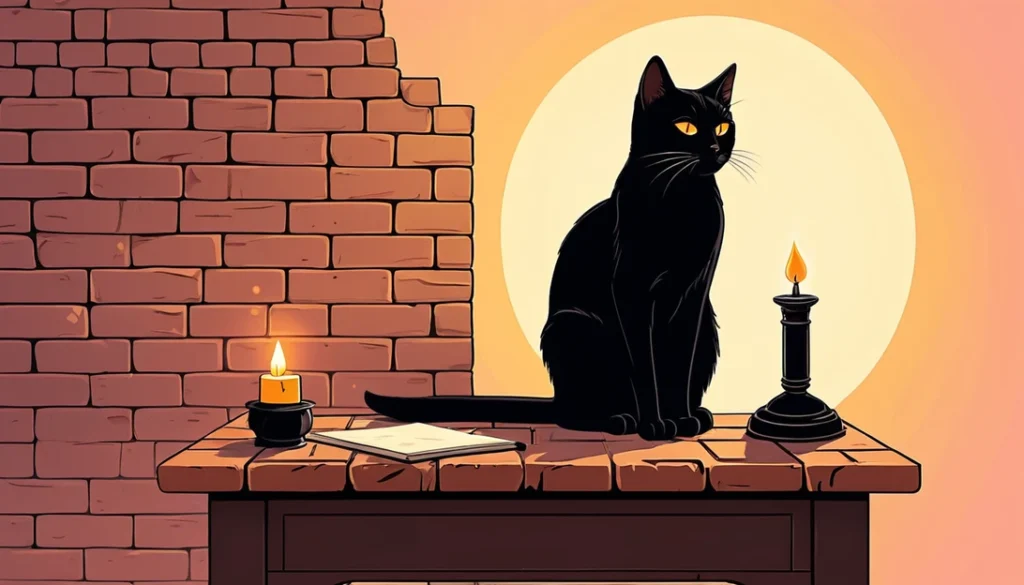
The cat will not leave him alone. In the cellar one day he swings an axe at it, his wife catches his arm, and he buries the blade in her head instead. He walls the body into a recess behind the chimney, plasters over it, and sleeps well for the first time in months. The cat has vanished, which he takes as a gift. On the fourth day the police search the cellar, find nothing, and are leaving when he raps the wall with his cane to show off the masonry. A howl comes back through the brick. The officers tear it open, and the corpse is standing there. “Upon its head, with red extended mouth and solitary eye of fire, sat the hideous beast whose craft had seduced me into murder, and whose informing voice had consigned me to the hangman. I had walled the monster up within the tomb!”
19 August 1843: Where It First Appeared
Poe’s The Black Cat ran on 19 August 1843 in the United States Saturday Post, which was the temporary title of the paper we now know as the Saturday Evening Post. Poe sold the piece for twenty dollars, a figure he mentions in a letter dated 26 August 1843, documented in the Poe Society’s publication history. Twenty dollars, for one of the most reprinted horror stories in English.
Reprints came fast. The newspaper ecosystem was certainly quicker than any modern notification asking whether the author had approved a repost. The Baltimore Sun carried it on 25 August 1843, six days later, and the Pensacola Gazette on 16 September. Poe collected it in Tales in 1845, and Rufus Griswold included it in the posthumous Works of 1850.
Europe got it early. Isabelle Meunier translated it for La Démocratie Pacifique in January 1847, and Charles Baudelaire, who became a major force in Poe’s French reception, produced his own version in 1853 and 1854. Success also drew mockery: Thomas Dunn English’s parody “The Ghost of a Grey Tadpole” had appeared by early 1844, as T. O. Mabbott’s editorial notes record.
The Fiend Intemperance: Alcohol in Poe’s The Black Cat
The narrator blames one thing by name. “I grew, day by day, more moody, more irritable, more regardless of the feelings of others,” he writes, and says his character had “through the instrumentality of the Fiend Intemperance,” and here he pauses to blush, “experienced a radical alteration for the worse.”
That word choice invites a temperance reading: happy family, bottle, ruin, moral. But the story refuses to settle into a reassuring tale of reform. The narrator describes drink, remorse and renewed excess, then reaches for perverseness and the supposedly malevolent cat as further explanations. At the murder, the immediate cause he describes is his own rage when his wife stops him attacking the animal. The bottle matters, but it does not remove his responsibility.
This is a reading of the story, not a diagnosis of its author. Poe’s drinking and the hostile accounts written about him require their own care; the Poe Society’s assessment of the evidence distinguishes reported incidents from attacks by literary enemies. It would be a mistake to treat a fictional murderer’s confession as Poe’s autobiography.
The biographical coda is grim enough without making it a tidy moral. On 27 August 1849, Poe joined the Shockoe Hill Division No. 54 of the Sons of Temperance in Richmond. The documentary chronology places Elmira Royster Shelton’s acceptance of his marriage proposal later, around 22 September. He died in Baltimore on 7 October, aged forty. The circumstances of that death remain disputed; they are not the last chapter of his fictional narrator’s story.
Poe Lived With Cats, and Wrote About Them First
Three and a half years before the horror story, Poe published a short, cheerful newspaper piece about his own black cat. The essay “Instinct vs Reason — a Black Cat” ran in Alexander’s Weekly Messenger in Philadelphia on 29 January 1840. In it he argues that the line between animal instinct and human reason is, in his phrase, “of a very shadowy nature,” and offers his cat as evidence.
The evidence is a door. Poe describes the cat working a thumb-latch in sequence: she springs from the floor to the guard of the latch, holds on with her left arm, presses the latch down with her right until it yields, then twists her body so her hind feet land beneath it and shoves off the door with her whole strength. It is affectionate, slightly smug writing by a man watching his pet outthink a piece of hardware. The article was lost for a century and rediscovered by the bibliographer Clarence Saunders Brigham, whose article reprinted it in the April 1942 Proceedings of the American Antiquarian Society, as the bibliographical record confirms.
Another cat in Poe’s life was Catterina, the tortoiseshell remembered in accounts of his household. The Poe Museum recounts her companionship and the story of her helping to keep Virginia warm. In the winter of 1846 to 1847, at the cottage in Fordham where Poe’s wife Virginia Clemm was dying of tuberculosis, recollections describe a household struggling to keep her warm. Catterina lay across Virginia’s chest to keep her warm, with Poe’s old military coat over the top. Virginia died in January 1847. The author whose fictional narrator called a cat a monster was now living with one remembered as a hot water bottle.
The Spirit of Perverseness: Poe’s Theory of Self-Sabotage
Halfway through the story the narrator stops the action to propose a psychological law. He calls it the spirit of perverseness and defines it as “one of the primitive impulses of the human heart, one of the indivisible primary faculties, which give direction to the character of Man.” It is, he says, “this unfathomable longing of the soul to vex itself, to offer violence to its own nature, to do wrong for the wrong’s sake only.”
This is the reason he gives for hanging Pluto. Not anger, not fear. He kills the cat because killing the cat is unforgivable, and the unforgivability is the attraction. Poe liked the idea enough to build a whole essay-story around it two years later: “The Imp of the Perverse,” in Graham’s Magazine, July 1845, where he calls perversity “a radical, primitive, irreducible sentiment” that analysis cannot touch.
It is a strikingly modern move. Poe is exploring self-sabotage decades before psychoanalysis took shape, and he puts it in the mouth of a man you cannot trust, which is the whole trick. If you want the mechanics of that device, we broke it down in our guide to the unreliable narrator. The narrator of The Black Cat is the textbook case: he asks you to read his confession as a medical report, and the report keeps convicting him.
Why the Cat Had to Be Black
Poe puts the superstition in the wife’s mouth and then leaves it hanging. “In speaking of his intelligence, my wife, who at heart was not a little tinctured with superstition, made frequent allusion to the ancient popular notion, which regarded all black cats as witches in disguise.”
The narrator dismisses this immediately, and the story never confirms it. That refusal is the engine. The tale offers competing explanations: the narrator proposes a chemical explanation for the image in the plaster, while the changing chest patch can be read as a projection of his fear. The howl can belong to an ordinary trapped animal. But every account reaches us through the man telling it, including his reassuring explanations. Poe hands you both readings and walks off. Making the cat black gives Poe a ready store of associations to draw on. It does not force the reader to accept the narrator’s supernatural suspicions.
The folklore is not one continuous, universal story of people fearing cats. We traced some of its shifts and contradictions in the history of black cat superstitions. The religious roles and animal mummies discussed in cats in ancient Egypt belong to another context, rather than a simple golden age before everybody became superstitious. Poe needs only enough folklore for his narrator to point an accusing finger at the pet.
The Birth of the Horror Cat on Screen
Poe’s The Black Cat has inspired numerous screen versions, and several share a habit: they keep the title and throw out the plot.
Universal’s The Black Cat (1934), directed by Edgar G. Ulmer, put Boris Karloff and Bela Lugosi on screen together for the first time and has almost nothing to do with anything Poe wrote. The Venice restoration programme identifies it as Universal’s biggest hit that year and the first of eight films pairing the actors. Its visual grammar came from Germany rather than Baltimore, a story we told in our piece on German Expressionism.
Roger Corman got closer in Tales of Terror (1962), the fourth entry in his eight-film Poe cycle for AIP. The middle segment welds The Black Cat to The Cask of Amontillado, with Vincent Price and a Richard Matheson screenplay, and the walled-up ending survives intact. Lucio Fulci made Black Cat: Gatto nero in 1981, moving the story to an English village and giving Patrick Magee a cat that kills on psychic command. Dario Argento took it again for his half of Two Evil Eyes (1990), casting Harvey Keitel as a crime scene photographer with a drinking problem, opposite a George A. Romero segment adapting “The Facts in the Case of M. Valdemar.”
The through line is the animal as witness. The useful way to read Poe’s cat here is as a witness, facing a killer who cannot stand being known. That is the appeal of scenes where a pet stares at an empty corner and the audience’s arms go cold, the same reflex we unpacked in why we get goosebumps. Related unease shows up in found footage horror and the stranger corners of weird fiction.
FAQ
When was Poe’s The Black Cat published?
19 August 1843, in the United States Saturday Post, the temporary title of the Saturday Evening Post. Poe was paid twenty dollars. It was collected in his Tales in 1845.
What is the cat’s name in the story?
The first cat is Pluto, named for the Roman god of the underworld. The second is never named: a near-twin of Pluto, missing one eye, with a white chest patch the narrator reads as a gallows.
Is The Black Cat a temperance story?
It can be read against temperance literature: the narrator explicitly blames intemperance for his deterioration. But he also invokes perverseness and the cat, and the story offers no reform or redemption. Those shifting explanations are part of what makes him unreliable; they do not add up to a single agreed moral.
Did Edgar Allan Poe own a black cat?
Yes. He wrote about one in “Instinct vs Reason, A Black Cat” for Alexander’s Weekly Messenger on 29 January 1840, describing how she opened a thumb-latch door. He also kept a tortoiseshell named Catterina.
What does “the spirit of perverseness” mean?
Poe’s term for the impulse to do something precisely because it is wrong. He defines it in the story as “the unfathomable longing of the soul to vex itself,” and expanded the idea into a separate piece, “The Imp of the Perverse,” in Graham’s Magazine in July 1845.
The Cat Was Always the Point
Poe wrote a story in which a man destroys his household and blames a bottle, a superstition, and finally an animal. His wife and pets suffer; his explanations keep trying to move the guilt somewhere else. Twenty dollars in 1843 bought a lasting image of horror: the pet that watches, the crime that will not stay bricked up, the voice in the wall. Years later, a real cat would help warm Poe’s dying wife. The contrast is not a secret key to the story, but it is a good reason to distrust the murderer’s insistence that the animal is the monster.