Why Does Time Feel Faster as You Get Older? The Science of Our Shrinking Years

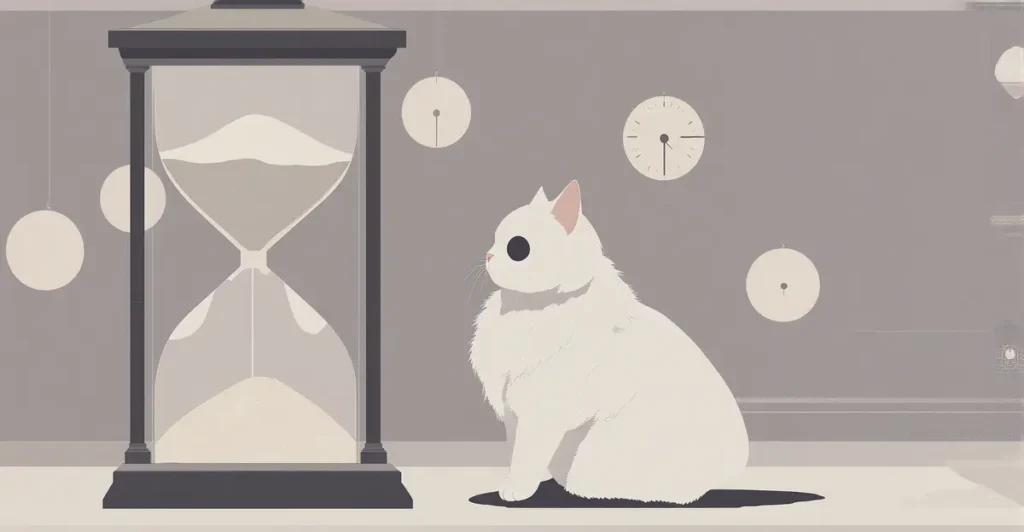
Your cat does not check the calendar. It does not notice that summer showed up early this year, or that an entire decade quietly folded in half while you were answering emails. A cat lives inside one long, elastic afternoon, equally surprised by every sunbeam. You, on the other hand, have probably caught yourself saying some version of “where did the year go?” and actually meaning it.

That feeling is not a personal failing, and it is not a sign you need a better planner. The sense that time speeds up as you get older is one of the steadiest findings in the study of how humans perceive time. The clocks have not changed. Your relationship with them has. Below is what is really happening inside your head, and a few honest things you can do to stretch the years back out.

The Clock Is Honest, Your Brain Is the Unreliable Narrator

Start with the boring truth, because it matters. A second is a second. The Earth has not sped up, your watch is not lying, and the universe is not running out the clock on you specifically. Physical time is constant. What changes is perceived duration, which is the brain’s private estimate of how much time went by.

Researchers split that estimate into two flavors. There is prospective timing, which is how long a stretch feels while you are living it (“this meeting will never end”). And there is retrospective timing, which is how long a period felt once you look back on it (“I cannot believe my kid is already ten”). The unsettling “time is accelerating” sensation is almost entirely the retrospective kind. In the moment, an ordinary Tuesday can crawl. It is only later, when you try to find that Tuesday in memory and come up empty, that whole months seem to have evaporated.

So the question “why does time feel faster as you age?” is really a question about memory. Hold on to that, because every theory below circles back to it.

The Proportional Theory: Every Year Is a Smaller Slice

The oldest and simplest explanation came from the French philosopher Paul Janet in 1897, and it is almost annoyingly intuitive. Each new year of your life is measured against every year you have already lived, so each one is a smaller fraction of the whole.

When you are two years old, a single year is half of your entire existence. That is why a summer at age six feels endless: it is a genuinely huge proportion of everything you have ever experienced. By the time you are forty, one year is one-fortieth of your life, a thin sliver by comparison. The year has not shrunk. Your reference pool has grown enormous, so the same twelve months land as a smaller and smaller percentage of “all the time I know about.”

It is the same reason a teaspoon of cream changes a small espresso completely and barely tints a bucket. The proportional theory is elegant, it predicts the general shape of the feeling, and it is almost certainly part of the story. It is just not the whole story, because pure math cannot explain why some weeks still feel long and others vanish.

The Novelty Theory: Boring Days All Go in the Same Drawer

Here is the explanation most scientists find more convincing. Your brain does not record time evenly. It records change. New, surprising, emotionally loaded experiences get encoded in rich, detailed memories. Repetitive ones get compressed into a single fuzzy template, because there is no reason to store the four hundredth identical commute in high definition.

Childhood and early adulthood are crowded with firsts. First day of school, first bike, first heartbreak, first apartment, first real job. The brain lays down dense, vivid memories for all of it, and when you look back, that period feels long because it is packed with distinct mental landmarks. The hippocampus, the brain region that files these episodes, is doing constant, effortful work. (If you want the deeper biology of how the brain keeps building and rewiring this memory machinery into adulthood, we got into the science in our piece on whether adult brains grow new neurons.)

Adult life, by contrast, tends to settle into routine. Same route, same desk, same three lunch spots. Fewer firsts means fewer distinct memories, which means fewer mental landmarks marking the passage of a year. Look back, and there is nothing to grab onto, so the period collapses inward. The smell of memory works the same way, which is why a single unexpected scent can drag back an entire summer you thought you had lost. (We pulled that thread apart in our explainer on petrichor and why rain smells like nostalgia.)

The Holiday Paradox

This is the part that makes novelty theory click. Think about a week-long trip somewhere new. While you are there, jammed with unfamiliar streets and food and small disasters, the days feel full and even a little long. Then you get home, and in memory that week feels enormous, like a fat chapter of your life. Meanwhile a normal week at home flies by in the moment, then leaves almost no trace at all.

That is the holiday paradox: novelty makes time feel slow in the moment and long in memory, while routine makes time feel quick in memory even when the days dragged. Your sense of a year’s length is reconstructed afterward from how many distinct memories it contains. A year of novelty feels rich and long. A year on autopilot feels like it barely happened.

The Dopamine Clock Slows Down

There is a chemical angle too. The brain seems to run an internal pacemaker, a rough internal beat it uses to estimate how much time is passing. That pacemaker is strongly influenced by dopamine, the neurotransmitter tied to reward, motivation, and attention.

When dopamine is high, the internal clock tends to tick faster, and we lay down more “ticks” per minute. As we age, baseline dopamine activity gradually declines. A slower internal pacemaker produces fewer subjective ticks for the same stretch of real time, so when you compare your internal sense of duration against the wall clock, the wall clock seems to be racing ahead of you. The same machinery is why a fever, certain drugs, or intense excitement can warp time, and why deliberately resetting your reward system changes how present you feel. (We covered that reset idea in our look at dopamine fasting.)

Bejan’s Theory: Fewer Mental Frames Per Second

In 2019, the Duke engineer Adrian Bejan offered a more physical explanation, and it is a fun one. He argued that what we experience as time is really a sequence of mental images, the snapshots the brain assembles from what the eyes take in. The faster you process and swap those images, the more of them fill a given minute, and the slower that minute feels.

Young brains, in Bejan’s account, process images quickly. The neural pathways are short, fresh, and efficient, so a child takes in a flood of mental frames per second, and time feels luxuriously slow. As we age, those pathways grow longer and more degraded, signals travel less efficiently, and the rate of image processing drops. Fewer frames per minute means the outside world appears to move faster, the way a film looks sped up when you drop frames. It is a contested theory, but it lines up neatly with the lived feeling that childhood afternoons went on forever. Your brain was simply running at a higher frame rate. (If you like this idea that the brain is basically plumbing and wiring, you will enjoy the discovery of the hidden drainage system that takes out the brain’s trash.)

Attention: You Stopped Watching the Pot

One more piece, and it is the one you have the most control over. How much you notice time depends on how much attention you pay to it. There is a well documented quirk called the oddball effect: a surprising or unexpected stimulus in a sequence is perceived as lasting longer than the routine ones around it. Novelty grabs attention, and attention stretches the felt moment.

A watched pot really does feel slow, because you are pouring attention onto the passage of time. As adults, we mostly stop watching. We run on habit, half present, attention shredded across notifications and to-do lists, and time we never looked at cannot leave much of a footprint. A day spent reacting to a buzzing phone is almost designed to vanish. (We made the case for reclaiming that attention in our piece on what all those notifications are doing to you.) Being present is not just spiritual advice. It is, mechanically, how you get more time back.

So Can You Actually Slow Time Down?

You cannot change the clock. You can change how much of your life you actually register, which is the only lever that matters. Every theory above points at the same prescription: give your brain more to encode. Here is the practical version.

  • Chase novelty on purpose. New places, new skills, new people, new routes home. A brain fed unfamiliar input writes denser memories, and dense memories make a period feel long in hindsight.
  • Break the routines that have gone invisible. You do not need to move countries. Cook a cuisine you have never tried, take the long way, rearrange a room. Small disruptions create new mental landmarks.
  • Be actually present for the good parts. Put the phone face down. The oddball effect rewards attention with felt duration, and you cannot remember a moment you never fully arrived in.
  • Keep some kind of record. A journal, a photo a day, a few lines at night. Writing things down forces encoding and gives the year texture you can find again later.
  • Learn things that are hard. Difficulty demands attention, and attention is the raw material of memory. Effort makes time stick.

What Your Cat Has Quietly Figured Out

Which brings us back to the animal asleep in the sunbeam. A cat is not worried about the year going by, because a cat is completely, almost aggressively present. It is fully inside this nap, this patch of warmth, this single dust mote drifting past. There is a real lesson buried in that smugness. The years feel fast because we live them at a distance, half watching, running on templates. The cure is not more hours. It is more presence per hour. Be a little more like the cat. Notice the sunbeam.

Frequently Asked Questions

Is time really speeding up, or is it just a feeling?

Just a feeling, but a real and well documented one. Physical time is constant. What changes is your perceived duration, mostly the retrospective sense of how long a past period felt. That estimate is reconstructed from how many distinct memories the period holds, so sparse, routine stretches feel like they flew by.

At what age does time start to feel faster?

There is no hard switch. The proportional effect begins in childhood, since each year is already a shrinking fraction of your life. Most people report the acceleration becoming noticeable through their twenties and thirties, as firsts get rarer and routine takes over. It tends to feel most dramatic when you compare a long-ago decade to a recent one.

Does this happen to everyone?

Broadly yes, across cultures, which is part of why researchers take it seriously. The intensity varies with how novel or routine your life is. People who keep learning, traveling, and breaking their patterns generally report time feeling fuller and a little slower than people locked in heavy routine.

Can you genuinely make time feel slower?

You can make it feel richer and longer in memory, which is the same thing in practice. The reliable methods are novelty, attention, and effort: do unfamiliar things, be present for them, and learn hard skills. All three force your brain to encode more detailed memories, and a densely remembered year feels long when you look back at it.

Do animals experience time differently than we do?

Likely yes. Smaller animals with faster metabolisms appear to perceive more visual information per second, which is part of why a fly is so hard to swat: to the fly, your hand moves in slow motion. Cats sit somewhere on that spectrum, plus they have the enormous advantage of not knowing what a calendar is. Whatever a cat’s internal clock is doing, it is not lying awake about lost decades.

Stay Curious, Stay Engaged!
Get our best stories delivered weekly. No spam, no fluff.
Share this story

Leave a Reply

Your email address will not be published. Required fields are marked *